Utah Homeowners Dropped by Insurers at Highest Rate in Nation
Palm Beach Gardens, Fla., Sept. 8, 2026 — Based on an analysis of official 2025 data reported by insurers to the National Association of Insurance Commissioners (NAIC), Weiss Ratings, the nation’s only independent rating agency covering insurance companies, reported today that Utah homeowners were nonrenewed by their insurers at the highest rate in the nation.
Utah insurers initiated nonrenewals equal to 4.45% of homeowners policies in force in 2025 — roughly one policy for every 22. That was 8.4 times Utah’s 2018 nonrenewal rate and more than 2.6 times its 2024 rate, propelling Utah from 17th worst in the nation to worst in just one year.
“In a very short period of time, Utah has gone from a warning to the nation’s loudest alarm bell,” said Weiss Ratings founder Dr. Martin D. Weiss. “A homeowner who has paid premiums faithfully for years can suddenly be forced to hunt for replacement coverage that may be more expensive and less protective.”
States with the Highest Homeowners Policy Nonrenewal Rates in 2025
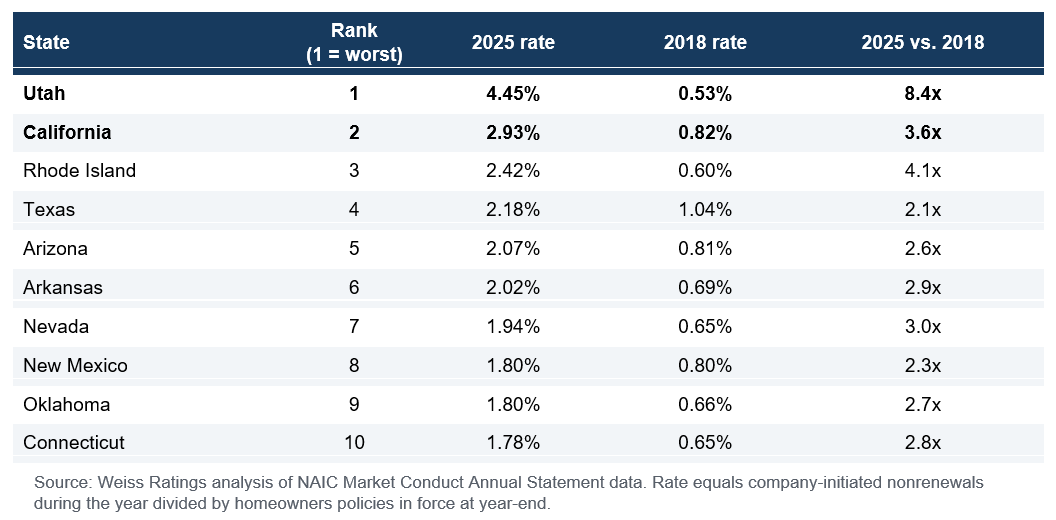
California shows where that road can lead when a breakdown in the regular insurance market persists. The state ranked second worst in 2025, with company-initiated nonrenewals equal to 2.93% of policies in force, about one in 34. Although down slightly from 2024, it was still 3.6 times California’s 2018 nonrenewal rate.
Surplus Lines: The Next Stop for Many Nonrenewed Homeowners
When regular, or admitted, insurers retreat, homeowners often seek replacement coverage from surplus-lines insurers. Such coverage may be more expensive, is subject to fewer rate protections, and is generally not protected by state guaranty funds if the insurer fails.
This shift is especially evident in California. Homeowners surplus-lines premiums written in the state rose from just $85 million in 2018 to $1.3 billion in 2025 — up 15-fold. However, in the past five years, for every dollar that these insurers earned in premiums from homeowners, they paid out only 49 cents in claims to policyholders, compared to nearly 71 cents paid out by regular insurers. Although this does not measure the outcome of any individual claim, it indicates that substantially less premium flowed back to policyholders in claims payments through the surplus-lines market.
In Utah, the trend is still in its infancy, but surplus lines premiums have already increased from $1.1 million in 2018 to $13.7 million in 2025, a 12.3x increase.
“In the wake of large storms and wildfires, we have seen the simultaneous surge in nonrenewals and the rapid expansion of costlier policies with fewer regulatory or guaranty-fund protections. This is alarming,” warned Weiss. “And the net result is that some industry players appear to be turning homeowners’ misfortune into an opportunity for their own bottom line.”
***
About Weiss Ratings: Weiss Ratings is the nation's leading independent provider of 100% unbiased ratings on stocks, ETFs, mutual funds, cryptocurrencies, banks, credit unions and insurance companies, covering more than 60,000 institutions and investments. Since its founding in 1971, Weiss Ratings has never accepted compensation from the companies it rates, and it never gives rated companies the opportunity to preview or suppress a rating before publication. All Weiss insurance company ratings are available at https://weissratings.com/en/insurance.
The U.S. Government Accountability Office (GAO) reported that the Weiss ratings of U.S. life and health insurers outperformed those of A.M. Best by 3-to-1 in warning of future financial difficulties, while also greatly outperforming those of Moody’s and Standard & Poor’s. The New York Times reported that Weiss “was the first to warn of the dangers and say so unambiguously,” and Barron’s called Weiss Ratings “the leader in identifying vulnerable companies.”