 |
| By Dawn Pennington |
The world's most important waterway has been effectively closed for business for two months.
Since the beginning of the war in Iran, traffic through the Strait of Hormuz remains 95% below normal levels.
That's not a seasonal slowdown or a temporary rerouting. It’s a near-complete shutdown of the artery that moves a fifth of the world's daily oil supply.
The man who runs the world's largest oil company, Saudi Aramco CEO Amin Nasser, isn't sugarcoating it.
During the company’s recent earnings call, he told investors,
“If trade and shipping remain curtailed by more than a few weeks from today, we anticipate the supply disruption to persist, and the market to normalize only in 2027.”
2027!
So, a structural rerouting of global energy supply that could last the better part of two years.
Most investors still aren't positioned for it.
The initial global energy shock already happened on Feb. 28 at the start of this conflict.
But it could pay to get positioned for any aftershocks, sooner rather than later.
I’ll give you four ways in just a moment.
First, here’s …
The Math Behind the Disruption
The Strait of Hormuz normally moves roughly 20% of the world's oil supply. And that’s every single day.
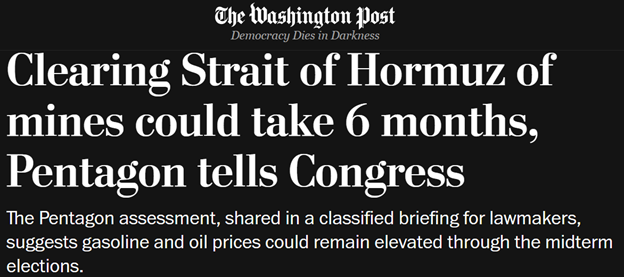
Iran mined the strait. And even if this so-called ceasefire holds, clearing those mines could take up to six months.
A supply chain catastrophe is playing out in slow motion, and energy markets are already responding.
WTI crude is up more than 65% from the end of May 2025. Gasoline prices across the U.S. are now above $4.50 per gallon, on average. That’s up 42% in a year.
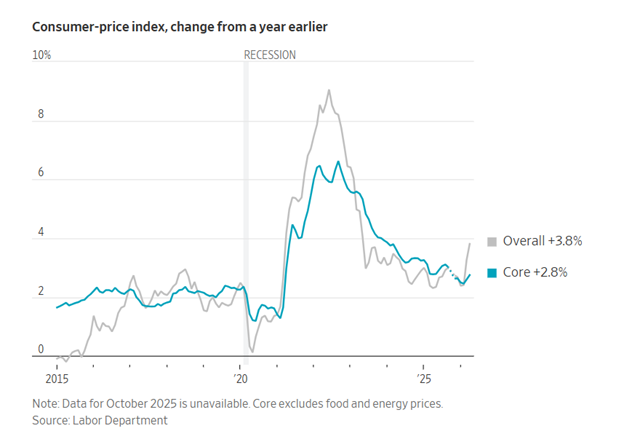
April CPI increased 3.8% from a year earlier. Energy is the primary driver, with gasoline up 28% and fuel oil surging more than 54% year over year.
The Chokepoint Hits LNG, Too
Most energy coverage misses something big: The disruption doesn't stop at oil.
Around a fifth of global LNG supply faces the same chokepoint, and the damage runs deeper than most people realize.
The bulk of that trapped LNG flows from a single Qatari facility, Ras Laffan, which has been struck by Iranian missiles. Qatar estimates repairs could take up to five years.
That timeline alone is enough to keep global LNG prices elevated well beyond any ceasefire agreement. And well beyond whatever diplomatic solution eventually emerges.
For U.S. LNG producers whose supply chains run nowhere near the Strait of Hormuz, that's a significant and durable advantage. One that could last half a decade.
Where the Oil & Gas Is Coming from Instead
When Middle Eastern supply gets cut off, the market doesn't freeze. It redirects.
Buyers move immediately to offshore production and to American LNG exporters ready to fill the gap.
Global energy flows are being reshuffled, and the true winners are already coming into focus.
Fortunately, Weiss has already done the legwork to find the best choices for investors.
The LNG Exporters Stepping into the Void
U.S. liquefied natural gas exporters are among the clearest beneficiaries of this disruption.
Take a look at two LNG stocks rated “Buy” by Weiss.
Cheniere Energy Partners (CQP), adirect infrastructure play on domestic export growth, is the largest LNG exporter in the States and one of the largest in the world.

Its Sabine Pass and Corpus Christi terminals operate near capacity. Plus, CQP is signing long-term contracts at premium rates as European and Asian buyers scramble to replace Middle Eastern suppliers.
EQT (EQT) is the largest natural gas producer in the U.S. and a key upstream supplier feeding LNG export terminals.

With four Gulf Coast terminals, the company is positioning itself for the next wave of export demand.
EQT’s strategic focus on capital discipline and balance sheet strength gives it staying power in an environment where weaker operators will struggle.
The Offshore Drillers Catching the Wave
The offshore drilling and services companies operating in the Gulf of Mexico are seeing demand surge alongside the LNG exporters.
Operators are shortening timelines on projects that seemed marginal at $60 oil but make compelling sense at $100-plus.
Consider these Weiss “Buy”-rated tickers for your portfolio.
TechnipFMC (FTI) is a subsea engineering and services giant. One with deep Gulf of Mexico exposure and a long track record of executing on complex offshore projects.

As the world's major oil producers race to bring new supply online outside the Hormuz corridor, FTI is poised to benefit from accelerating capital expenditure.
FTI boasts an “A-” Weiss stock rating. This grade is backed by strong fundamentals and a recent earnings beat that confirms the business is firing on all cylinders.
Subsea 7 (SUBCY) is a specialized subsea pipeline and infrastructure contractor.

It’s less well-known than some of the bigger players in the space. But it’s purpose-built for an increase in offshore sourcing.
The broader subsea services complex is seeing more activity as operators fast-track development on projects that $100 oil has made newly compelling.
Just the Start
If the Hormuz blockade extends through June, July and August — the peak demand months for energy in the Northern Hemisphere — the supply squeeze compounds.
Gasoline prices push higher, inflation stays hot and the Fed’s already-difficult situation becomes nearly impossible.
After April’s CPI data, the market has priced in a 50% chance of a Fed rate hike this year.
Higher oil, higher inflation and higher rates spell a flight toward real assets … and the companies that produce them.
The investors who recognize this early — and rotate into U.S. LNG exporters and offshore drillers before the summer headlines hit — should look like geniuses by fall.
The reality is they’re not geniuses. It’s much simpler than that.
They were just paying attention.
It’s easy to look smart when you invest wisely.
To your health and wealth,
Dawn Pennington
P.S. How did we find these top-rated plays in a major developing trend? With the stock-selection tool that all your favorite Weiss editors use: Weiss Ratings Plus.
To see Ratings Plus in action, we just put together a special, always-up-to-date report on another megatrend. You can learn about it — and grab the constantly-updating link to it — right here.