 |
| By Bob Czeschin |
The world welcomed the ceasefire between President Trump and Iran’s Revolutionary Guards with a hearty sigh of relief.
Celebrations on Wall Street seem to indicate the stock market thinks the war is already over.
However, it most assuredly is not.
Trump has not withdrawn his threat to bomb bridges and power plants if Iran refuses to surrender its enriched uranium.
That said, the intensity of kinetic conflict is clearly trending lower.
Accordingly, it is not too soon to start thinking about what a post-war rebuilding phase might look like. Or how to invest for it.
After some 13,000 aerial attacks, much of Iran lies in ruins. And as soon as oil revenues begin to flow again, ample money will surely be available to rebuild.
Problem is, vast swaths of Iran’s domestic economy — including heavy construction and big infrastructure projects — are dominated by Iran’s Revolutionary Guard Corps (IRGC).
The IRGC is also a notorious hotbed of regime fanatics.
Plus, they normally do business only with trusted cronies. (This makes it easier to manage and divvy up the graft.)
Non-Iranian investors like you and me are absolutely not welcome.
Because of this, the biggest, most-immediate, post-war rebuilding opportunity has nothing to do with restoring bombed-out buildings and bridges.
Ironically, it lies in rebuilding the depleted stockpiles of missiles and munitions that blew them up in the first place!
Modern War Eats Ammunition
Consider the nose gun on an A-10 Warthog close air-support jet in the Persian Gulf.
It fires 3,900 rounds a minute. That’s a whopping 65 bullets per second!
So fast, a mere 18-second burst totally exhausts the entire magazine the A-10 can carry.
Also consider America’s famous Tomahawk sea-launched cruise missiles, which can precisely hit targets 1,000 miles away.
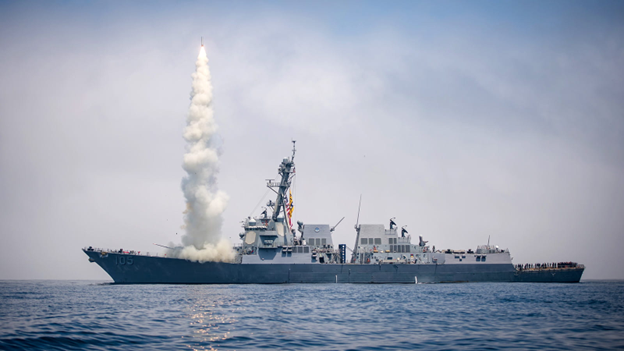
Between last June’s 12-Day War and Operation Epic Fury, U.S. commanders fired off about a thousand Tomahawks (costing about $2.6 million each).
That far exceeds their use in previous conflicts.
Think of it this way. The Center for Strategic and International Studies says the Pentagon normally buys only about 90 new Tomahawks a year.
At that rate, it would take 11 years to replace what war on Iran has already burned through.
America’s precise inventory of Tomahawks is of course a closely guarded military secret. But estimates run about 3,000.
That suggests the Pentagon has already burned through at least a quarter of its entire stockpile.
This is why rebuilding the Pentagon’s munitions stockpiles is so urgent.
Otherwise, few (if any) may be available for any other military emergency such as a Chinese move against Taiwan, for example.
By the way, it’s not just Tomahawks the Pentagon is worried about running out of.
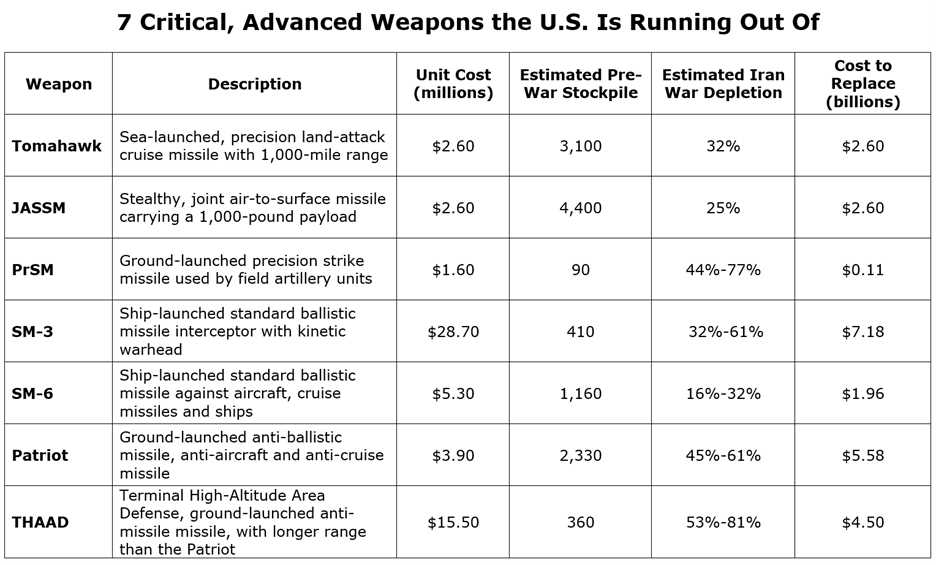
All-weather Patriot missile systems.
Long-range JASSM missiles.
“Hit-to-kill” THAAD missile systems.
Precision Strike Missiles (PrSM).
Navy-standard SM-3 and -6 missiles.
All will need to be replaced.
And with President Trump calling for the U.S. defense budget to swell to $1.5 trillion in 2027 …
A 40%+ increase over this year …
We can expect spending on these big-ticket items won’t be a problem.
Consider These 6 Defense Giants
The cost to rebuild depleted inventories of these weapons to pre-war levels would amount to about $24.5 billion worth of business for defense companies.
This is just the beginning.
Remember, only a ceasefire is in effect.
If Trump launches a shock-and-awe bombardment of Iran’s bridges and power plants, many more munitions will be needed.
And if Pentagon war gamers start incorporating lessons from the Iran War into grand contingency planning for the next great power conflict …
Like war with China …
They’re going to clamor for peacetime munitions stockpiles.
Ones that are a couple orders of magnitude bigger than what existed on the eve of Epic Fury.
Right now, there are a bunch of defense companies whose cash registers will ring up a merry tune as these orders come pouring in.
Among them:
- Lockheed Martin (LMT) manufactures THAAD interceptors (quadrupling production is already underway). It also builds Patriot missiles, JASSM and PrSM missiles.
- BAE Systems (BAESY) is the U.S. subsidiary of British defense giant BAE Systems PLC. It makes the infrared seekers that steer THAAD interceptors to their targets. It also makes laser-guidance kits that turn unguided rockets into precision munitions. And it also makes electronic warfare systems for military aircraft.
- RTX Corp. (RTX) manufactures Tomahawk cruise missiles, SM-3 and SM-6 missiles, Patriot missile radars and launchers and other air-defense components.
- General Dynamics (GD) makes Gatling guns and ammunition used by aircraft like the A-10 Warthog, F-15, F-16 and F-35 fighters. It also builds the M1 Abrams main battle tank and Virginia-class nuclear attack submarines.
- Northrop Grumman (NOC) manufactures precision-strike munitions, components and platforms such as the B-2 Spirit stealth bomber, the B-21 Raider 6th generation stealth strategic bomber, and the E-2D Hawkeye early warning and control aircraft.
- Boeing (BA): Manufactures guidance systems for Patriot and SM-3 missiles, Joint Direct Attack Munition (JDAM) guidance kits that convert dumb bombs into precision weapons, AH-64 Apache attack helicopters, F/A-18E Super Hornets, and EA-18G Growler electronic attack aircraft.
To be clear, these companies are not recommendations.
They are meant to be a starting point for doing your own research.
My recommendation?
Punch these tickers into our Weiss Ratings Plus tool.
Use them to build a custom watchlist.
Look at their overall Weiss ratings and their Risk and Reward grades.
Plug them into our brand-new Income Prediction Tool to see how much you can make in dividends and capital appreciation on your own customized timeline.
Set alerts for when their rating or price rises or falls.
And use any of our one-click screeners or Stock Ratings Analyst to find more ideas that best fit your investment style and time horizon.
We make it easy to get started with Ratings Plus.
Just click this link here and fill out the simple form at the end of our brief video presentation.
Best,
Bob Czeschin