 |
| By Michael A. Robinson |
There was a time when you could park your money in an ETF, go about your life and sleep well at night.
Those days are over.
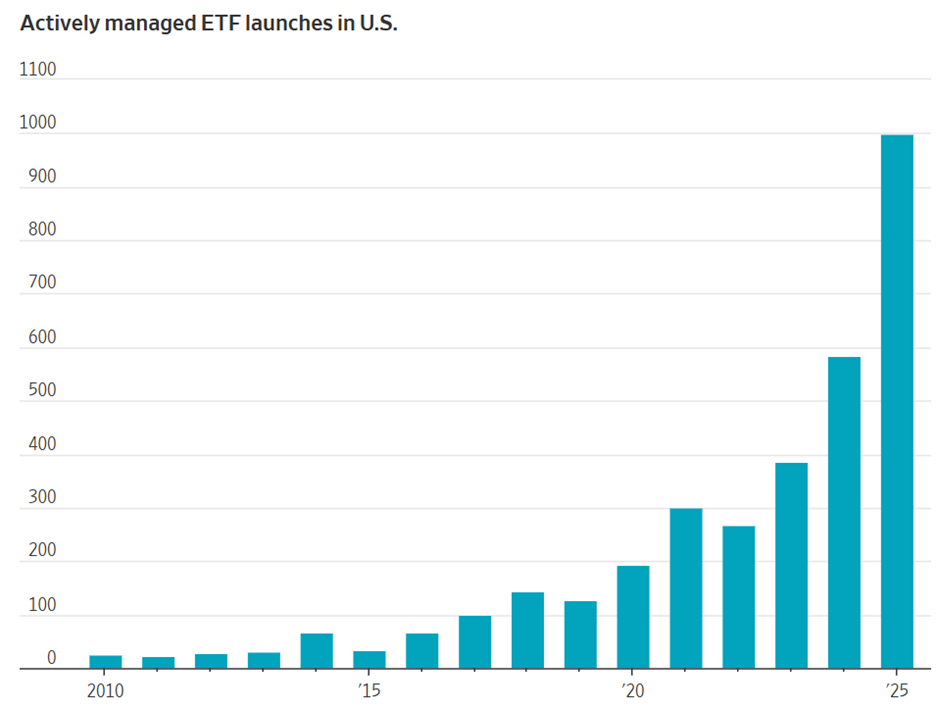
Today, exchange-traded funds have grown into a massive $15 trillion market.
But what Wall Street is now packaging under that label increasingly bears little resemblance to the simple, low-cost funds investors once relied on.
A new wave of products — what I call synthetic ETFs — has entered the market.
They’re far more complex — and more dangerous — than the Street will tell you.
One of these newer funds is down roughly 70% this year. That’s nearly 10 times the decline of the S&P 500 over the same period.
That drubbing is why I think you should avoid synthetics. They’re just too risky.
Besides, I’ve found a much better fund — one tied directly to what I call The New American Buildout powered by AI.
This investment was up 24% in the first quarter alone.
Let me show you why there’s so much more upside ahead …
The Joy & Profits of Stable Investments
To understand what’s in play today, it helps to go back to where this all began.
The first exchange-traded fund debuted in 1993 with the SPDR S&P 500 ETF.
It was a simple idea: Give everyday investors a low-cost, transparent way to own the broader market. And it worked.
Over the next three decades, ETFs grew into a giant market with roughly $15 trillion in U.S. assets, while ETF ownership climbed to about 16.9 million U.S. households, or roughly 13% of all households.
For good reason.
For millions of investors, ETFs have been one of the smartest wealth-building tools ever created.
They offer diversification, liquidity and low fees.
They allow ordinary people to gain exposure to the market or an entire sector without having to pick individual stocks one by one.
In volatile markets like this one, they can also be a sensible place to park cash while investors wait for new leadership to emerge.
Now then, it may sound contradictory, but I believe the average retail investor should own a combination of ETFs and individual stocks.
The stocks are where you generate market-crushing gains that can literally change your life.
The ETFs are supposed to be where you get safety, stability and instant diversification.
But as the saying goes: “That was then, this is now.”
The Era of High-Risk ETFs
Earlier, I noted that one of these newer ETFs was down about 70% this year.
That fund is a leveraged play on Dogecoin, a meme cryptocurrency.
In other words, this wasn’t diversification. It was a leveraged bet on one of the most speculative assets in the market, wrapped in an ETF label many investors still associate with safety.
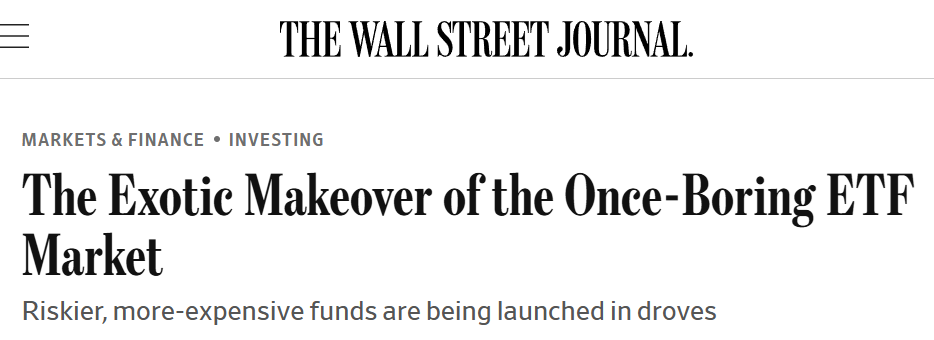
In a recent story, the Wall Street Journal cited the case of a fund offered by Tuttle Capital.
This one tries to generate income by trading same-day options tied to a stock that is highly volatile because of its deep exposure to Bitcoin.
As I see it, that’s not long-term investing — it’s short-term trading inside an ETF wrapper.
Now put that in perspective.
During the first quarter, the S&P 500 was down roughly 7%. The two funds I mentioned a moment ago got mauled in a rough market.
Over the same period as those deep losses, a broad S&P 500 ETF would have beaten those two funds by nearly tenfold.
That is the problem with what I call synthetic ETFs.
They may carry the ETF label. But under the hood, they are built with leverage, options and concentrated bets.
They are exotic trading vehicles, not long-term investment tools.
It’s almost as if they were designed for very aggressive traders.
And I believe that defeats the entire purpose.
Which is why I’ve taken a very different approach — focusing on the New American Buildout powered by AI.
The Digital Infrastructure King
Equinix (EQIX) is not a typical fund.
It’s a real estate investment trust — one that owns and operates some of the most critical infrastructure in the digital economy.
At its core, Equinix runs data centers. But not just any data centers.
These are high-performance facilities where companies store, process and exchange massive amounts of data in real time.
As AI expands, that demand is accelerating rapidly.
The company has delivered 85 consecutive quarters of revenue growth, the longest streak of any company in the S&P 500.
That kind of consistency is rare — and it speaks directly to the essential nature of what Equinix provides.
And now, the next phase is underway.
Equinix is building out its xScale portfolio, a global network of hyperscale data centers designed to serve the largest cloud and AI players in the world.
That portfolio now exceeds $8 billion in value, with more than 725 megawatts of power capacity — and demand is rising fast as hyperscalers race to expand AI capabilities.
This isn’t a concept stock. It’s a mission-critical landlord at the center of the AI ecosystem.
And that’s where the real opportunity comes into focus.
The global data center market is projected to surge into the hundreds of billions of dollars in the coming years, driven by AI, cloud computing and the explosive growth of digital infrastructure.
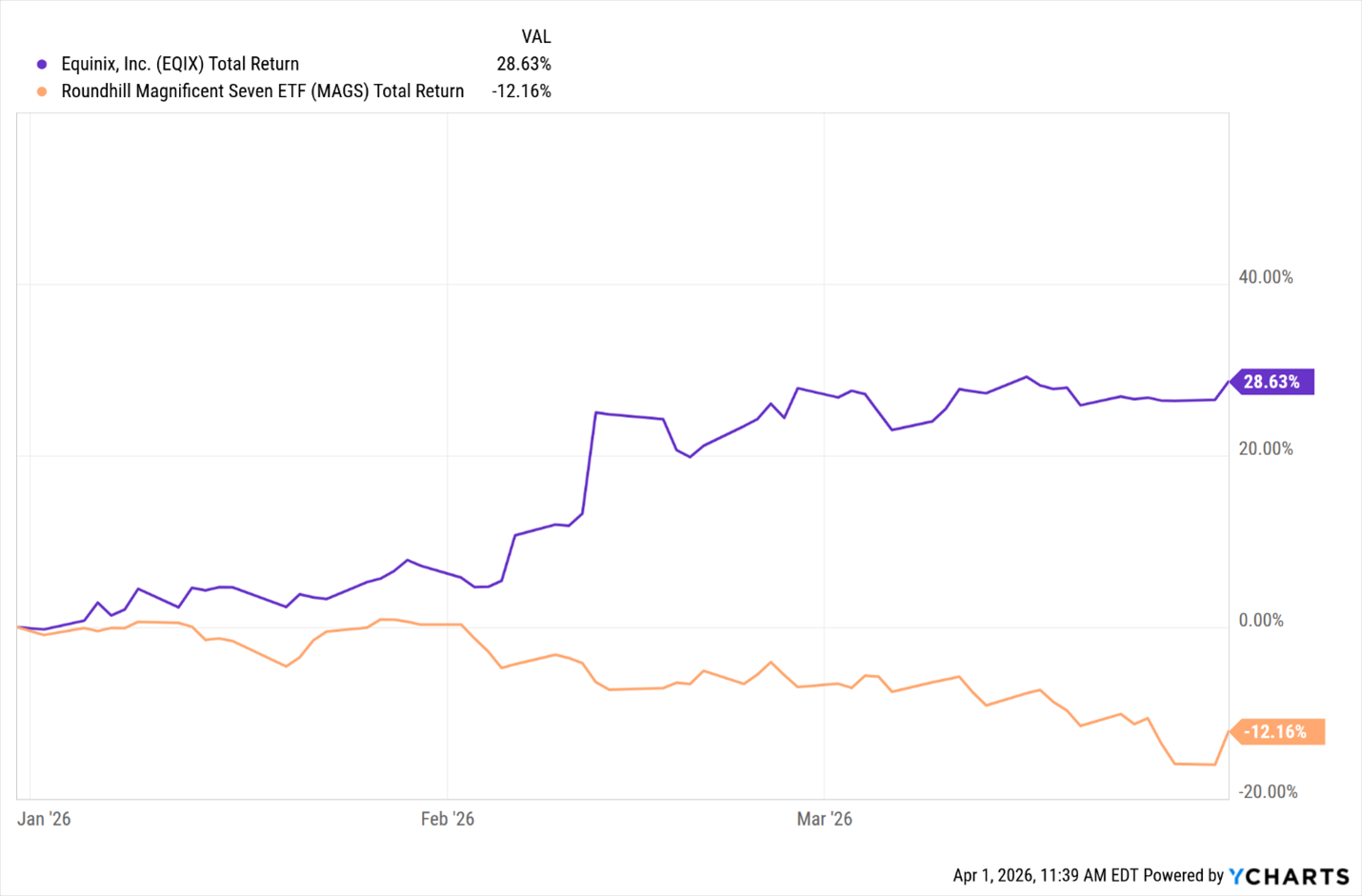
At the same time, investors are beginning to shift away from overcrowded Big Tech names — many of which are under pressure from massive capital spending — and into the companies supplying the backbone of that growth.
That’s exactly where Equinix sits.
It is a direct play on data center demand — and a clear beneficiary of the AI buildout now underway.
The stock is already delivering strong gains this year, and I believe there is still plenty of upside ahead.
Now you can see why I call this The New American Buildout powered by AI.
Massive demand. Real assets. And a physical infrastructure story that has the potential to outperform the broader market in the years ahead.
In fact, I just shared three major beneficiaries of this trend — and shift from the Mag 7.
Best,
Michael A. Robinson