 |
| By Bob Czeschin |
Until Feb. 28, about a fifth of world oil production flowed through the Strait of Hormuz.
Then, the Iran War effectively severed this vital artery.
That caused what IEA chief Fatih Birol calls “the greatest global energy security threat in history.”1
And it goes well beyond petroleum.
The Iran War cut off access to the world’s biggest natural gas field (South Pars/North Dome), which sits inside the Persian Gulf.2
It cut off Qatar, the world’s largest LNG exporter, from Asian energy markets.
Plus, Iranian airstrikes destroyed almost a fifth of its gas export infrastructure.
So, even if the Strait re-opened tomorrow … it could still take up to five years to restore LNG exports from the Persian Gulf to pre-War volumes.3
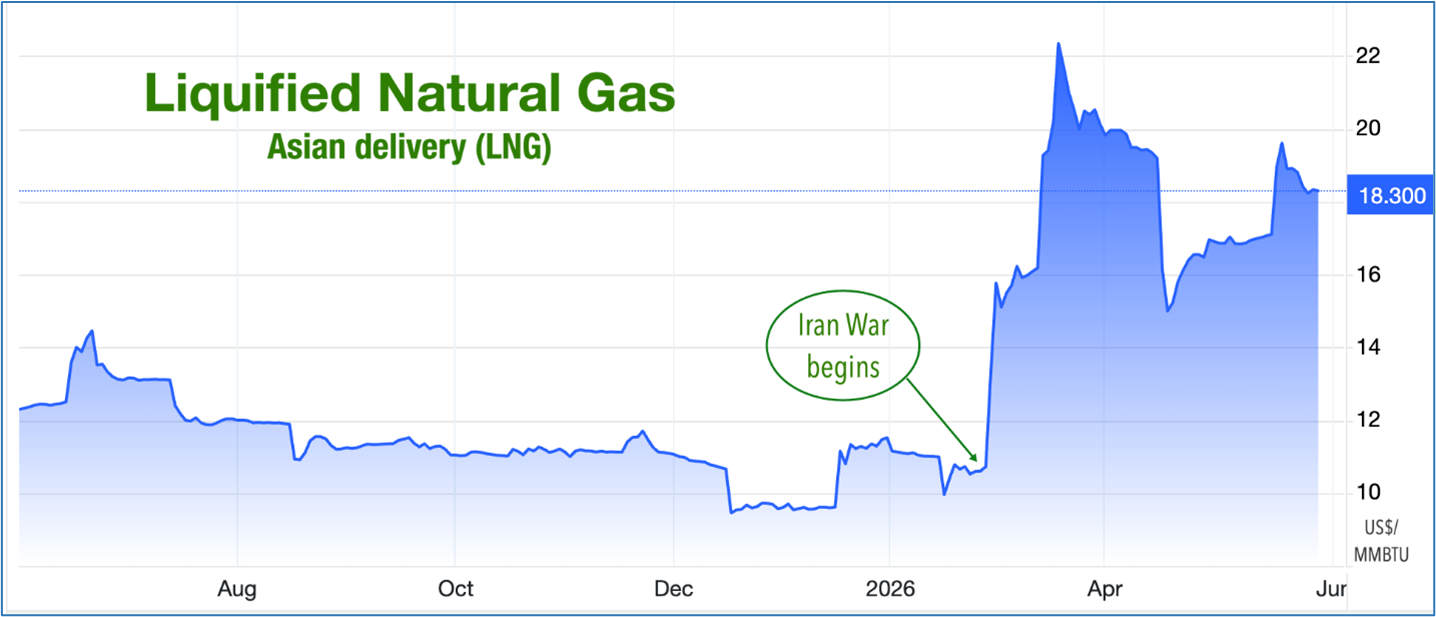
Naturally, gas prices reacted accordingly.
The vast majority of the Persian Gulf’s LNG exports normally go to Asian nations that primarily use it to generate electricity.
For example …
- Natural gas-fired plants routinely supply 92%-93% of Singapore electricity.
- Bangladesh sources around 70% of its power from gas.
- Roughly 68% of Thailand’s electric power comes from gas.
- 27% to 30% of power generated in Japan and South Korea derives from natural gas.
China relies on natural gas for just 3% of its power. But its economy is so big, this translates to a whopping 1.4 trillion cubic feet of gas.
It’s much the same story in India, Asia’s second-largest economy.
Because of all this, not only did closing the Strait of Hormuz send Asian LNG prices spiraling sharply up.
It also triggered mad scramble for alternative resources to cover the shortfall.
And in Asia, that’s coal.
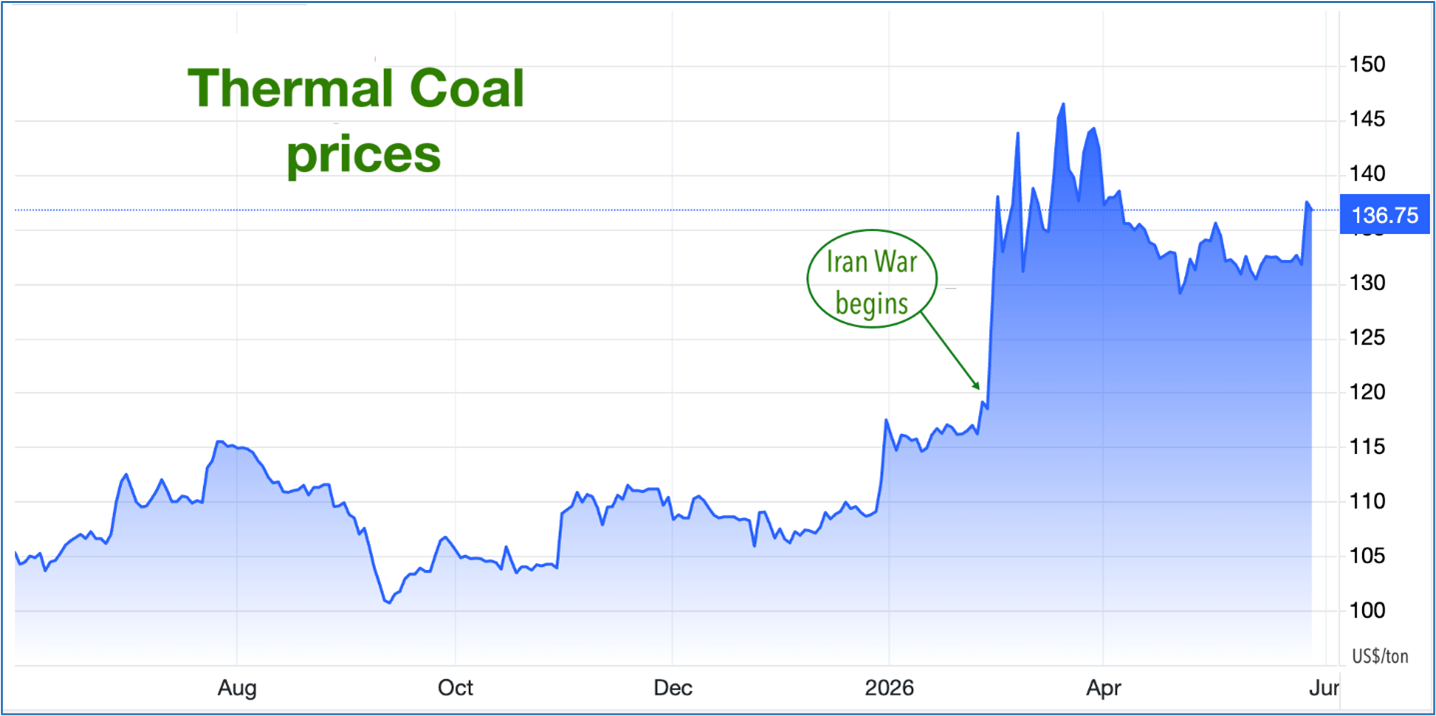
Notice that the price trajectories of Asian LNG and thermal coal following the start of the Iran War … are almost identical.
Maybe that shouldn’t be a big surprise. Because we live in an era when global supply chains are being wrecked by military conflict and disrupted by tit-for-tat tariffs.
And natural gas basically depends on “just-in-time delivery.”
Because it is so difficult and expensive to store, few power plants are able to hold substantial inventories.
By contrast, it’s not uncommon to see mountains of coal piled up near coal-fired plants.
That allows them to remain operational even during weeks — or months-long — supply interruptions.
Accordingly …
- Before the war, Japan capped coal-fired power usage at 50%, intending to phase it out entirely. Now all bets are off. And utilization limits are going up instead of down.
- Thailand has restarted two coal-fired units to offset higher natural gas costs.
- Coal-fired power generation in South Korea surged 30% year-over-year, as Seoul lifted ceilings on capacity utilization.
- Before the war, Taiwan got half its electricity from LNG — a third of which came from Qatar. Now, it’s restarting coal-fired power generators, previously idle for months as it tried to shift away from coal.
- India is restarting a previously idled coal-fired facility. And mandating all power plants running on imported coal to maximize output.
The Gasification Kicker
Since the 17th century, chemists have known flammable gas could be created by cooking coal in the absence of air.
By the 19th century, most major cities had gasworks producing coal gas for street lamps, homes and factories.
Then by the 1960s, lighting applications were overtaken by the incandescent light bulb. And indoor heating applications by the discovery of cheap, abundant natural gas.
But in Asia, this technology was never discarded or forgotten.
Indeed, China spent decades further developing and refining it.
As a result, manufactured gas today can do a lot more than fuel power plants.
It can also be a feedstock for petrochemicals and nitrogen-based fertilizers.
And now, thanks to the Iran War, the whole world is learning a critical lesson: how important it is to have a readily available, substitutable alternative to natural gas.
Indeed, gasification could be coal’s next great growth opportunity.
If Chinese coal gasification were a country, it would already be the world’s third-largest coal consumer — ahead of America and Japan.
On top of that, Beijing has another 21 gasification projects planned or under development.
India is jumping on the same bandwagon, investing nearly $4 billion in a coal-to-chemicals business.
It aims to convert 75 million tons of coal into fertilizers, plastics and other synthetic products.
Investment Implications
The Iran War is creating new sources of demand for coal — especially in Asia — with potential to keep prices going up for quite a long time.
One good way to benefit from this trend might be the Range Global Coal Index ETF (COAL).
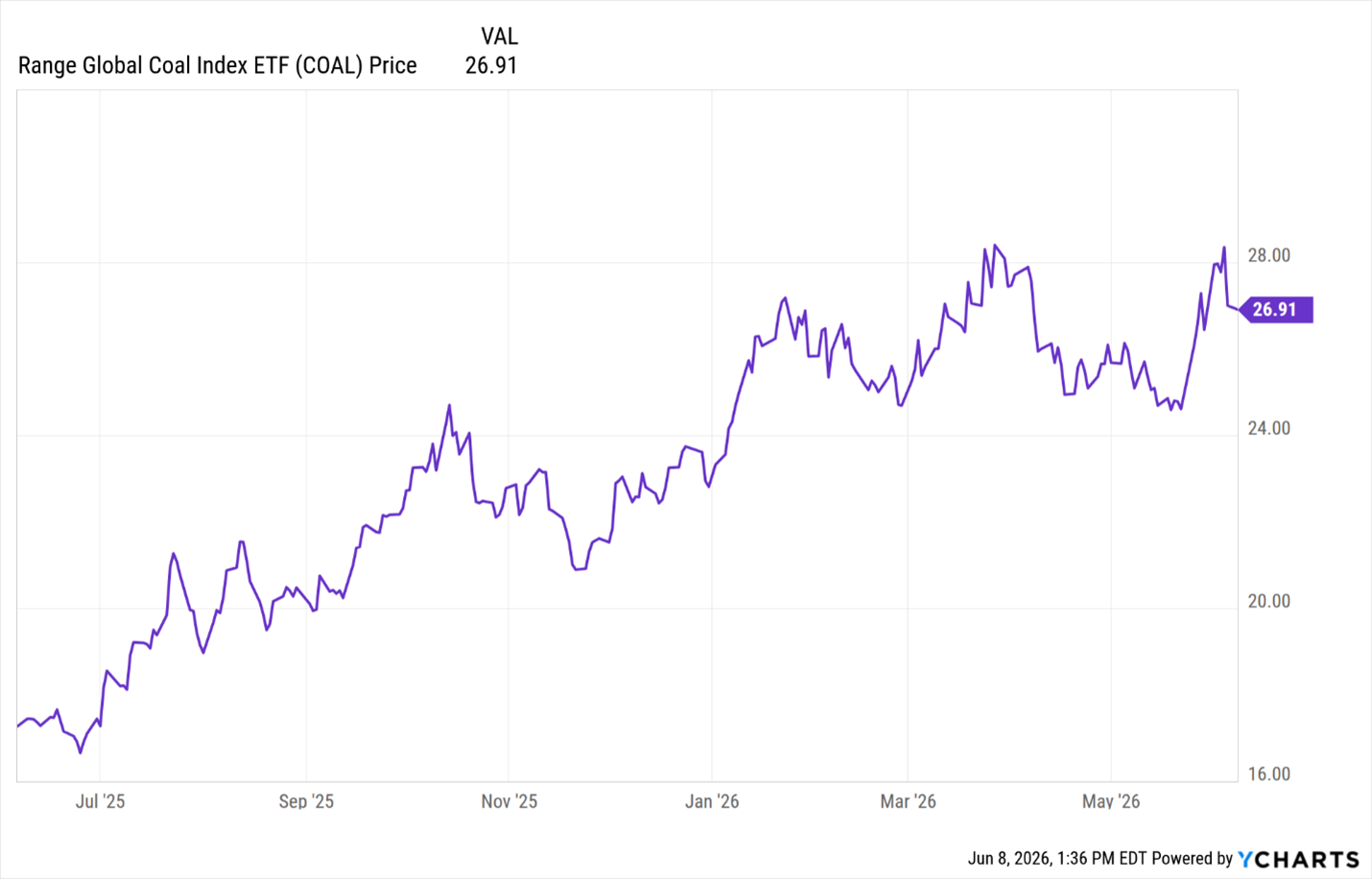
That’s because it offers the direct and concentrated exposure to global coal stocks, particularly Australian producers.
The fund has an expense ratio of 0.85%, which is more than you’d find with a larger fund. But it’s niche holdings make it worth the price tag.
It’s up 56% over the past 12 months and could have further to go as the world shifts back to reliable coal.
Best,
Bob Czeschin
1https://www.nytimes.com/2026/04/01/opinion/oil-crisis-iran-electric-solar.html
2https://en.wikipedia.org/wiki/South_Pars/North_Dome_Gas-Condensate_field