Bots, Ballots & Musk: What the Yandex Strikes Really Changed Online

|
Key Takeaways
|
 |
| By Dawn Pennington Reviewed by: Jim Nelson |
In early October, the internet seemed to quiet down.
Over four days, Ukrainian drones slammed into three data centers owned by Yandex, Russia’s equivalent of Google.
I wrote about these attacks’ impact on data centers, chips and memory makers earlier today.
But something else came out of this upward tick in digital infrastructure strikes …
By the end of the weekend when these Yandex data center attacks occurred, a viral claim circulated on social media: The attack had wiped out many of the bots people blamed for some of the internet’s worst behavior.
And it seemed to have data behind it.
A chart pulled from Cloudflare’s (NET) public traffic tracker showed automated traffic from Yandex’s network down roughly 90%.
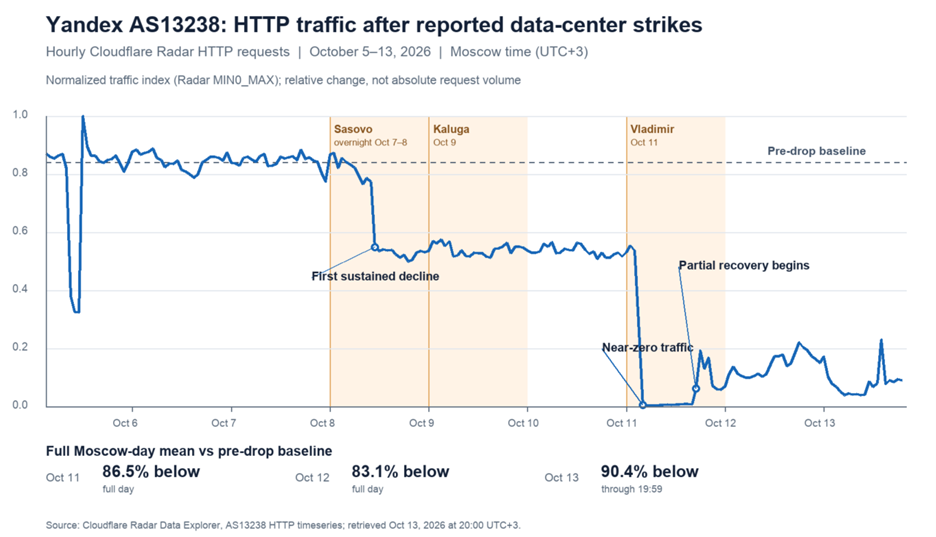
People started checking their replies. The angry comments, the endless pile-ons under political posts seemed different. Many swore they had thinned out overnight.
Then someone pulled up Elon Musk’s account. His posts seemed to be getting a fraction of their usual likes.
The jokes wrote themselves.
For a few days, it looked like Ukraine had taken out the troll farms.
But is that really what happened?
Probably not — at least not the way people think.
The truth about those bots says something much bigger about the internet — and the companies that profit from it.
What Really Went Dark
Here’s the problem with that 90% claim — it measured all automated traffic from Yandex’s network, not social media troll accounts or bot farms.
Cloudflaretracks automated traffic, meaning requests sent by machines rather than people.
For a company like Yandex, most of that traffic comes from something far less dramatic: web crawlers.
Every search engine runs them.
Crawlers visit websites around the clock, read what’s on the page and catalog it so it shows up when someone searches.
Google has them. Microsoft has them. So does Yandex — or did, until the strikes.
When Yandex’s data centers went offline, its crawlers went offline with them.
Cloudflare itself noted that its figures include search crawlers and monitoring tools, not just social media activity.
And machines like these don’t just live on some small corner of the web — they’re everywhere.
In 2024, bots made up 51% of all web traffic, according to security firm Imperva.
This was the first time in about a decade that machines outnumbered humans online.
Plenty of this traffic is malicious, but Imperva’s “bad bots” are mostly scrapers and scammers testing stolen passwords, not fake social media accounts arguing politics.
That’s where the story went sideways.
A search engine’s data centers got mixed up with bot farms, and that confusion inflated the headlines.
And there’s another wrinkle …
Russian influence operations don’t need to run through Yandex.
They can use infrastructure spread across multiple providers and countries, making them harder to trace and disrupt.
But that doesn't mean Russian social media bot farms are a myth. They’re very real.
In July 2024, the U.S. Justice Department and X took down 968 accounts tied to a Kremlin operation.
It was run by a deputy editor at the state network RT and an officer from Russia’s FSB security service.
The engine behind it was AI software called Meliorator, built to mass-produce convincing fake personas.
Many of the accounts claimed to be Americans.
None of this operation ran through Yandex. The bots were registered through private email servers, which the FBI seized.
This is the uncomfortable reality of the internet in 2026.
AI makes fake people cheap to build and operate. And whoever runs them doesn’t need Russia’s Google to do it.
Bots, Ballots & Musk
We don’t know for sure that Russian influence operations were unaffected.
People swore they felt a change on social media, and with the midterms weeks away, that impression took on a life of its own.
The theory spreading online went like this: If the bots vanished when Yandex went dark, and pro-Trump replies seemed to thin out at the same time, then Russia had been propping up American political accounts.
Some called it a genius move by Ukraine to influence online discourse just weeks before the midterms.
Others flipped it around.
If Ukraine really had silenced accounts that leaned one way, then a foreign government had just strategically tilted the American conversation ahead of an election.
Conservative commentator Jack Posobiec made exactly that case, accusing Zelensky of sabotaging Trump.
But Zelensky never actually mentioned MAGA, Musk or the midterms. He only said that it had become “a little easier to breathe” on social media.
The same weekend President Trump warned Ukraine to stop hitting Russian oil refineries, the owner of X posted that “Zelensky has gone too far.”

That silence is ironic.
In 2022, Musk nearly walked away from his $44 billion Twitter deal over this exact question.
Twitter said fewer than 5% of its accounts were fake. Musk said at least 20% — and maybe “much higher.”
Four years later, he owns the platform, and the internet counts bots under his own posts.
Meanwhile, Europe is taking the idea seriously. Lithuania’s prime minister suggested asking Ukraine to strike more Russian data centers as a way to protect elections.
Bots Left — Users Stayed
Which brings us back to where this started.
If the viral posts were right and the bots really had been wiped out, you might expect social media stocks to take a hit.
Fewer bots could mean less engagement, and less engagement could mean fewer advertising opportunities.
As of now, investors don't appear to see the strikes as a meaningful threat to social media companies' business models.
Advertisers want the real people who scroll, click and buy — not bots that inflate engagement.
And Meta (META) has never pretended its platforms are bot-free.
In its 2023 annual report, the company estimated that false accounts made up about 4% of Facebook’s worldwide monthly users. That’s roughly one in every 25 accounts.
Even with those fake accounts, Meta still brought in more than $160 billion from advertising in 2024.
Advertisers have been buying around bots for years. The money still follows the people.
Meta passed that test on Oct. 21.
In its third-quarter report, ad revenue rose 26% to $63.1 billion, and daily users averaged 3.64 billion in September, up 3% from a year earlier.
A one-time $9.89 billion legal charge cut profit, but the ad business didn’t blink.
Keep the bigger picture in mind: Half the internet may be machines, but the other half still pays.
To your health and wealth,
Dawn Pennington