Cheap Drone Tech Has Global Defense Giants on the Ropes

 |
| By Bob Czeschin |
As investors, we need to do a fair bit of sleuthing to find the powerful trends that move markets.
In my own investigation, I spotted an opportunity on the horizon that’s been rather quiet.
Last week, President Trump denied reports that the U.S. was running low on munitions due to the war with Iran.1
But just a few days later, the Department of Defense (DoD) asked contractors to ramp up production.
Deputy Secretary Steve Feinberg told industry leaders that “years-long development cycles”2 were too long. “We must dramatically accelerate our program schedules and expand our production capacity now.”
Here’s the problem …
The current model for defense manufacturers no longer adds up to success for the DoD. Or the American taxpayer.
It’s in that gap that opportunity sits for a handful of new defense contractors.
And for investors savvy enough to pay attention.
The Economy of War Is Changing
From the Black Sea …
To the Red Sea …
To the Strait of Hormuz …
The same unforgiving arithmetic is disrupting a prevailing paradigm of modern warfare: Firing a $1.6 million missile to knock down a $1,000 drone can never be a winning strategy.
Low-cost kamikaze drones are fundamentally reshaping the 21st-century battlefield.
How?
By forcing military powers to rethink procurement strategies built around expensive, high-end weapons systems.
In the war with Iran, U.S. forces face a bitter reality.
The unit cost of the least expensive surface-to-air missile in America’s inventory (the PrSM) exceeds the $1,000 price of Iran’s Shahed kamikaze attack drone — by a whopping 16-to-1.
| Weapon | Description | Unit Cost (millions) |
| PrSM | Ground-launched precision strike missile used by field artillery units | $1.6 |
| SM-3 | Ship-launched standard ballistic missile interceptor with kinetic warhead | $28.7 |
| SM-6 | Ship-launched standard ballistic missile against aircraft, cruise missiles and ships | $5.3 |
| Patriot | Ground-launched anti-ballistic missile, anti-aircraft, and anti-cruise missile | $3.9 |
| THAAD | Terminal High-Altitude Area Defense; ground-launched anti-missile missile, with longer range than the Patriot | $15.5 |
As the beneficiary of the world’s biggest defense budget, the Pentagon can of course afford a little red ink.
And knocking down a $1,000 drone with a multimillion-dollar missile can still be worth it … if it saves a multibillion-dollar frigate or cruiser.
But longer term, such a lopsided cost exchange ratio is not survivable.
In plain English, the way we fight right now is just too expensive.
Accordingly, the Pentagon is facing an "evolve or die" moment.
It’s racing to stockpile low-cost one-way attack drones, interceptors and counter-unmanned aerial systems (UAS).
Before the next crisis erupts. Or the U.S.-Iran Memorandum of Understanding blows up.
Going forward, the military must shift away from high-cost weapon systems and decades-long procurement cycles. And back toward what actually made the U.S. a victor in World War II …
Namely, the ability to mass-produce low-cost weapons at scale. In volumes that simply overwhelm foreign adversaries.
And one company capable of just that is already on the DoD’s radar.
Old Process, New Industry
The key to low-cost drone manufacture is to make the most of readily available, off-the-shelf components.
That’s something DZYNE knows well. It’s a leader in cost‑disruptive drones and anti-drone systems.
To make its fixed-wing drone — called The Blitz — it uses a common factory process known as steam chest molding.
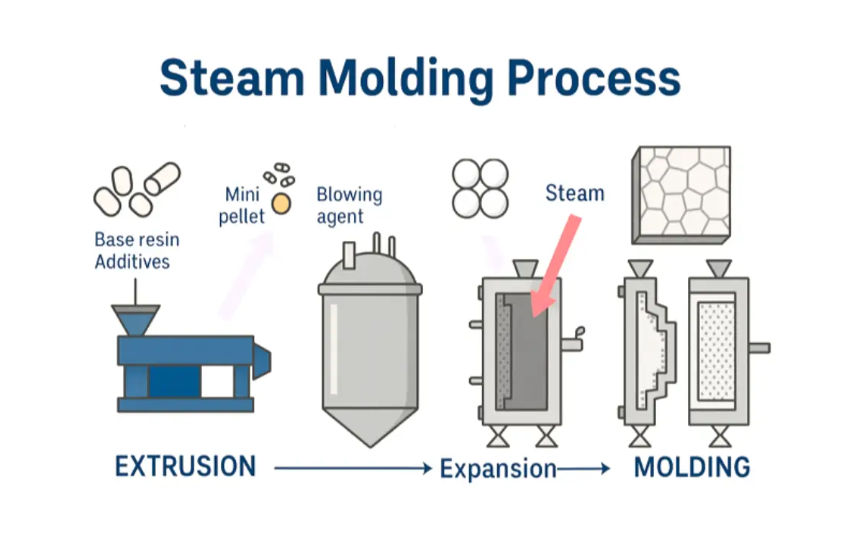
Basically, it’s a way to create lightweight plastic parts using steam and molds. In fact, this same process is used to mass produce …
- Bicycle and motorcycle helmets,
- The insulated coolers that keep your beer cold during a summer picnic,
- And, chances are, the packaging your flat-screen TV arrived in.
There’s a reason this method is used across factories: It’s simple and cheap.
No autoclaves. No exotic supply chain. No precision machinery or machinists.
It’s this process that helps keep costs for Blitz drones down.
Just as important as price is the machine’s ease of use. Each drone fits inside a standard-issue rucksack.
They assemble in under two minutes. And, crucially for the Pentagon, it only takes a couple hours to train a new operator.
The drones’ ranges extend 50 to 90 miles, with swappable payloads for surveillance or jamming. Or plastique, if you prefer a one-way attack drone.
DZYNE has also created a subtle way to transport and launch multiple Blitz drones at once.
Called the BlitzBox, it’s a nondescript shipping-container system.
One that’s designed to conceal and transport up to 100 Blitz drones to a desired launch point for a coordinated swarming raid.
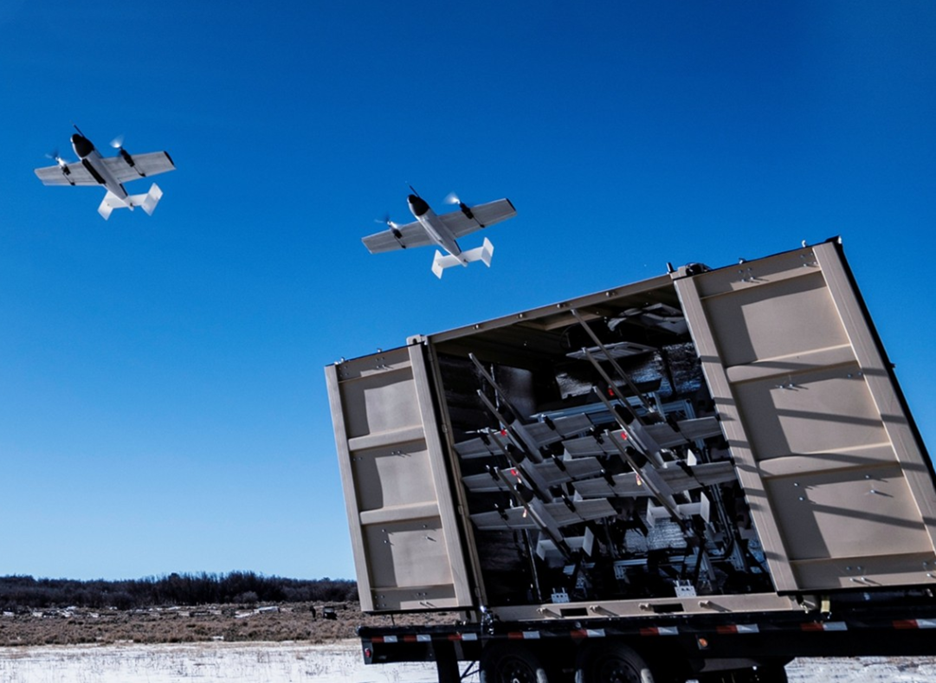
By design, the BlitzBox looks like any other shipping container you might see on a truck, a ship, port or railyard.
That’s by design. To escape notice, right up to the moment of launch.
That is exactly the logic Ukraine demonstrated last year.
It launched a drone swarm deep inside Russia. And it did so from a modified shipping container positioned near an airbase to target strategic bombers.
Drone threats to military bases have become so common that anti-drone defenses are a must.
DZYNE has an answer for that, as well.
They’re aptly called Dronebusters — human-portable, anti-drone jammers that blind drones using a GPS guidance system.
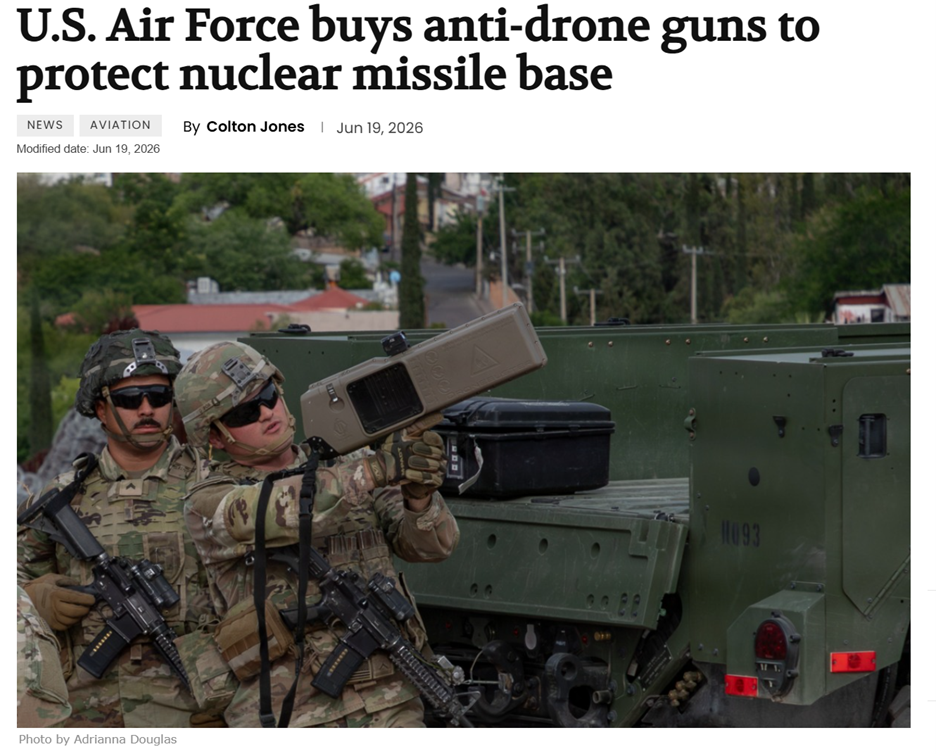
Which is why one of North Dakota’s most-sensitive nuclear missile bases just ordered a batch of them.5
Once you’re on the DoD’s radar, future contracts become easier to bid for.
5 Ways to Get Exposure
Low-cost drone and anti-drone technology is a market poised for massive expansion.
Especially as the U.S. and its allies push military procurement cycles into high gear through the end of the decade.
This is likely going to be the next major technology inflection point for the aerospace and defense industry.
In short, I don’t think this trend is going anywhere.
Which is why I want to highlight five public companies laser-focused on low-cost, scalable drone and anti-drone tech.
Let me be clear from the start:
These are not “buy” recommendations.
What they should be is a starting point for your own research into this theme. And its immensely profitable potential.
1. Ondas (ONDS). Recent share price: $9.31.
DZYNE was a private company. But in July, it was acquired by Ondas,6 a leading provider of next-gen defense and security tech.
In addition to DZYNE’s products, Ondas also offers …
- Drones: Autonomous "drone-in-a-box" systems via Optimus System (fully autonomous for security, surveillance and data collection).
- Anti-Drone: Cyber over radio frequency (CoRF)-based Sentrycs systems (detection, identification, tracking, mitigation). Iron Drone Raider (autonomous interceptor drone) to defend critical infrastructure.
2. AeroVironment (AVAV). Recent share price: $189.15.
- Drones: Leading provider of small, unmanned aircraft systems (sUAS), including the Raven, Puma, Wasp and Switchblade loitering munitions.
- Anti-Drone: Titan family (RF-based detection, tracking and neutralization). AV Halo command software for fused sensor data. LOCUST laser weapon system (featuring low-cost per-shot drone defeat).
3. AEVEX (AVEX). Recent share price: $21.76.
- Drones: Offers unmanned precision strike systems (Disruptor, Sicario, Atlas) and long-endurance platforms like Raker. Uses advanced manufacturing ("Drone Factory of the Future") for rapid production in contested areas.
- Anti-Drone: Provides Red Teaming services (threat replication, vulnerability testing and training) to help strengthen defenses.
4. Red Cat Holdings (RCAT). Recent share price: $9.97.
- Drones: Key platforms include Black Widow, Hellcat, Teal 2, FANG, and the Arachnid family for rescission strike/sensor-to-shooter missions.
- Anti-Drone: Provider of affordable, battlefield-proven tactical drones for contested environments.
5. Redwire (RDW). Recent share price: $13.12.
- Drones: The acquisition of Edge Autonomy helps Redwire bring battlefield-tested tactical and long-range reconnaissance drones with AI, edge computing and swarm capabilities. The focus is on integrating with "orbital drones" in very low-Earth orbit.
A Bonus Way to Play
There’s another theme at work in this trend: Disruptors vs. dominators.
For years, the likes of Lockheed Martin (LMT), Northrop Grumman (NOC), RTX Corp. (RTX) and General Dynamics (GD) have dominated the defense sector.
But with the economy of war adapting to the 21st century, disruptors who can supply cheaper tech faster could have their moment in the sun.
Here’s the key: Savvy investors don’t choose which side to play. They make room for both in their strategy.
That’s exactly what my colleague and tech expert Michael Robinson does in his Disruptors & Dominators newsletter.
He helps his members navigate ever-changing markets to ride the giants while also getting exposure to the exciting up-and-coming names across several sectors.
Best,
Bob Czeschin
1https://truthsocial.com/@realDonaldTrump/posts/117046698987056229
3https://epsole.com/steam-chest-molding/
5https://defence-blog.com/u-s-air-force-buys-anti-drone-guns-to-protect-nuclear-missile-base/