Corning’s 20-Year Bet on Fiber Is Finally Paying Off in the AI Boom

|
Key Takeaways
|
 |
| By Michael A. Robinson Reviewed by: Jim Nelson |
We're nearing the fourth anniversary of what will wind up being one of the most important technological breakthroughs of our lifetimes.
That's a bold statement, I know. But consider what this technology can do.
It can write sophisticated computer code in seconds, help doctors identify diseases, design new products and perform hours of office work in a matter of minutes. And that's just the beginning.
McKinsey & Co. says this tech is set up to add as much as $4.4 trillion in value to the global economy — every year. That's more than the entire GDP of the United Kingdom.
Of course, I'm talking about artificial intelligence, specifically ChatGPT, which I have nicknamed “Chad.”
It’s the chatbot that introduced millions of everyday people to the extraordinary power of AI when it debuted on Nov. 30, 2022.
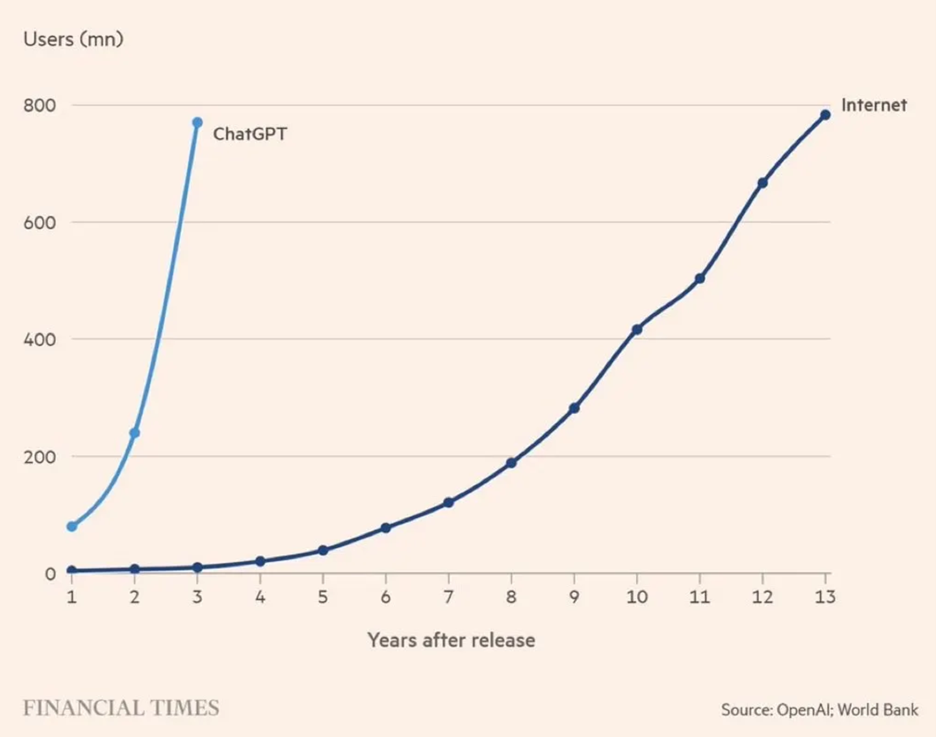
Talk about a roaring success.
In less than four years, ChatGPT has gone from zero to 1.2 billion weekly active users, making it the fastest-growing consumer tech in history.
Related story: The Earnings Double I Found While Traveling With AI
Today, I've identified a way to profit from this revolution.
Let me show you why it’s on pace to double its earnings in just two years …
4 Years That Changed Everything
To appreciate how far AI has come, consider how quickly our lives changed when ChatGPT arrived.
Suddenly, anyone with an internet connection could interact with a powerful AI system simply by typing a question. No programming experience needed.
And what began as a clever chatbot quickly evolved into something much more powerful.
Today, AI can analyze financial statements, write software, create realistic images and videos and help businesses automate everything from customer service to inventory management.
But one of the most exciting applications is happening in medicine.
You see, developing a new drug traditionally involves years of research, testing and trial and error.
Scientists must examine countless molecules to determine which ones might effectively treat a disease.
AI can accelerate parts of that process by analyzing enormous amounts of biological data and identifying promising drug candidates.
And if you think that's science fiction, consider this …
In 2024, three researchers received the Nobel Prize in Chemistry for breakthroughs involving computational protein design and structure prediction.
Related Story: AI (& This Drug Giant) Could Save Your Life
Two of them, Google's Demis Hassabis and John Jumper, developed an AI system called AlphaFold.

It solved a problem scientists had struggled with for 50 years: predicting the three-dimensional shapes of proteins.
That's enormously important because proteins perform many of the essential functions inside our bodies.
Knowing their structures can help researchers understand diseases and develop new treatments.
Using AlphaFold, scientists have predicted the structures of virtually all 200 million proteins identified by researchers.
A problem that frustrated scientists for half a century is now being tackled with extraordinary speed, thanks to AI.
And the implications stretch far beyond medicine.
As companies discover new applications, demand for the powerful chips, servers and other infrastructure needed to run AI keeps growing.
A Digital Connections King
That’s where Corning (GLW, “C+”) comes in.
Founded in 1851, it has a long history of innovation, from Pyrex cookware to the Gorilla Glass used in more than eight billion devices like smartphones and tablets.
And that status as a tech “twofer” bodes well for the stock’s long-term success. More on that in a moment.
These days, one of its biggest growth opportunities comes from a technology that millions use daily but never see — fiber optics.
Corning makes the high-speed cables that connect servers, data centers and AI systems as well as homes and businesses.
Its optical communications division now accounts for roughly 40% of sales. And Silicon Valley is still fully on board.
For instance, Meta Platforms (META, “B-”) recently signed a multiyear agreement worth up to $6 billion for fiber-optic cables and connectivity equipment. The pact includes sales built in through at least 2030.
And just weeks ago, longtime customer Verizon Communications (VZ, “B”) signed a multibillion-dollar agreement covering more than 80 million miles of optical fiber through 2032.
To meet that demand, Corning plans to increase its optical output as much as tenfold to help meet the soaring demand for high-speed digital connections.
Its contracts cover a staggering amount of fiber. We’re talking enough of it to circle the Earth more than 3,200 times.
An “Overnight Success” After 20 Years
Corning's emergence as a major AI infrastructure supplier may seem like an overnight success story. But the truth is quite different.
The company spent nearly two decades losing money on fiber optics. Investors and analysts urged Corning to ditch the business.
Instead, Corning doubled down. And today, that persistence has put it in the pole position in the AI infrastructure race that will continue for years to come despite the current backlash slamming the sector.
But this is no one-trick pony. Corning also makes Gorilla Glass, the durable material used in hundreds of millions of smartphones, tablets and other devices.

The company has been a longtime supplier of specialized glass for Apple's iPhone, with the iDevice king investing heavily in the relationship over the years.
And there's more to the story of this “twofer” tech stock.
Corning has built a diversified business with exposure to several powerful long-term trends. We’re talking display technology, automotive glass and specialty materials.
And long-term supply agreements continue to roll in, creating a sales stream that may not yet be fully priced into the stock.
Make no mistake. This momentum is already showing up in the financials.
In its most recent quarter, Corning reported earnings growth of 36%. That's roughly 50% faster than its average annual earnings growth over the past three years.
At that new pace, we’d see earnings double in about two years.
And that brings up a key thing to keep in mind about the market’s recent retreat.
As savvy investors, we don’t freak out when tech stocks head down.
Instead, we look for great names like Corning that we hope to own for years to come.
Best,
Michael A. Robinson
P.S. Because Corning has been around so long and has had such a steady stream of income from its many other products, it’s one of the few “tech” companies that actually pays a dividend.
However, that dividend is only about the same as the average stock in the S&P 500: a 1% yield.
On Tuesday, your income specialist, Nilus Mattive, will show you how to get 22x that income.