Data Centers Are Now a Military Target. Here’s Why Nvidia Matters

|
Key Takeaways
|
 |
| By Dawn Pennington Reviewed by: Jim Nelson |
Last month, the internet was busy arguing about bots.
Did Ukraine’s drones take out Russia’s troll farms? Did this attack inadvertently clean up social media? How will this affect U.S. elections if all the troll accounts are offline?
It made for a fun few days online. But most people missed the real story: Those drones hit the cloud.
Over four days in early October, Ukraine struck three data centers belonging to Yandex, Russia’s largest internet company, and knocked its AI supercomputers offline.

That’s the part investors should care about, not the bots.
The strikes didn’t just cost Russia a pile of expensive hardware. They proved something the whole tech industry has been dreading: Data centers are now a military target.
What Russia Actually Lost
The first strike hit Yandex’s Sasovo data center on Oct. 8.
A fire broke out, the site shut down completely and Yandex admitted it couldn’t say whether it could salvage the equipment inside.
Sasovo housed tens of thousands of servers.
Next came Kaluga, Yandex’s largest data center, where several modules were knocked out.
Lastly, Vladimir went fully offline after the attack.
By the end of the weekend, Yandex Cloud was running in emergency mode, and the company was telling customers to fall back on their own disaster recovery plans.
But the biggest targets sat inside Sasovo and Vladimir: all three of Yandex’s AI supercomputers.
One of them, Chervonenkis, ranked 19th in the world as recently as 2021.
According to Yandex’s published specs, those three machines ran on 3,776 Nvidia (NVDA) A100 chips.
A single A100 goes for about $4,000 used and up to $15,000 new. That puts the chips alone at between $15 million and $57 million.
But chips don’t run on their own.
Packaged into full servers, like Nvidia’s eight-chip DGX A100 systems at $150,000 to $200,000 apiece, the hardware comes to roughly $70 to $95 million.
Add networking, the buildings and tens of thousands of other servers, and the bill likely clears $100 million.
But the big problem for Russia isn’t just the financial hit — it’s whether it can replace the hardware at all.
Nvidia Won’t Take the Order
Normally, if a company loses Nvidia chips, it just calls Nvidia and places an order.
But in this case, that’s impossible, because Nvidia stopped selling to Russia in March 2022, just weeks after the invasion of Ukraine began.
So where can it get replacement chips?
Yandex has just three options — and none of them are ideal.
The first is the gray market.
Restricted chips often find their way into Russia through middlemen.
Hong Kong is a major hub, with a single office address linked to roughly $4 billion in chip shipments.
India is another. One Mumbai pharmaceutical company reportedly shipped 1,111 high-end Dell servers to Russia.
But smuggled chips come at a steep markup. And if they break, Nvidia won’t help fix them.
The second option is buying Chinese chips.
Russia can legally buy Huawei’s AI chips. But many see them as copies of older U.S. designs, not rivals to Nvidia’s best tech.
The third is to rebuild slowly with whatever it can scrape together … and fall further behind in the AI race.
This isn’t the first time this conflict has dealt Yandex a financial blow.
In 2024, Yandex’s Dutch parent company, now called Nebius Group (NBIS), was forced to split from the Russian operation due to Western pressure and Nasdaq’s refusal to trade Russian companies.
While limitations still stand for Russian Yandex, Nebius, once it was free from the conflict's shackles, planned to triple its Nvidia GPU deployments.
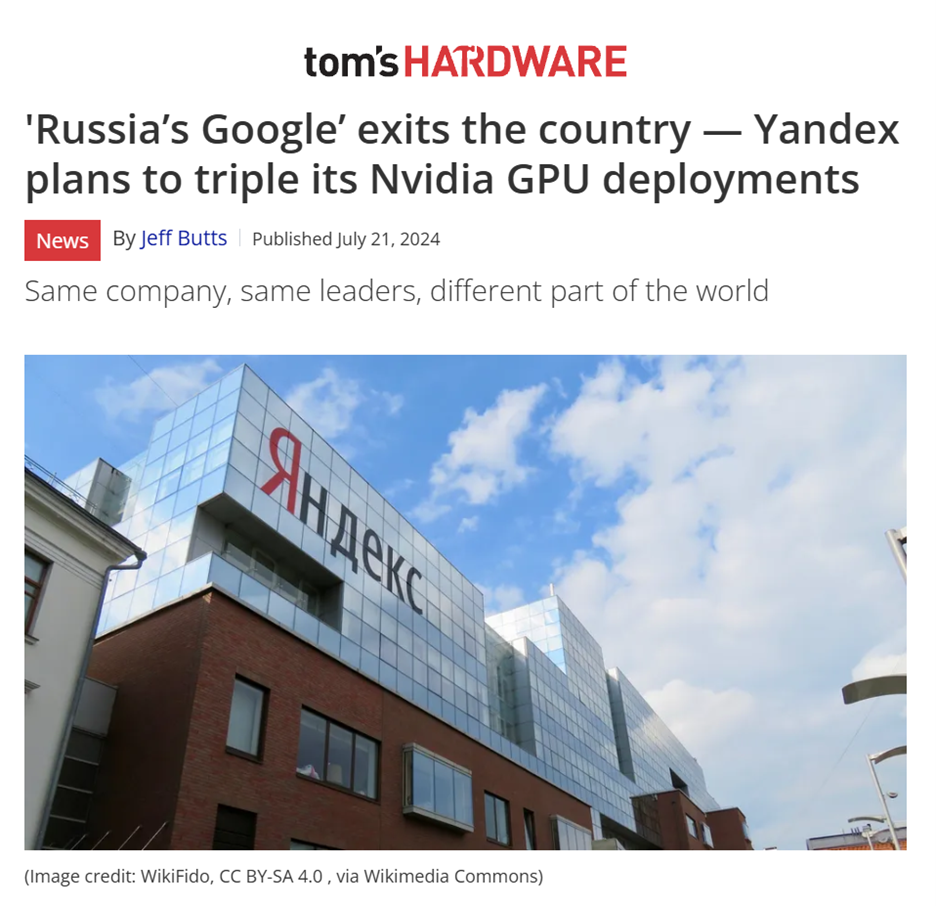
So the part of Yandex that left Russia is now an Nvidia customer, while the half that stayed is getting hit by drones.
The Cloud Has an Address
For years, we’ve talked about “the cloud” like it floats somewhere overhead.
It doesn't, in fact. It lives in buildings. Big, power-hungry buildings packed with some of the most expensive hardware on Earth — and most of them aren’t hard to find.
Militaries have increasingly valued such targets.
In March, Iranian drones directly struck two Amazon Web Services data centers in the United Arab Emirates.
A third facility, in Bahrain, sustained collateral damage from a nearby strike. Fires broke out, power systems failed and Amazon (AMZN) told customers to move their workloads out of the region.
Analysts called it one of the first known cases of military action hitting large-scale cloud infrastructure.
And it wouldn’t be the last.
Since September, Russia has been striking Ukrainian data centers, including a Kyiv business center where four people were killed. Ukraine answered by going after Yandex.
Today it’s Russia and the Gulf. In a future conflict over Taiwan, Alphabet (GOOGL), Microsoft (MSFT) or Alibaba (BABA) facilities could be targets.
Our own Bob Czeschin recently looked at how decentralized networks could help protect AI computing from strikes like these.
This changes the industry’s direction.
Redundancy becomes mandatory. Cloud providers can endure the loss of one data center, but losing several at once in a coordinated strike is a different problem.
The fix is more sites, spread farther apart, which means buying more land and more hardware than they strictly need.
Geography gets repriced. The U.S. has spent years pushing for AI data center deals in the UAE and Saudi Arabia, hoping to turn the region into an AI hub.
Now these sites are high risk, and new real estate must be found.
Governments step in. In August, Putin gave the Russian state power to take control of critical infrastructure it deems poorly protected from drones.

Expect other governments to start asking who’s guarding their data centers, and who’s paying for it.
Voters are pushing back, too.
On Tuesday, voters in 10 states weighed 41 data center ballot measures.
Towns from Ohio to California to Kansas voted to ban new data centers, some outright and some above a certain size.
Fewer places to build is one more squeeze on a market that’s already short on sites, power and chips.
What This Means for Nvidia
Yandex was once an Nvidia customer. Every one of its supercomputers runs on Nvidia chips.
So did Nvidia even notice losing Russia’s biggest internet company back in 2022? And if Yandex could place an order today, could Nvidia even fill it?
Realistically, those 3,800 chips wouldn’t move Nvidia’s needle.
Nvidia brought in about $303 billion in revenue over the past year. Even $57 million worth of chips is a rounding error.
In fact, attacks on data centers could work in Nvidia’s favor.
Every company now planning for a strike, or just a very bad week, has a reason to buy backup capacity.
More sites. More servers. More chips sitting in reserve in case the main ones go dark.
That means more money in Nvidia’s pocket.
At the same time, any increased demand lands on a supply chain that’s already maxed out.
In August, Nvidia’s CFO said the company’s supply-demand gap should last at least through its fiscal year ending in early 2028.
Nvidia isn’t the only chipmaker facing strain.
Every AI chip needs high-speed memory to do its job, and that market is just as tight if not worse.
Only three companies make it at scale: Samsung (SSNLF), SK Hynix (SKHY) and Micron (MU).
Earlier this month, Micron’s CEO said he expects supply and demand to be “much tighter in calendar 2027 and 2028 than they were in 2026.”
More than 75% of the company’s planned output for next fiscal year is already spoken for.
Add a wave of just-in-case buying, and the few companies making these chips gain serious pricing power.
Buyers don’t have anywhere else to go.
And Nvidia’s stock isn’t priced for a shortage that could last until 2028.
At just under $200 a share, it trades at about 25 times earnings, well below its average over the past year, and under 15 times what analysts expect it to earn next year.
That’s a modest price for a company whose revenue grew 83% over the past year.
Then there’s Nebius.
It had a rough month. The stock has fallen sharply from its 2026 high, as investors worry about funding and the cost of AI buildouts.
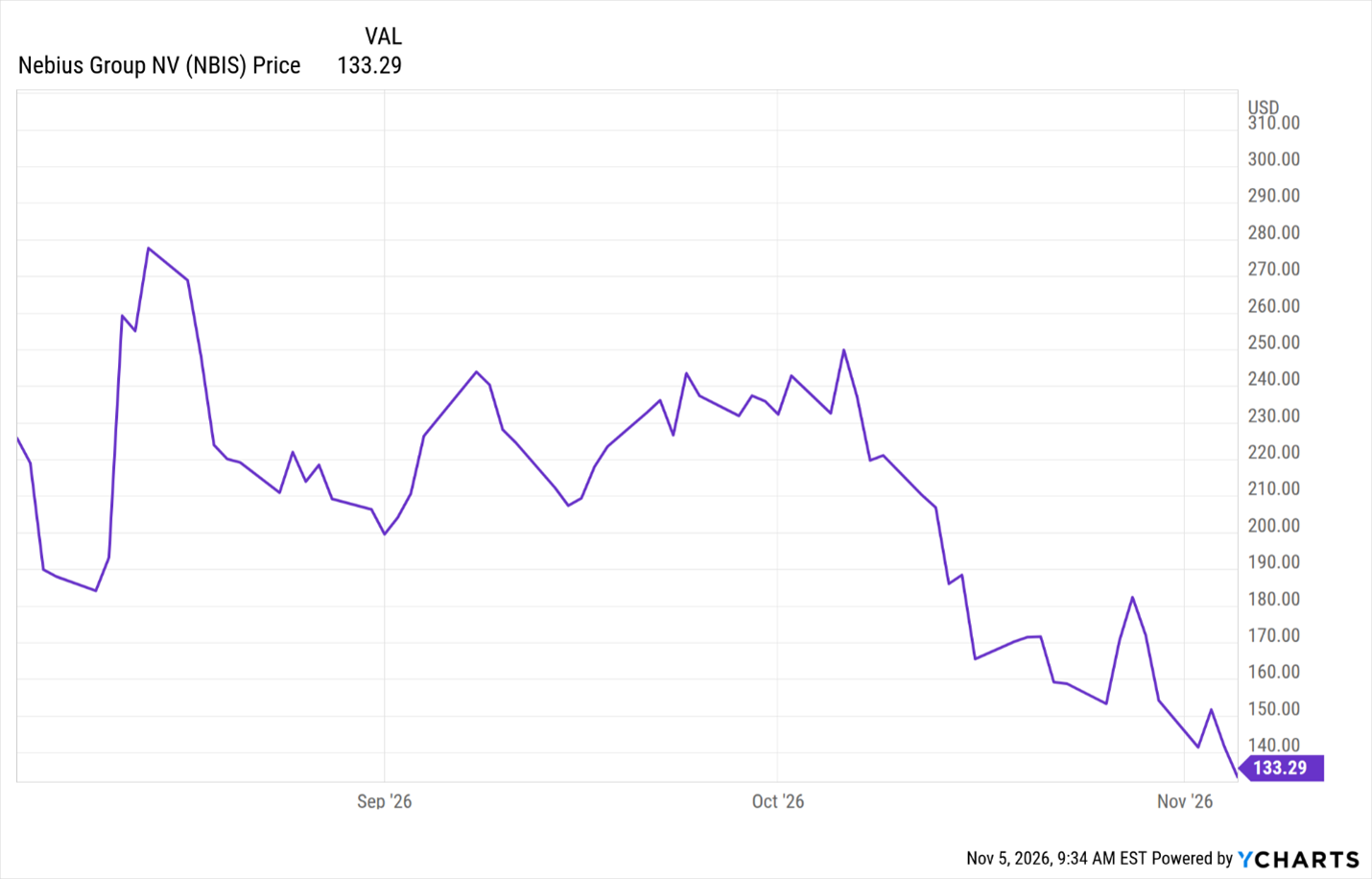
But revenue jumped 454% last quarter, Microsoft and Meta have committed roughly $32 billion to the company and Nvidia itself invested $2 billion in Nebius in March.
It’s not a quiet stock. But it’s the half of Yandex that gets to keep buying chips.
Zoom out and the lesson is simple.
A handful of drones took a country’s top AI machines offline in four days.
Every tech giant on Earth is now doing the math on what that means.
That math points to more sites, more servers and more chips.
And right now, there aren’t enough to go around.
To your health and wealth,
Dawn Pennington