 |
| By Bob Czeschin |
Food prices in the United States have been going up an average of 3.19% a year for 113 years.
However, they hit 11.4% in 2022, as the Ukraine War caused a spike in oil prices and virtually choked off Russian fertilizer exports.
Now, something similar is happening again.
Only this time, the problem is not a squeeze on exports from Russia, but from the Persian Gulf.
Thanks to the publicity surrounding the U.S.-Israeli-Iran war, almost everyone knows 20% to 25% of global oil and liquefied natural gas (LNG) pass through the Strait of Hormuz, the world’s most infamous maritime choke point.
What’s less widely known is that the Strait may be even more critical to global fertilizer shipments. Or that modern agriculture has never been more oil- and gas- dependent than it is today.
The Green Revolution
Diesel-fueled planters and harvesters vastly increased the scale and efficiency of farm operations.
Pumped irrigation brought thousands of acres of marginal acreage into fruitful production.
But most important of all, large and repeated applications of chemical fertilizers made it possible to double or triple crop yields on the same land.
And today’s most widely used nitrogen fertilizers are derived from natural gas.
- Just under 30% of global ammonia exports (of which more than two-thirds go into fertilizer production) originate along the Persian Gulf. Saudi Arabia is the world’s second-largest ammonia exporter. Oman is the sixth largest.
- Persian Gulf countries account for about 35% of global trade in urea, the world’s most popular nitrogen fertilizer. Saudi Arabia is the world’s largest urea exporter. Oman is the third largest.
- About 50% of the world’s seaborne sulfur passes through the Strait. Sulfuric acid is used to turn phosphate rock into phosphate fertilizers.
The Strait of Hormuz has now been virtually impassable for about a month.
There are two oil pipelines that circumvent the Strait (Saudi Arabia’s Petroline and Abu Dhabi’s ADCOP Pipeline).
But there are no such work-arounds for LNG, ammonia, urea or sulfur.
So, prices have nowhere to go but up. Which feeds directly into galloping food prices.
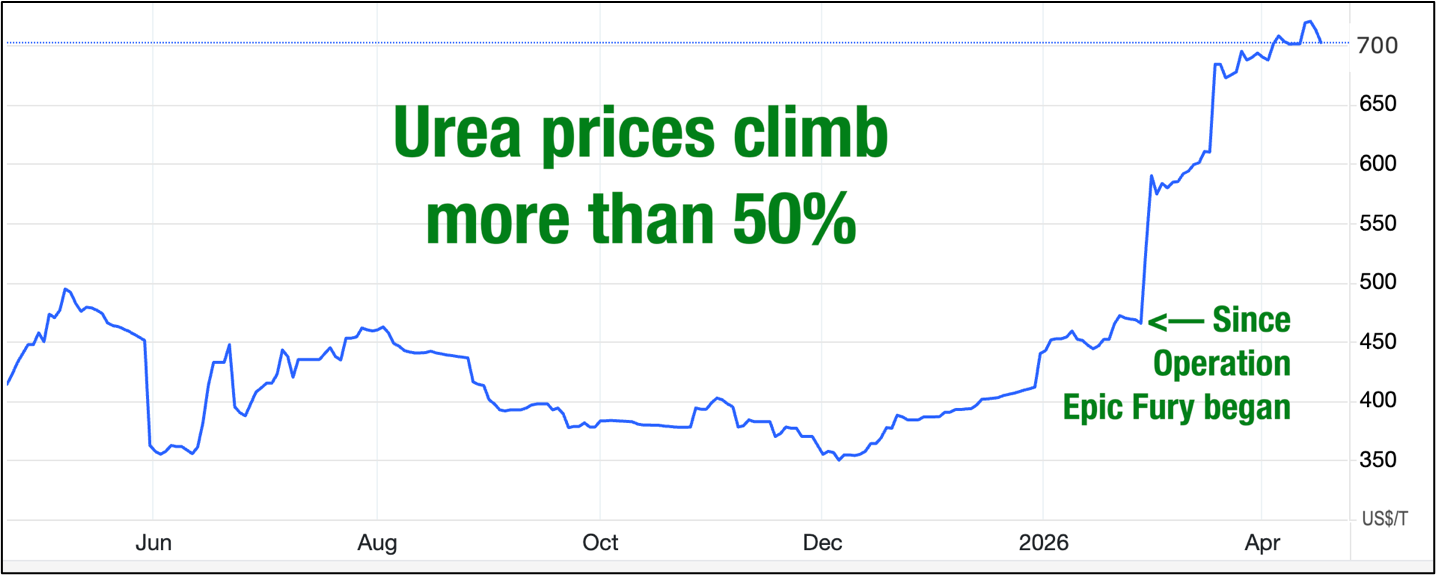
Urea is the world’s most widely used nitrogen fertilizer.
Indeed, a recent Farm Bureau survey found more than 70% of U.S. farmers cannot afford all the fertilizer they need.
This raises the specter of missed fertilizer-application seasons resulting in even lower future crop yields. And thus, even higher food prices down the road.
What this all boils down to is simple. Higher food prices are on the way.
And the longer the Strait stays blocked, the higher they’re going to go.
Already, I’d say there’s a decent chance they exceed the 11% surge we saw in 2022.
Indeed, the United Nations is warning of a global agrifood catastrophe if blockage of the Strait isn’t ended forthwith.
How to Fight Back
Because we all have to eat, there’s no way not to be exposed to galloping food prices.
But that doesn’t mean we meekly accept them.
There are a number of publicly listed companies that should do very well during periods of rising food prices.
You might consider investing in a few of them. In hopes of stacking up gains to offset — or even dwarf — your growing grocery bill.
Bunge Global (BG) is an agriculture company with businesses ranging from vegetable oil production to milling to grain and commodity production. It also produces sugar and ethanol.
The stock also did very well on both sides of the 2022 spike in food inflation.
Kroger (KR) and Albertsons (ACI). Even though they typically operate on very narrow gross margins, rising food prices actually bolster profits because customers shift to higher-profit in-house private-label brands.
Hershey (HSY). As a food product producer, HSY is fully exposed to rising food prices. But its dominant brand gives it unusual power to raise its selling prices as necessary — without imperiling sales or profits.
Deere & Co. (DE) is an industry-leading heavy farm equipment maker. But it also sells digital products using AI, machine learning, GPS, cameras and cloud connectivity to make farming more efficient — and reduce seed, fertilizer, chemicals and fuel costs.
For example, instead of spraying a whole field with herbicide, a product called “See & Spray” uses AI to identify individual weed plants scattered across a field of crops. And individually spot sprays them. Cutting herbicide usage, a whopping 50% to 75%.
These stocks are not recommendations. They are meant to be a starting point for doing your own research into building an anti-food inflation portfolio tailored to your specific circumstances.
For specific recommendations, you’ll need to hear about a group of stocks my colleague, Sean Brodrick, just identified.
He calls them the “Mag 7 Miners.” This is the only place to get the full list.
Best,
Bob Czeschin