 |
| By Michael A. Robinson |
All investors seem to talk about these days is AI or SpaceX. And for good reason.
The white-hot trends are upending the global economy and transforming everything from culture to politics and beyond.
And minting new fortunes along the way.
The top five contributors to the S&P 500’s outstanding earnings growth in the first quarter were all AI’s leading lights — Nvidia (NVDA), Alphabet (GOOGL), Amazon (AMZN), Meta (META) and Micron (MU).
All but Meta are currently “Buy”-rated by Weiss.
But another golden opportunity is emerging in a sector that's been mostly ignored, until recently.
I'm talking about biotech.
Biotech was the single biggest sector story in the Russell 2000’s late-June reconstitution.
Out of 237 companies added to the small-cap index, 87 were healthcare related. That was more than double the number of technology (35) additions.
And of the 17 IPOs added to the Russell 2000, eight are in healthcare.
Now, healthcare is the word they use. But coupled with AI, the opportunity is much bigger than that.
How much bigger?
From weight loss and heart disease to the most stubborn and deadly cancers, new treatments are emerging from clinical trials that are helping solve some of humanity's greatest health challenges.
Call it the Golden Age of Biotech.
Slowing a Silent Killer
On May 31, researchers with Revolution Medicines (RVMD) revealed incredible Phase 3 results for their breakthrough cancer drug at the annual meeting of the American Society of Clinical Oncology.
The conference crowd erupted in cheers.
The once-a-day pill, daraxonrasib, doubled survival time for patients with advanced pancreatic cancer, from less than seven months on a current chemo schedule to 13.2 months.
It also lowered the risk of death by 60%.
Pancreatic cancer is called a “silent killer.”
Symptoms often go unnoticed until it’s too late. Once it spreads, just 3% of those diagnosed are alive five years later.
RevMed’s drug targets the gene mutation called KRAS, which is found in over 90% of pancreatic cancers.
KRAS works like an on/off switch that controls how cells grow.
It causes that switch to remain “on,” which allows the cancer cells to flourish and spread.
Unlike older inhibitors that bind to proteins in the "off" state, daraxonrasib works like a “molecular glue” that binds to the proteins while they are active and driving cancer growth.
Side effects have been minor — just 1.2% quit the drug from side effects versus 11% on chemo.
Analysts think the market for pancreatic cancer by itself could be north of $10 billion.
But this drug has even bigger potential.
That’s because the KRAS mutation is also found in lung, colorectal, ovarian, kidney and gastric cancers. And RevMed already has three more similar RAS inhibitors in trials.
But that’s just the start …
A Surge of New Drugs
Take weight loss.
Eli Lilly’s (LLY) new drug, retatrutide, showed a 28.3% reduction in average body weight at 80 weeks in its Phase 3 trial.
Compare that to blockbusters like Zepbound (about 22% at 72 weeks) and Wegovy (about 15% at 68 weeks).
Morgan Stanley thinks the obesity drug market could more than double from $79 billion last year to $190 billion by 2035.
Then there’s heart disease, the leading cause of death in America.
The global heart drug market is expected to grow from $157.8 billion last year to $214.9 billion by 2034.
Last June, Merck (MRK) released results showing its Phase 3 drug cut bad LDL cholesterol by almost 56%.
It can be taken as a pill, potentially disrupting the injectable incumbents after it gets final FDA approval.
Then more recently, Lilly reported that a single IV dose of its CRISPR treatment lowered LDL cholesterol by as much as 62%, with effects lasting past 18 months.
You can think of it as one-and-done gene edit for cardiovascular disease … a treatment that was science fiction a few years ago.
Meanwhile, researchers at the Mayo Clinic used an AI model to find 73% of pancreatic cancers on routine CT scans 16 months before doctors found them.
The idea is that if you can catch the silent killer early, the whole survival math changes.
How to Play It
After three brutal years in the wilderness, biotech is back.
The broad sector as tracked in the SPDR S&P Biotech ETF (XBI) is up 90% over the past year.
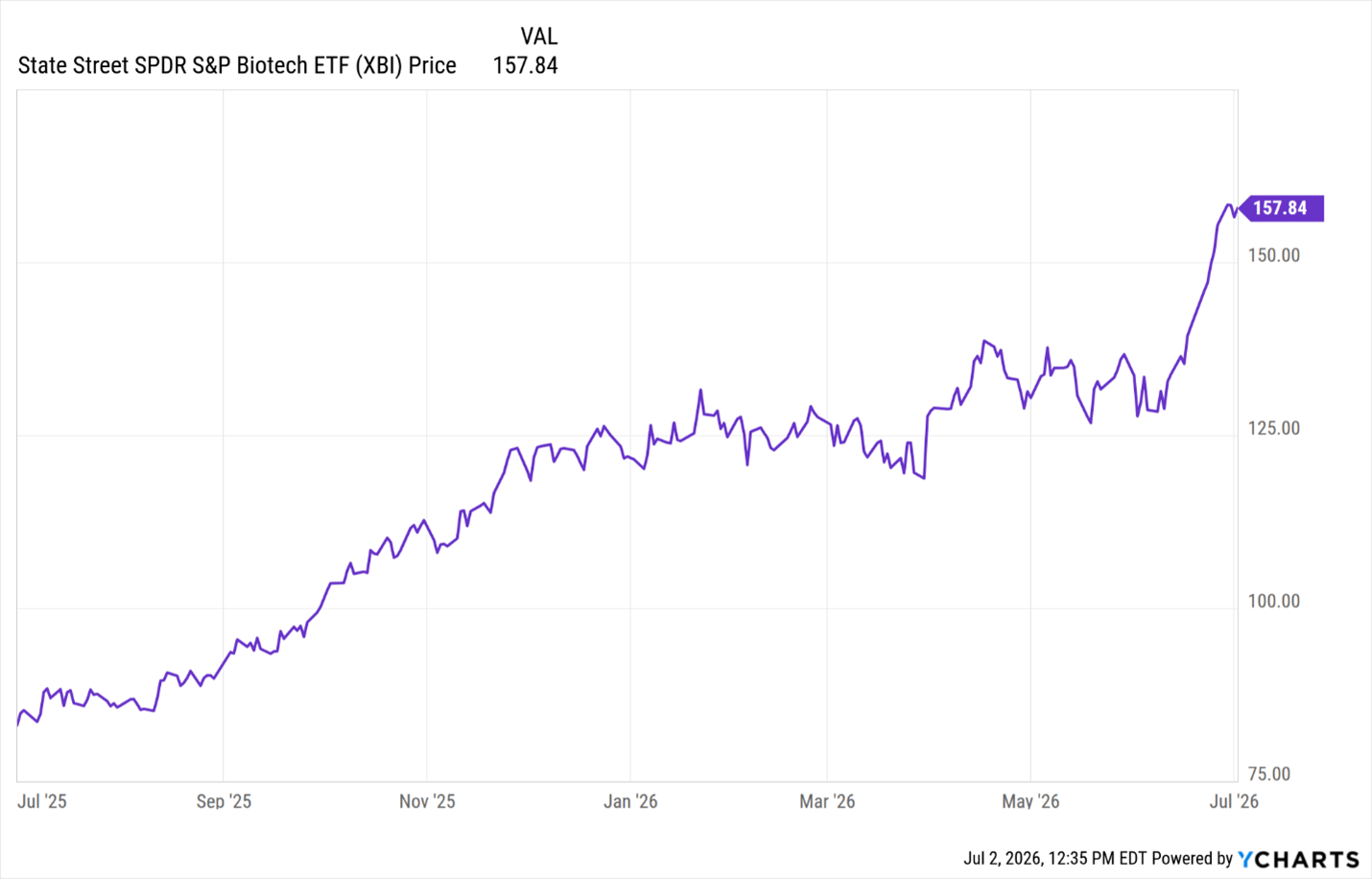
Two forces have been driving the rally.
- An M&A wave at decade highs as Big Pharma scrambles to replace patent cliffs.
- AI collapsing drug discovery timelines from years to months.
Yet with all the oxygen going to AI and SpaceX, plenty of investors still treat biotech as an afterthought.
Best,
Michael A. Robinson
P.S. Dr. Martin Weiss has been tracking this story since well before biotechs started rallying. And he just shared what he recommends you do now.