How to Play the Next $75 Billion AI Boom That Fits in Your Pocket
 |
| By Michael A. Robinson |
Elon Musk recently shot down rumors that SpaceX (SPCX) is building its own iPhone-like device as "utterly false."
But a closer look at the fine print in media reports on the prototype reveals a hot new trend I've been telling you about.
A trend Grand View Research expects to grow from a $10.7 billion market last year to $75.5 billion by 2033.
Of course, I'm talking about on-device AI.
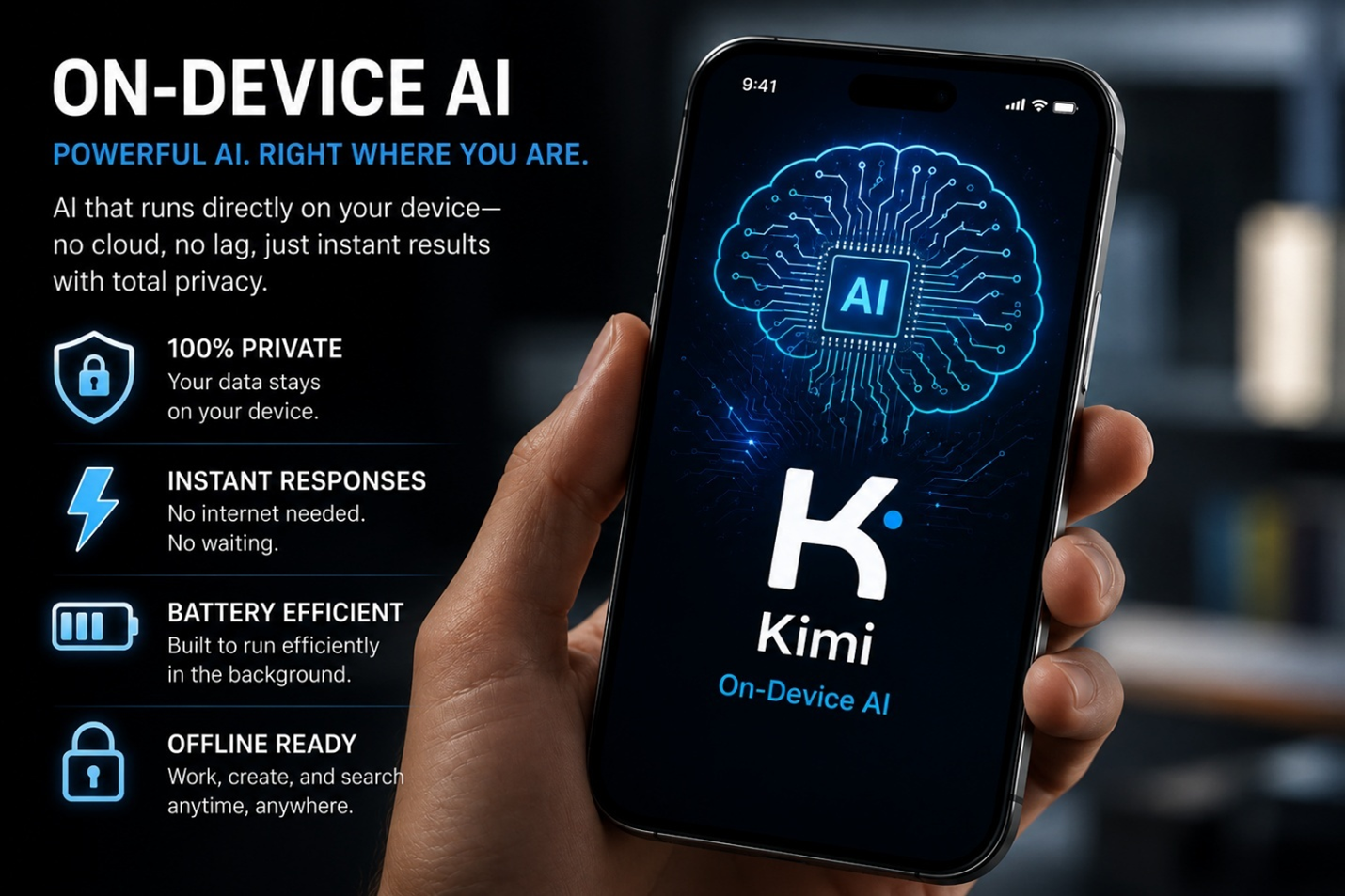
On-device AI is fast becoming a crucial next phase in the multitrillion-dollar AI Supercycle that’s underway.
Why Investors Should Watch This Tech Closely
Everyone else is talking about data centers.
Meanwhile, AI is spreading from the data center to the phone in your pocket.
And unlike your Siri or Alexa apps, which can play your music and give you travel directions …
On-device AI has a whole world full of real-world uses.
And potentially out-of-this-world ones.
The Wall Street Journalrecently reported that SpaceX is working on a prototype "slimmer" than an iPhone.
It would run SpaceX's operating system and xAI's models.
And the device would reportedly use special chips from an American manufacturer built for the age of on-device AI.
Here's why that last detail is so important …
Enter the NPU Revolution
Whether SpaceX ever ships a single phone, does not matter here.
What does matter?
The chip tech behind it is what will make on-device AI a must-have — not just some cool app or buzzy new feature.
I won’t keep you in suspense here. I’m talking about Qualcomm (QCOM)’s Snapdragon chipsets.
They contain a slice of silicon called an NPU, or neural processing unit.
You can think of an NPU as a small AI engine that lives next to the main processor, built to run AI models on the device itself, instead of in some distant data center.
I'll explain exactly why that matters in a second. What’s more important is that …
The Tipping Point Is Here
The NPU shift is hitting an inflection point right now.
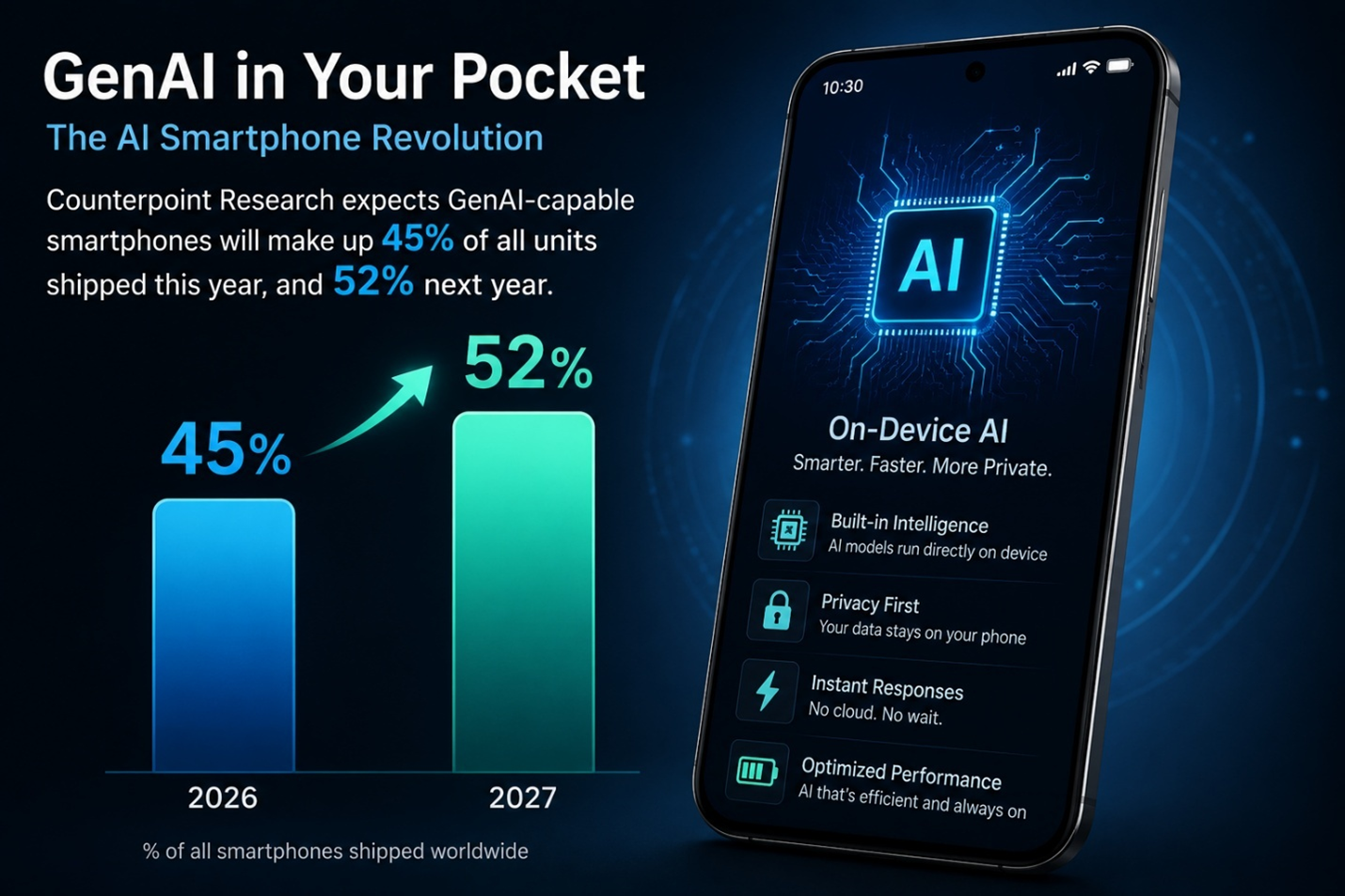
Counterpoint Research expects GenAI-capable smartphones will make up 45% of all units shipped this year, and 52% next year.
Two years ago, they were roughly a tenth of the market. In other words, in a couple years, AI-ready silicon went from a premium curiosity to nearly half of every phone sold.
And it's not just phones.
IDC projects that by 2028, 94% of all PCs shipped will carry a dedicated NPU.
Microsoft (MSFT) already requires 40+ TOPS of NPU muscle just to slap its "Copilot+ PC" badge on a laptop.
That single spec forced NPUs onto every chipmaker's roadmap.
Qualcomm's latest Snapdragon X2 Elite Extreme, unveiled at CES this spring, packs an 80 TOPS NPU.
That’s nearly double the prior generation.
Laptops from Asus, HP and Lenovo are already shipping.
On phones, the Snapdragon 8 Elite Gen 5 runs compressed AI models at roughly 220 tokens per second.
That allows your on-device AI to write at paragraph-length almost instantly.
It processes data right on your device for fast, private AI responses, even when you’re offline in airplane mode.
Your prompts, texts and private files never leave your device, making it more secure from hackers or corporate servers that want to “listen in.”
And your private data isn’t shipped to the AI firms to train their models.
So What Do NPUs Actually Do?
TOPS stands for "tera operations per second," or trillions of simple math operations.
AI inference mostly involves huge amounts of multiplication and addition.
So an NPU is built to chew through that math cheaply, without draining your battery.
But latency is also key.
On-device inference responds in under 20 milliseconds. A round trip to the cloud takes 200 to 500 milliseconds.
Why does that matter? Human perception treats anything under about 100 milliseconds as instant.
At cloud speeds, AI is something you tap and wait for.
At NPU speeds, AI can run a live translation during a call, a camera that understands what it sees in real time, or an assistant that responds before you finish the thought.
And because of the physics, the cloud can never close that gap.
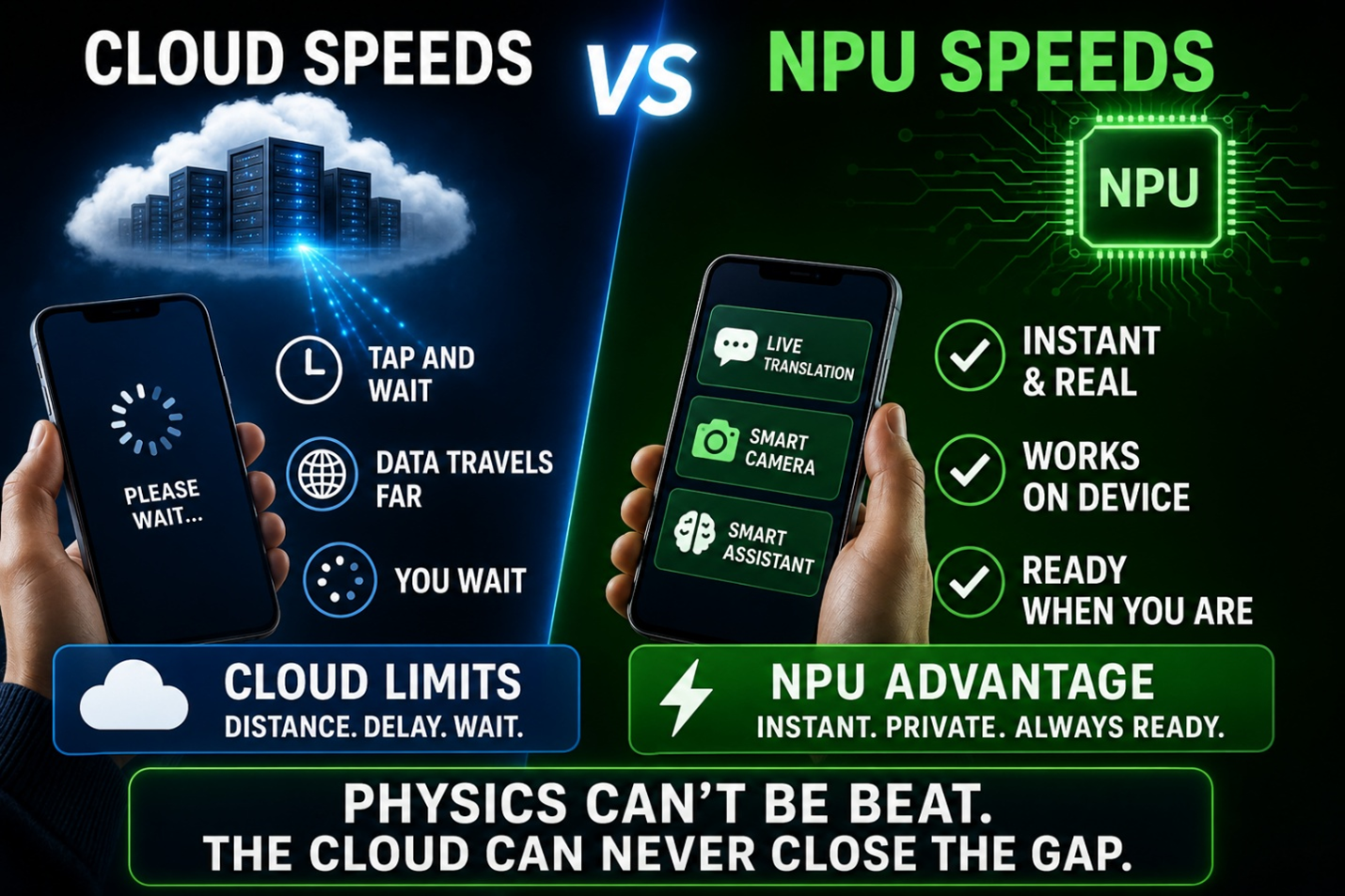
Speed-of-light round trips plus server queues put a hard floor under cloud latency.
That makes the NPU a separate, must-have layer of the AI stack, not a cheaper substitute for the cloud.
To be clear, your phone won't replace the data center. Big jobs still get sent to the cloud.
The real-world setup is hybrid: a router on the chip decides, in an instant, whether a task runs locally or sent upstream.
Either way, that router lives on the NPU.
It's Not Just the Chips Getting Smarter
The hardware isn't the only thing improving.
This month, Chinese lab Moonshot AI released Kimi K3.
It’s an open-weight model the company claims is roughly 2.5 times more efficient than its predecessor. That’s thanks to new tricks in how it handles attention.
Those same tricks that make a model cheaper to run at scale are what let engineers shrink it to fit on a phone chip.
The winners in on-device AI will be whoever pairs the leanest models with the most capable NPU.
If you’re looking for something to invest in, there are several ideas closer to home.
Who's Building & Who Gets Paid
The AI behemoths are already all-in.
Apple (AAPL) has made its Neural Engine since 2017.
Its new M5 chips go further. With these, it puts neural accelerator chips inside every GPU core.
Samsung (SSNLF) claims its new Exynos 2600 — the industry's first 2-nanometer mobile chip, debuting in the Galaxy S26 — is a 113% jump in AI performance from its prior chip.
Apple and Samsung build chips for their own devices.
Meanwhile, data center king Nvidia (NVDA) is making its own splash.
Its new RTX Spark superchip is co-designed with Taiwan-based MediaTek.
It puts 1 petaflop (a one followed by 15 zeros) into slim Windows laptops from Dell, HP and Microsoft.
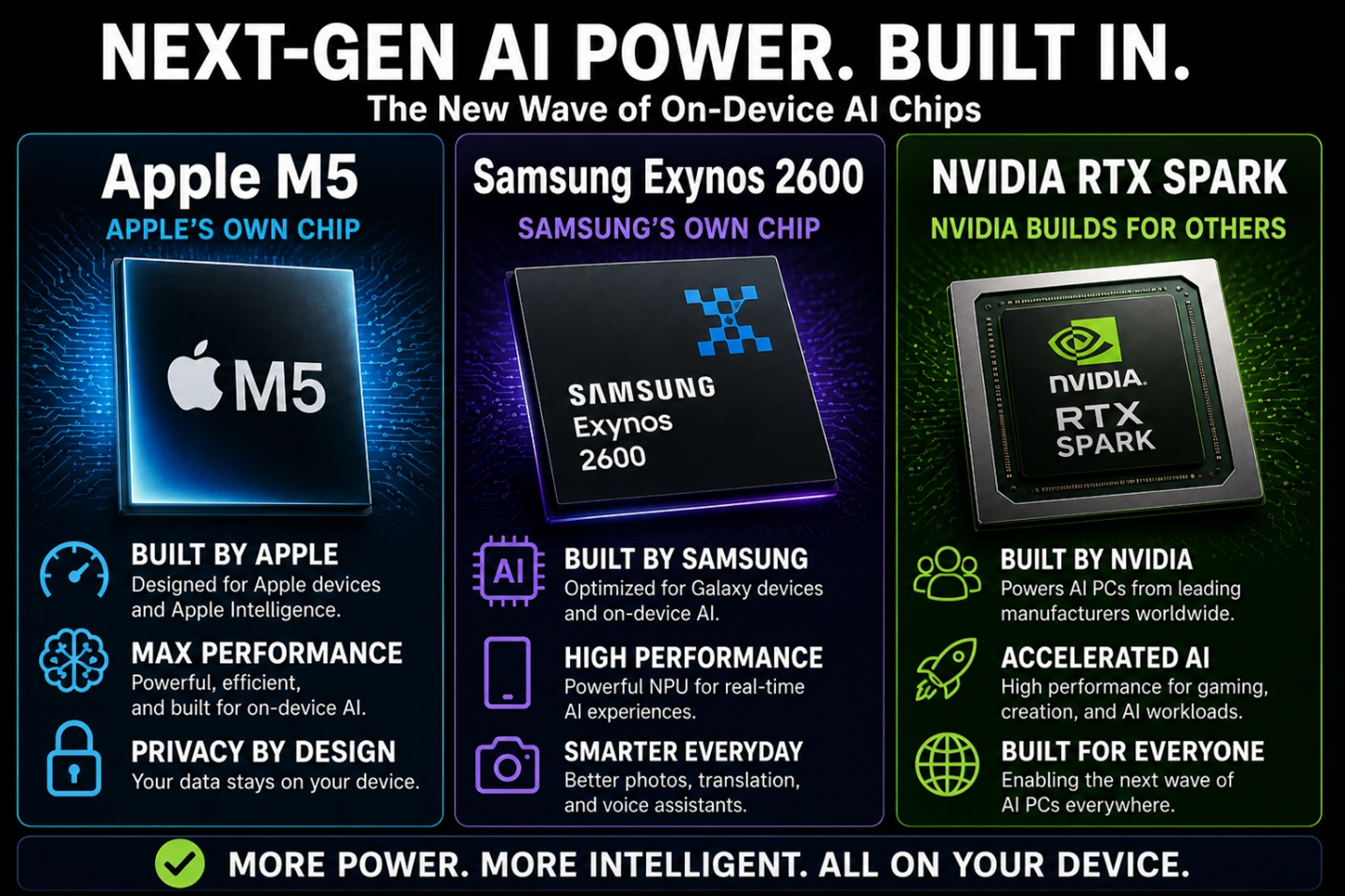
Rather than bet on any single one of these advanced chips to “win,” I prefer a good picks-and-shovels play.
In this case, that’s Qualcomm.
Whether it’s Android phones or Copilot PCs, they turn to the same Snapdragon layer.
That’s true no matter which AI app or model you use.
The Bottom Line
Musk may be right that SpaceX isn't building a phone. It doesn't matter.
Soon, most new devices will require an NPU to compete.
That's the mark of a true platform shift.
A $10.7 billion market growing sevenfold by 2033 …
Riding inside nearly half the phones …
And, soon, almost all the PCs sold on Earth …
That's not a feature.
That's the next phase of the AI Supercycle. Hiding in plain sight in your pocket.
Best,
Michael A. Robinson
P.S. Musk’s SpaceX does this a lot. It brings attention to new technology. And others ride the wave higher.
That’s why I was so interested when he announced “Project Unlimited.” And I found the companies about to profit from it.
1https://www.wsj.com/tech/ai/spacex-showed-investors-prototype-of-elon-musks-new-ai-device-b445c57b