How to Play the Sixfold Increase in Quantum Funding

 |
| By Chris Graebe |
Just a few years ago, quantum computing was little more than a science experiment.
The math checked out on paper. But actually building a useful system — let alone a commercially viable one — was a pipe dream.
Just one of those quantum chips could solve certain problems in mere minutes that even our most advanced computer chips would need years to accomplish.
This is the power of quantum computing.
Too bad we’re still years away from harnessing this power …
Right?
At the start of 2025, Nvidia’s (NVDA) CEO claimed we were still 15 to 30 years away from making “very useful quantum computers.”
Then, just a month later, Microsoft (MSFT) unveiled its Majorana 1 quantum chip.
This first-of-its-kind chip taps exotic particles through a novel architecture that Microsoft claims will soon set the standard for error-resistant computation.
Nvidia’s CEO has since amended his statements and now thinks we are a matter of years — not decades — away from quantum utility.
And these weren’t empty words — Nvidia has now joined the race and has its own quantum research lab up and running.
Almost overnight, quantum has exploded.
2026 feels like the inflection point — not just hype, but the moment the technology starts catching up to its promise.
The CHIPS Act
Microsoft, IBM (IBM) and Alphabet (GOOGL) have been betting on the future of quantum for years.
But it’s not just the blue-chip companies making strides.
A burgeoning ecosystem of startups is pushing the technology further and earning billions in funding in the process.
On Sept. 8, the U.S. government finalized agreements to pay three quantum computing startups $100 million each in exchange for a minority stake.
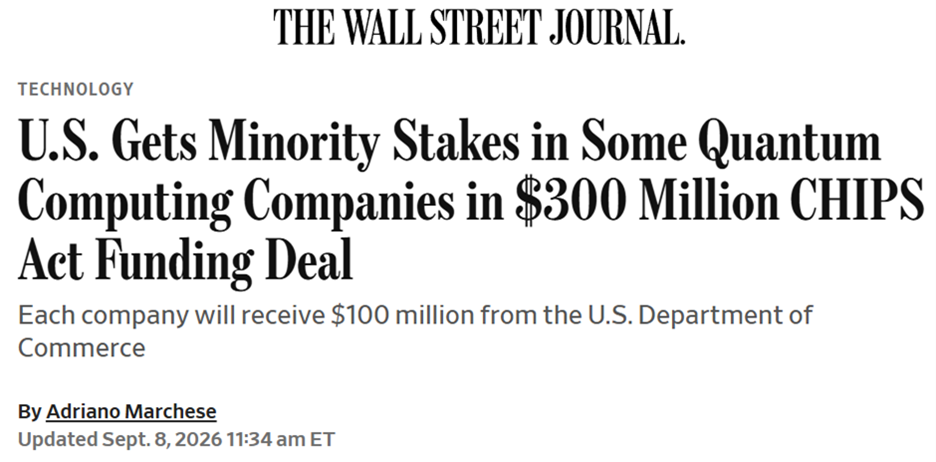
This was done under the banner of the CHIPS and Science Act, which aims to bolster domestic semiconductor research and manufacturing.
It’s worth noting that the CHIPS Act was never intended to fund quantum technology.
Its initial purview was limited to traditional transistor chips with the goal of a more resilient and competitive domestic market.
However, in response to quantum computing’s momentum, the administration extended the legislation's reach to include it.
It's a mark of real confidence — and a sign the technology has evolved enough to justify it.
Three small companies are already set to receive funding for their quantum development …
The Companies
Each of the recipients of the CHIPS funding takes a distinct approach to quantum computing.
They all aim to master the incredibly complex, cutting-edge wizardry of quantum chip manufacturing, but with unique methods and goals.
Quantinuum (QNT) focuses on trapped-ion qubits, a technology known for being the most precise approach available today.
These chips offer the highest quality results per qubit with the fewest errors.
The company went public on June 4 of this year, raising $1.68 billion.
The market responded to Quantinuum’s capital influx with a 3.9% increase in its stock price.
D-Wave Quantum (QBTS) makes a simpler type of quantum computer specially designed for a narrow range of in-demand problems.
Its sights are set on real-world business problems like scheduling, logistics and materials.
D-Wave made the first commercial sale of a quantum computer in history to Lockheed Martin in 2011.
After the CHIPS Act news broke, D-Wave’s stock price jumped 5.4%.
Lastly, Rigetti Computing (RGTI) makes supercooled superconducting circuits using a similar approach to Google and IBM.
It launched its Cepheus-1 system this year and has teamed up with Nvidia to link its systems to Nvidia GPUs.
Rigetti saw the biggest gain, its stock rising 7.4% following the funding announcement.
How to Invest in Quantum
Quantum computing today has limited commercial value. Current systems still don’t outperform classical computers on any task any business actually needs solving.
And yet …
Over 300 companies globally have adopted it.
Quantum startups earned $12.6 billion in funding in 2025 — 6.6 times more than the year before.
And the entire quantum computing market is projected to double by 2028, according to QED-C.
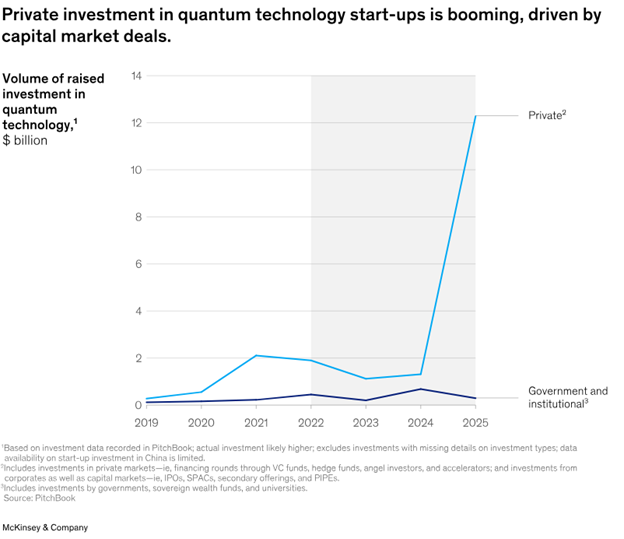
We can see the billion-dollar problems right in front of us.
We know, based on physics, that quantum computing is the best way to solve them.
Now it’s just a matter of designing and refining the incredibly complex systems that will make it all possible.
This is the bet investors make when they invest in quantum.
Quantum stocks trade on roadmaps and government contracts, not earnings.
Given that uncertainty, the smartest approach isn't picking one winner — it's spreading exposure across the industry.
Quantum ETFs bundle shares of multiple quantum computing companies — pure plays, diversified giants and quantum-adjacent suppliers — into a single investment.
The main appeal here is diversification.
Since it's genuinely unclear which company or technology will ultimately win, an ETF spreads your bet across the sector rather than concentrating risk in one speculative name.
Defiance Quantum ETF (QTUM) is the top dedicated quantum technology ETF.
It launched in 2018 and currently manages $5.6 billion in total net assets from around 86 companies.
But a better way to play this quantum boom is to find the next major startup before it goes public.
I am about to tell a small group of investors about a pre-IPO quantum-assisted cybersecurity play. Get the full scoop here.
Happy hunting,
Chris Graebe
2https://www.mckinsey.com/featured-insights/charts/quantum-investment-surge