Own the AI Chip Boom Today, With Robots as Upside
 |
| By Michael A. Robinson Reviewed by: Nick Stern |
At my local hardware store, a clerk recommended an odd-looking wall anchor for making a repair in my wife's closet.
Naturally, I asked just how it would work. His response stunned me. “Go home and watch a YouTube video,” he said.
Gee, thanks for nothing.
Then again, I admit I've learned quite a few things from watching instructional videos.
Whether it's replacing a toilet valve, installing a ceiling fan or repairing a gas fireplace, there's a good chance you'll find a video that shows you exactly what to do.
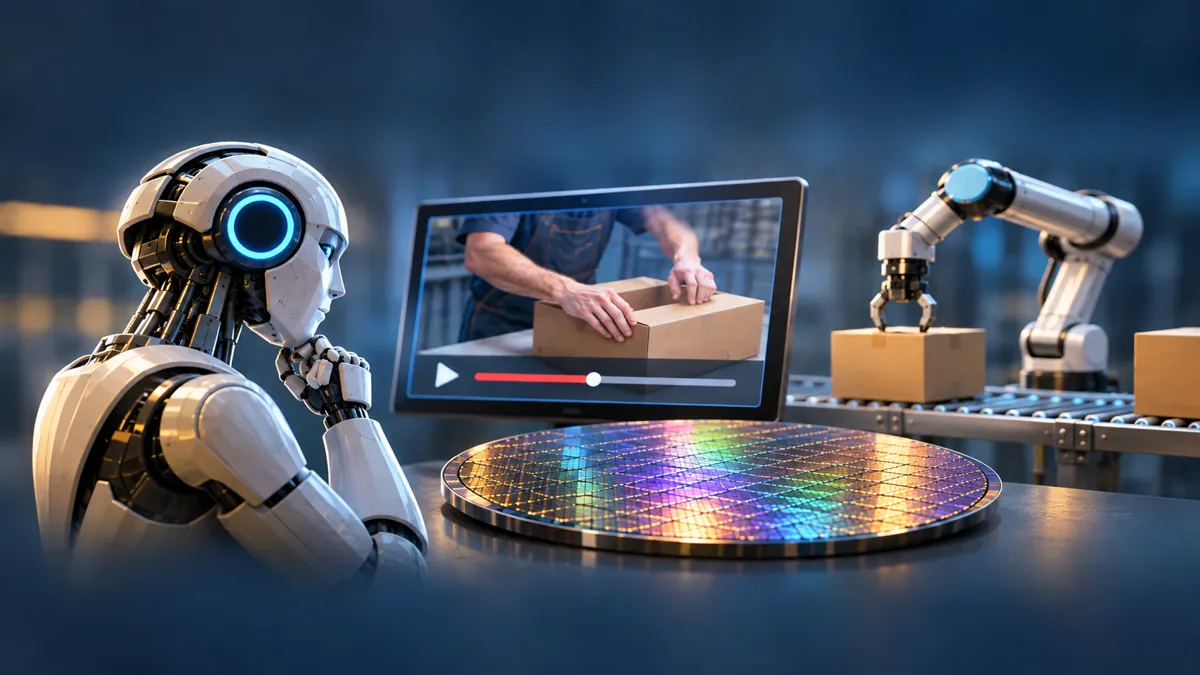
Turns out humans aren't the only ones who learn by watching videos. Robots are getting into the act, too.
In fact, a startup recently unveiled an AI system that can teach robots unfamiliar tasks by showing them a video of a human performing the job.
It's still early in this trend. But this breakthrough could have a profound impact on the $42 billion industrial robotics market.
And I've found a way to play it with a stock boasting explosive earnings growth …
Watch and Learn
The company behind the breakthrough is Pittsburgh-based Skild AI, a partner of artificial-intelligence powerhouse Nvidia (NVDA, “B-”).
Skild recently introduced a system called S1 that helps robots learn unfamiliar jobs from video demonstrations. That's a radical departure from traditional robotics.
For decades, engineers have had to program robots with detailed instructions: move here, grab this, turn that, etc.
When a factory changes a task, the robot often needs new programming. Skild's approach could simplify the process enormously.
Show the machine a video of someone doing a job, and its AI works out how to perform it.
Skild has demonstrated robots making pancakes, preparing coffee and potting plants. In one test, a robot learned an unfamiliar task in just 11 minutes.
And there's evidence the approach works.
In tests involving unfamiliar tasks, Skild's system successfully completed individual steps 66% of the time, versus just 9% for a competing AI approach.
That's more than seven times better.
Granted, the technology is still young. A two-thirds success rate isn't enough for many factory jobs.
But imagine teaching a robot a new task by showing it a video instead of paying engineers to rewrite its instructions.
That could make automation practical for thousands of additional businesses.
The Robot Revolution
I've followed robotics for decades. I first encountered industrial robots in Detroit's auto industry in the early 1980s.
Back then, they were mostly mechanical arms that welded car frames or moved components. They performed the same programmed movements, over and over.
Today, robots are everywhere. They vacuum our homes, clean swimming pools, and mow lawns. And that's just the beginning.
In factories, robots assemble electronics, inspect products, and package goods. In warehouses, autonomous machines carry inventory and move heavy supplies.
Other robots work alongside employees, handling repetitive tasks while people focus on more complicated jobs.
The market is expanding quickly.
Grand View Research expects global industrial robotics sales to reach nearly $42 billion this year and approach $79 billion by 2033.
That's nearly double in seven years.
And if robots become easier to teach, businesses that previously considered automation too complicated or expensive may finally take the plunge.
Which brings me to a company already supplying the machines they need.
A Chip-Testing Leader with a Robot Business
That company is Teradyne (TER, “C+”).
Based in Massachusetts, Teradyne has helped manufacturers automate operations for more than six decades.
Founded in 1960 by two MIT classmates, it became a leader in automated testing equipment that checks whether electronic components work properly.
Today, that includes sophisticated semiconductor chips powering AI data centers.
Teradyne also has a substantial foothold in robotics.
Through two subsidiaries, Universal Robots and Mobile Industrial Robots, it sells machines that businesses can deploy today.
Universal Robots makes collaborative robots, or "cobots," designed to work alongside people under appropriate safety conditions. These machines can assemble products, load equipment, and package goods.
More than 75,000 have been deployed worldwide, with customers including Ford (F, “D+”), L'Oréal (LRLCY, “B-”) and Stellantis (STLA, “E+”).
Mobile Industrial Robots, meanwhile, makes autonomous machines that transport supplies through factories and warehouses. Some can move loads exceeding 2,600 pounds — roughly the weight of a small car.
Together, these businesses position Teradyne to benefit as companies automate both production tasks and material handling.
An Earnings Powerhouse
Teradyne isn't ignoring the AI revolution.
Like Skild, it's working with Nvidia — using advanced computing to improve robots' vision, planning and movement.
That doesn't mean Teradyne's robots already learn from Skild's videos.
It does mean Teradyne is investing in the same broader shift: machines that can handle more complex jobs with less rigid programming.
Meanwhile, Teradyne's established semiconductor-testing operation is producing impressive results.
In the second quarter, companywide revenue reached $1.33 billion, more than double the $652 million recorded a year earlier.
Earnings per share jumped from 49 cents to $2.38. Much of that surge came from semiconductor testing, rather than robotics.
Robotics is still a small part of sales, about 7%, so the real engine today is chip testing.
But that's precisely what makes the opportunity interesting. Investors gain exposure to the AI chip boom today, plus the potential upside of wider robot adoption tomorrow.
And analysts expect the earnings momentum to continue. Current forecasts call for per-share profit growth of roughly 133% this year.
Of course, that pace won't last forever. So, let's use a more conservative assumption: annual earnings growth of 24%, the three-year average cited in my research.
At that rate, earnings would double in just over three years. And remember, as earnings grow, stock prices often do, too.
With AI transforming both chip manufacturing and industrial automation, Teradyne has two powerful growth engines.
And as robots learn to do more simply by watching us, I expect the demand for smarter automation to keep growing.
Best,
Michael A. Robinson