 |
| By Michael A. Robinson |
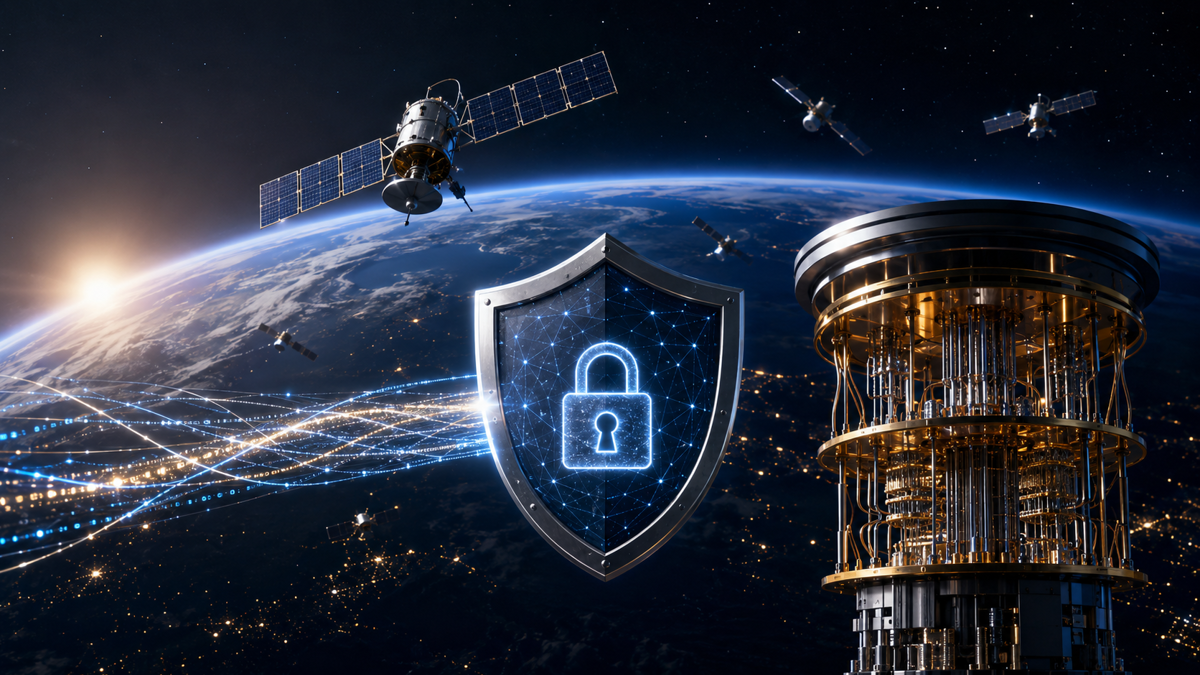
SpaceX (SPCX) pulled off the largest IPO in history last month, raising roughly $86 billion and minting a new mega-cap whose Starlink service pairs rockets with a satellite network.
And while space stocks have come back to earth after SpaceX’s IPO, the sector is expected to grow to a $1.14 trillion market by 2034 from $652 billion this year.
We’re going to see interest rise again. In fact, Sean Brodrick expects that very soon.
At 2 p.m. Eastern today, he’s going to take part in a special event on the subject.
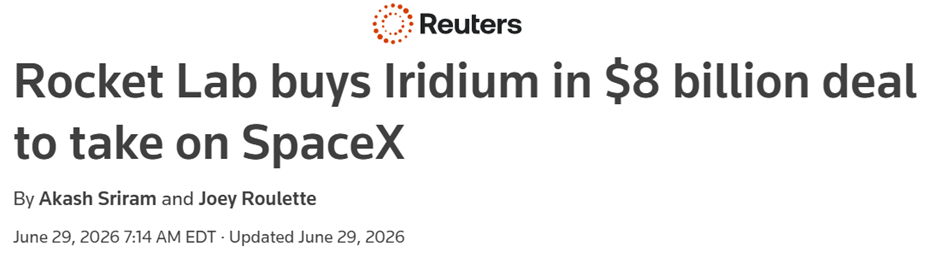
Recently, Rocket Lab (RKLB) said it's going to buy Iridium Communications (IRDM) for $8 billion at a 24.1% premium.
The move is widely seen as mirroring SpaceX’s playbook to vertically integrate its space tech operations.
Rocket Lab already designs, builds and launches spacecraft and rockets.
Yes, adding Iridium brings Rocket Lab a profitable low-earth-orbit (LEO) satellite network, global spectrum in the L-band and 2.5 million+ government, defense, aviation and maritime subscribers.
But Iridium’s real value is a lot more than just its bandwidth … it’s also about trust.
Its customers pay for links that can't be intercepted, spoofed or faked.
Indeed, cybersecurity has become an urgent issue for digital comms across the board.
That’s because a powerful new computing technology is poised to disrupt the entire field …
‘Harvest Now, Decrypt Later’
Your bank account login, your medical records, your crypto wallet address … not to mention national security info.
All the most precious data we use every day is guarded by special encryption that keeps our secrets safe and hackers at bay.
But that protection is now at risk by quantum computing.
These computers can solve complex problems it would take current machines thousands of years to complete.
It’s why their potential to make new drugs and materials, advance AI and optimize logistics could unlock a $2.7 trillion market by 2035.
Here’s the problem.
That massive power could also hand quantum the ability to blast through our most advanced public key encryption.
The day that happens is known in the sector as Q-Day. And the date to get there keeps getting closer.
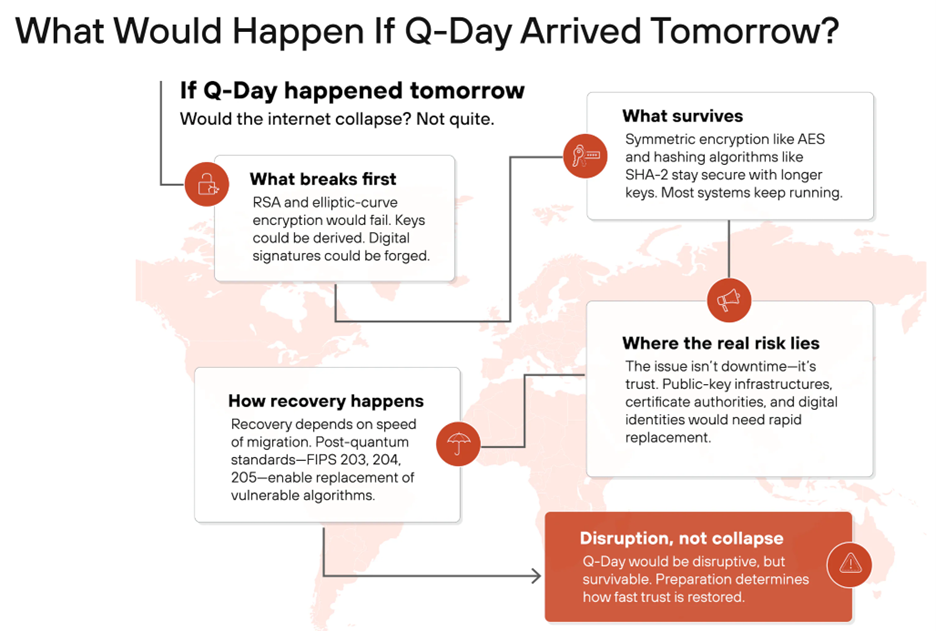
Some of the top quantum firms on the planet, including Google (GOOGL), Cloudflare (NET) and IBM (IBM), now expect we’ll reach Q-Day as early as 2029.
Meanwhile, hackers are already taking in encrypted data today (data that doesn’t tend to change that much over time) to unlock once the hardware matures.
Once captured, no future patch can un-expose it.
This process is known as “harvest now, decrypt later” and it’s what keeps every cyber expert up at night.
In fact, the Trump Administration recently said Q-Day could arrive as soon as 2028.
It’s why the President just issued a new executive order to speed up quantum security.

The order sets a Dec. 31, 2030 deadline for federal agencies to move their most sensitive systems to post-quantum standards, and a year later for post-quantum authentication.
Contractors will also have to comply with post-quantum standards by the end of 2030.
Why Space Is the Hardest Problem of All
Nowhere is the Q-Day cyber exposure longer-lived than in orbit.
Satellites, command systems and government data keep their strategic value for decades.
Intercept the traffic today and it’s still valuable when quantum matures.
An enemy could watch a group of satellites’ health, see which assets are used against which targets and map out ground stations across the fleet.
But the bigger danger is manipulation.
The same cryptography that keeps data private also makes sure commands are real and confirms telemetry hasn't been altered.
Break it and the military can't trust what's on their screens.
In an orbit crowded with 13,000+ active satellites and over 130 million debris fragments, forged tracking data could trigger the wrong collision-avoidance call … or none at all.
Worse, quantum enables the ultimate insider attack against our spacecraft.
Then there's the payload.
While nothing looks broken, a bad downlink could lead to a false missile-launch warning, the Navy chasing a ghost ship or a false crop report.
This is a real risk as the Golden Dome program leans on space-based detection.
And it could become the perfect gray-zone weapon — one that’s hard to detect or blame on China, Russia, Iran or North Korea.
The fix is to swap the right algorithms without replacing hardware. And to move to post-quantum standards ASAP.
Voyager Technologies (VOYG) and IBM have already shown a post-quantum-secured ISS-to-Earth link is possible.
And researchers have successfully tested that post-quantum algorithms can work on Iridium’s satellite links.
The Picks & Shovels
The cleanest exposure is the switch to post-quantum encryption itself.
STMicroelectronics (STM) has already shipped a post-quantum cryptography, or PQC, accelerated mobile chip.
The quiet enabler will win whichever quantum machine crosses the line first.
Among pure-plays, IonQ (IONQ) is a leader with over $3 billion in cash and one of the few names with positive sales.
Quantinuum (QNT), freshly IPOed, is a high-fidelity hardware name and now investable.
Quantinuum has brought three quantum computers to market over the past six years, with a commercial pipeline of over $5 billion.
For the space angle, Sean Brodrick has even more ideas … ones he’s about to share.
If you come to his 2 p.m. Eastern event, you’ll see where he’s looking.
Best,
Michael A. Robinson
2https://www.paloaltonetworks.com/cyberpedia/what-is-q-day
3https://www.cybersecuritydive.com/news/quantum-cryptography-white-house-executive-order/823530/