 |
| By Bob Czeschin |
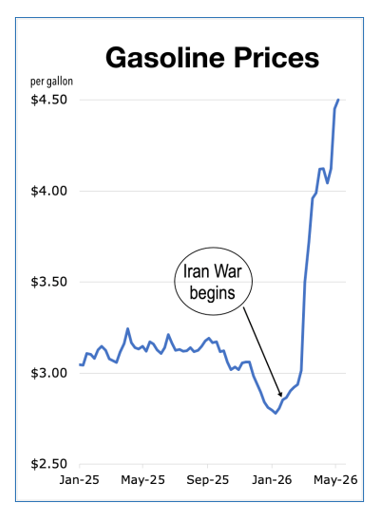
The summer driving season is fast approaching in the United States. And politically sensitive gasoline prices have just hit $4.50 a gallon for regular unleaded — with no hint of a top in sight.
That’s the national average. In California, the average price is $6.17.
For context, know this. Before the Iran War halted shipping through the Strait of Hormuz (the world’s most-famous maritime chokepoint), average gas prices across America were under $3.
Gas prices are politically sensitive, because most folks remember a time when $100 seemed like a lot of money.
That it’s now barely enough to fill up your tank … crystallizes years of pent-up frustration over relentlessly rising prices.
And it energizes consumers to look around for somebody to blame.
However, this is a bad time for potential voters to be in a foul mood.
Midterm elections are just six months away. And Trump’s Republicans have only a razor-thin majority in Congress.
If lost, this could effectively doom the Trump presidency.
Democrats have already promised a blizzard of investigations and re-impeachments to overwhelm his remaining months in office.
The White House appears unworried, at least in public, based on several key assumptions.
- The Strait can re-open by June.
- That this is enough time for global oil shipments to ramp up again.
- And for oil prices to stabilize at pre-war levels (under $70 a barrel), reversing the uptrend in gasoline prices before mid-term voting begins.
Sadly, the first two assumptions may be enormous “asks” right now.
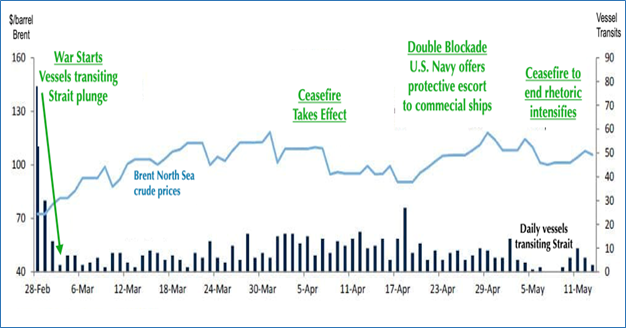
The chart below shows the impact of the Iran War oil prices (up 54%) and commercial traffic through the Strait (down 97%).
War Impact on Oil Prices and Strait of Hormuz Traffic
After massive material losses to aerial bombardment and a suffocating U.S. Naval blockade, it was said Iran could no longer pay its soldiers.
Which, in theory, would force Iran to the negotiating table. Until we learned:
- Tehran was quietly maximizing its new rail link to China to carry more crude.
- Fleets of unmarked cargo planes were also spotted flying in from Russia.
- Meanwhile, elite IRGC “shock troops” were still somehow getting paid.
And their grip on the Strait remains unshaken.
This makes it unlikely the U.S. Naval blockade alone can forcibly dislodge them.
Shock-and-Awe Invasion
Of course, the clearest path to a full reopening would be for the Pentagon to send in 100,000 ground troops to physically occupy Iran’s side of the Strait … and remove the regime in Tehran.
But Trump has refused to put U.S. boots on the ground in precisely the kind of foreign war he repeatedly railed against on the campaign trail.
Another possibility: One last air campaign that fully exhausts the Pentagon’s extensive target list.
After which, Trump can declare victory and order U.S. troops home.
He would hope the chaos unleashed sweeps away the IRGC, leading to a new government.
However, this would still leave Iran in unchallenged control of the Strait going forward.
If so, it could be quite a long time before risk-averse ship operators and marine insurers feel safe enough to return to the Persian Gulf in pre-war numbers.
Such a situation would be broadly similar to the Houthis attacking Red Sea shipping near the Bab el-Mandeb Strait (another famous maritime chokepoint).
As you can see below, Houthi attacks caused roughly a 60% plunge in Red Sea maritime traffic.
This eventually led to ferocious counterattacks by American forces (Operation Rough Rider).
Daily Traffic through Red Sea Maritime Chokepoint
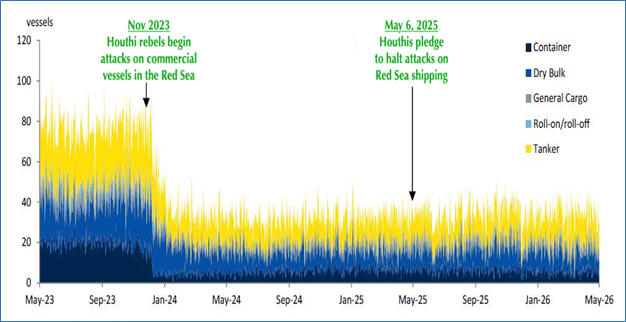
On May 6, 2025, President Trump announced a bilateral ceasefire and declared victory in the Red Sea.
The Houthis promised to stop shooting at U.S. vessels and disrupting commercial shipping.
So far, so good, right?
There’s just one problem. A full year has since gone by.
Yet, Red Sea shipping traffic still has not increased from pre-ceasefire levels. Because nobody trusts the Houthis
The same thing could easily happen if Iran remains in charge of the Strait of Hormuz, even if there’s a new government in Tehran.
Investment Implications
What all this boils down to is this. Don’t look for lower gasoline prices anytime soon.
And instead of railing at how much it costs the next time you top up your tank, why not get in on some of the action?
The VanEck Oil Refiners ETF (CRAK) invests solely in promising companies that earn at least 50% of their revenues from producing and selling gasoline, diesel, jet fuel, etc.
And as you can see, it’s having a great year …
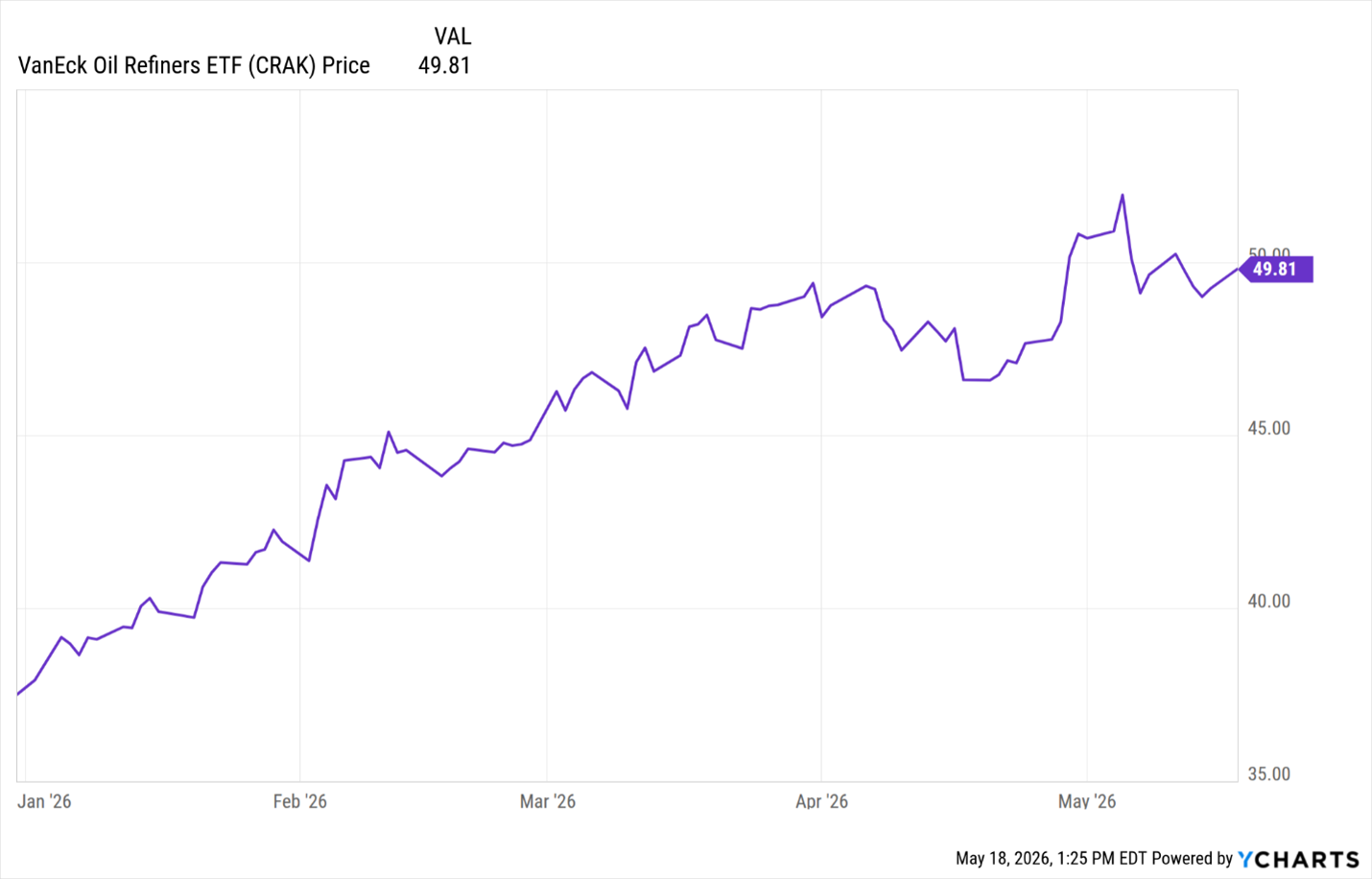
It’s up 33% since the start of 2026. But if gas remains higher for longer, that’s just the beginning.
Of course, higher gas prices will seep into nearly every other part of the economy.
Recent inflation data already shows the start of this.
With wages relatively stagnant, you might be looking for alternative places to make up the income you need to pay for these higher costs.
Fortunately, for a very limited time, Nilus Mattive is showing Weiss VIP members how to use his “Friday Income Machine.”
Last Friday, it produced income of $1,054. A similar payday should arrive this coming Friday, too.
Best,
Bob Czeschin