Stay 5 Steps Ahead of AI and Quantum-Powered Hack Attacks

 |
| By Bob Czeschin |
Computer security has always been an arms race. But in 2026, artificial intelligence and quantum computing have become force-multipliers.
And they’re shifting the balance of power decisively to the dark side.
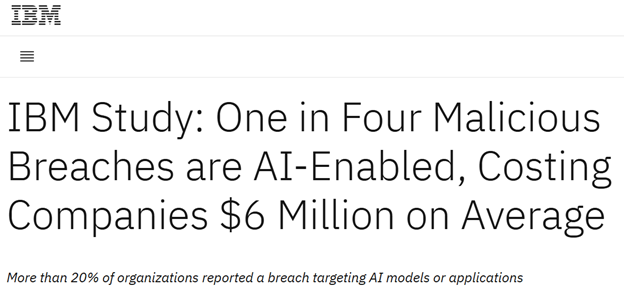
Roughly 1-in-4 reported malicious data breaches already involve attacker use of AI, costing victims $6 billion.
Attackers use AI in fiendishly clever ways:
Ultra-lifelike phishing and social engineering. Flawless, personalized emails, messages and websites. Without the grammatical errors that once served as warning signs.
Deepfake audio and video that make voice and video calls from “colleagues,” “bank representatives” or “family members” indistinguishable from the real thing.
Rapid identification of targets, with the most promising subject to almost immediate labyrinthine assault.
Scanning for, testing and chaining potential exploits is a time-consuming enterprise.
But now, what human hackers require days or weeks to do can now be accomplished in just hours at the speed of silicon.
Hunter-killer hackers who never sleep, operating with limited or no human supervision.
This has been the underlying, if officially unstated, dream of battlefield robotics, since the days of H.G. Wells, Isaac Asimov and George Lucas.
However, autonomous, opportunistic silicon soldiers will soon be the newest mercenaries of the hacker wars. Well before they hit any flesh-and-blood tactical frontier.
To be sure, defenders are also racing to deploy AI.
And those who do report lower breach costs.
But the near-term advantage still favors offense over defense.
That’s because offensive workflows compress more easily into autonomous processes than careful, organization- or system-wide defense.
And because attackers can focus their firepower on a single perceived weak spot.
Meanwhile, defenders typically have a whole organization to protect.
That’s both the threat and the opportunity.
Let me explain.
The Coming Cryptographic Reckoning
The promise of quantum is a big one.
One day, it stands to solve the complex problems that humans and even today’s supercomputers can’t.
Unfortunately, we’ll have to wait for all those drug discoveries and other breakthroughs we’ve been promised.
That’s because quantum is bringing major security challenges that will have to be addressed first.
- AI is disrupting digital security right this very moment.
- But quantum computing poses a mortal threat to the very foundations of digital trust.
Modern public-key encryption methods — RSA and elliptic-curve cryptography (ECC) — currently protect all secure internet traffic.
But bank websites, digital signatures, email encryption, software updates and the blockchain (which permanently stores trading and transaction data, among other uses) that operate “securely” now have an uphill battle ahead.
Why? Systems that are RSA- and ECC-protected rely on math problems. Ones classic computers cannot solve efficiently.
But quantum computers? Those could solve such problems rapidly. Or find computational shortcuts.
The Timeline for Quantum’s Arrival Is Also Shrinking
The good news is that no cryptographically relevant quantum computers yet exist.
Current machines are far too small and error-prone for practical attacks on RSA or equivalent systems.
However, frenetic global research efforts are fast compressing timelines.
Remember in January 2025 when Nvidia CEO Jensen Huang told investors that useful quantum computers are still about 20 years away?
Those comments sparked a quantum catastrophe for investors in stocks of quantum developers like Rigetti Computing (RGTI) and IonQ (IONQ).
Well, if the Q-Day clock is correct, we’re only two years away from quantum computers being strong enough to break the methods that protect digital data.2
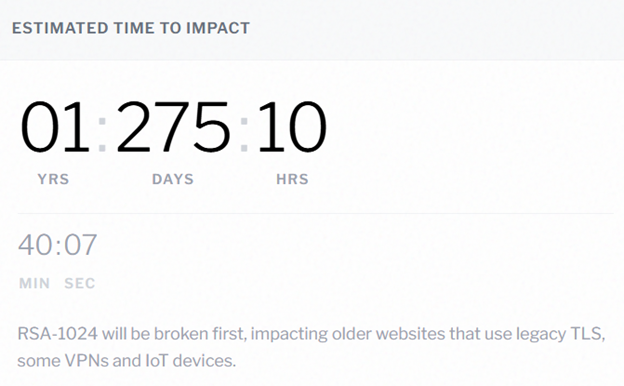
Not only is two years away closer than we think, but …
Hackers don’t need quantum computers today to make quantum a problem.
Sophisticated hackers are snatching and storing encrypted traffic and data today.
Not just garden-variety hackers, but also nation-state actors.
They can harvest sensitive data now. Then hold it until the technology exists to decrypt it later.
All they need is for quantum capabilities to sufficiently mature.
And whether that’s two years or even two months away, that day is coming.
So the time to start preparing is now.
How to Become a Tougher Target
Security can never be absolute.
But there are a few things you can do to make yourself less visible and more unattractive to would-be hackers.
- Prioritize strong, phishing-resistant authentication. Use passkeys or hardware security keys wherever available. Avoid SMS-based two-factor authentication.
- Treat unexpected communications from unknown sources with extreme skepticism. Especially those that create urgency or request money, credentials or remote access. Verify everything through separate channels.
- Keep software and devices updated. Lots of AI-accelerated exploits still rely on known vulnerabilities that nobody ever got around to patching.
- Use reputable password managers and unique credentials. Enable full-disk encryption.
- For high-value crypto or sensitive data, follow layered practices: hardware wallets for significant holdings, offline seed-phrase backups and separate risk tiers for different activities.
AI is already making computer security more difficult by increasing attack speed, scale and sophistication.
Quantum computing threatens the cryptographic foundation that makes digital commerce and communication possible.
Neither totally “wrecks” security overnight or renders careful practices useless.
But both raise the stakes and compress timelines.
Users who prevail despite steeply rising cyber threat levels will be those who never pass up new ways to strengthen authentication, updates, verification habits, cryptographic modernization and layered defenses.
All of which help convince the bad guys to leave you alone. And go bother someone else!
Best,
Bob Czeschin
P.S. Yesterday, startup specialist Chris Graebe shared news of a private company at the forefront of this race to defend from the bad guys to a small group of investors.
Fortunately, for a limited time, you still have a chance to hear about it directly from him … including how to join early investors BEFORE this frontier quantum defender ever goes public.