The Companies Cashing AI’s Checks Don’t Have a Money Problem

 |
| By Dawn Pennington |
Lately, the AI story has been all about money.
Who has it, who’s borrowing it and who might run out.
Those worries sent AI stocks tumbling earlier this month as investors started asking a simple question: Can the companies building AI actually afford it?
But follow that money to where it really goes, and the story changes.
Every dollar spent on AI ends up buying something physical: chips, memory, hard drives, cooling systems. And the companies making those parts don’t have a money problem.
They have the kind of problem every business wants: more orders than they can fill.
Memory chips are a good example.
Micron (MU), one of the world’s biggest memory chipmakers, just posted a record quarter. And its CEO says he can’t see when the shortage will end.
Nobody knows exactly what AI will turn into. But whatever it becomes, it will run in data centers. And every data center needs the same parts.
AI’s future is still uncertain. Its shopping list isn’t.
This week, we got a fresh look at how big that list is getting.
On Wednesday, Microsoft (MSFT) and Alphabet (GOOGL), two of AI’s biggest buyers, revealed how much they plan to spend.
The two expect to spend a total of $370 billion combined this year with both announcing accelerated spending in 2027.
That’s a lot of money. And it’s to buy all the things that go into data centers.
So let’s walk through a data center, layer by layer, and meet the companies filling those orders.
What’s Actually Inside an AI Data Center
Nvidia (NVDA) gets most of the glory.
Its GPUs steal the headlines, and plenty of people talk about AI as if it all lives inside that one chip.
But in reality, an AI data center works more like a body. The GPU might be the heart, but it’s only one organ.
It needs memory to hold the data it’s working on, networking to talk to thousands of other chips, storage to keep it all, power to run and cooling so it doesn’t cook itself.
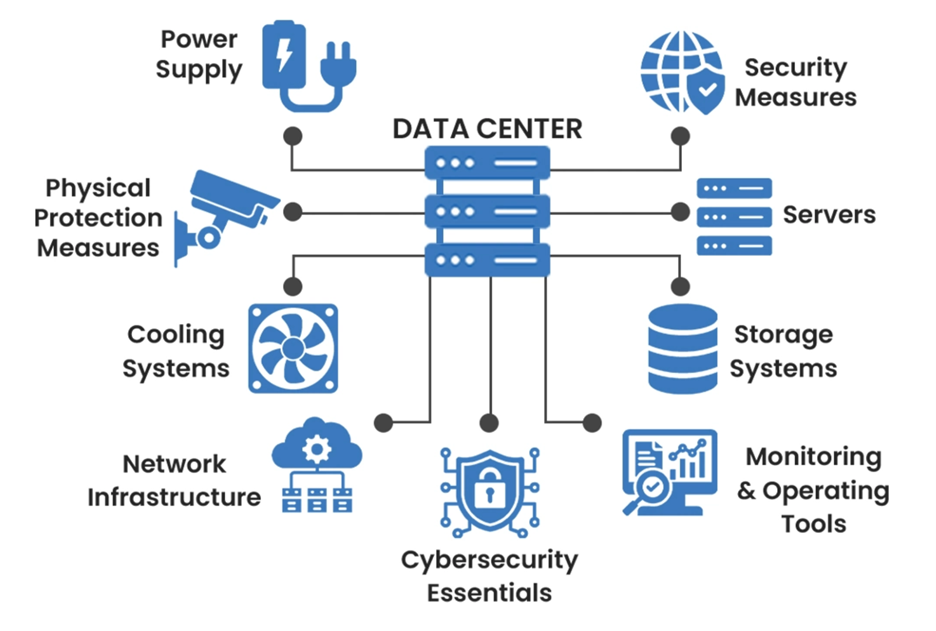
Take away any one of these, and the whole thing falls apart.
And none of this is pie in the sky. These are established companies with real customers, already on the market.
We’re talking about hardware with a barcode on it.
Within each layer, there’s a giant. These companies dominate their corner of the industry and sell to nearly every major AI player in town.
Yet they rarely make the front page.
You may never have heard of some of them, but AI doesn’t run without them.
The Brains: GPUs and the CPU Comeback
Let’s start with the chips doing the thinking. There are two kinds, and they work together.
The CPU, or central processing unit, is the manager. It hands out the work and keeps everything else in sync.
The GPU, or graphics processing unit, is the muscle. It was built for video games, where it crunches thousands of simple calculations at once to draw every frame on your screen.
And that turned out to be exactly what AI needed.
Back in 2012, researchers trained a breakthrough AI model on two off-the-shelf gaming cards.
Nobody had built a chip for AI yet, so the industry grabbed the most powerful tool already on the shelf.
It never looked back.
Today, the GPUs inside data centers have almost nothing to do with graphics. The industry often calls them AI accelerators.
Nvidia still dominates, with AMD (AMD) fighting for a bigger slice, while Alphabet, Amazon (AMZN) and Broadcom (AVGO) build custom AI chips of their own.
That’s the part of the story everyone knows.
Here’s the part most investors don’t.
Training an AI model takes armies of GPUs. But running that model for millions of people every day is a different job. It’s less about raw muscle and more about coordination.
And coordination is the CPU’s specialty.
Intel (INTC) has quantified it. Today’s training setups use roughly seven or eight GPUs for every CPU. As AI moves into everyday use, Intel expects that ratio to shrink to three or four.
AMD says that could eventually reach a one-to-one ratio.

In other words, for the same number of GPUs, the world could need roughly twice as many CPUs … or more.
If that plays out, the humble CPU could be one of the most underrated bets in AI.
Memory: The Biggest Shortage in AI
If there’s one thing AI can’t get enough of, it’s memory.
Every AI chip needs fast memory right next to it, and bigger models need more. But nearly all of it comes from just three companies: Micron, SK Hynix (SKHY) and Samsung.
And new memory factories take years to build. So when AI demand exploded, supply couldn’t keep up.
The result is a full-blown shortage.
Micron’s latest numbers look almost made up.
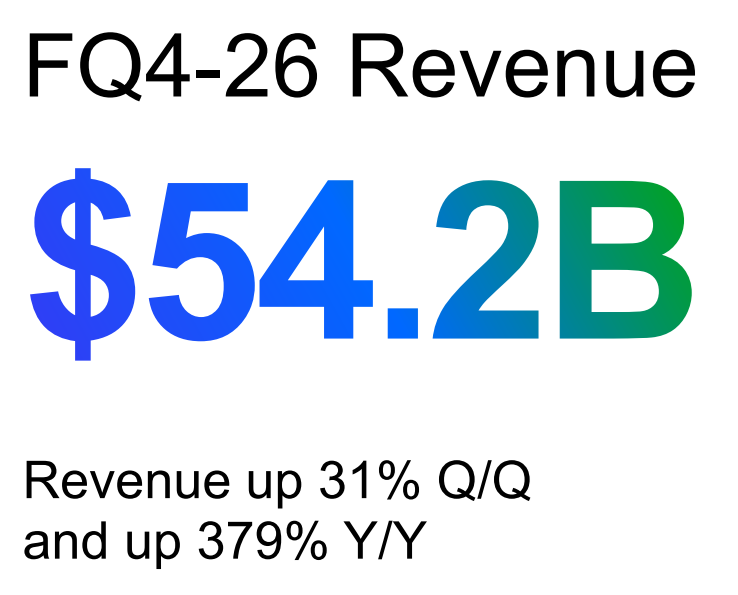
Quarterly revenue hit $54.2 billion, nearly five times what it was a year earlier. Its gross margin was 86.8%. And about 75% of what it plans to make in 2027 is already spoken for.
SK Hynix, Nvidia’s top memory supplier, is swimming in so much cash that it’s reportedly weighing a special dividend, a one-time cash bonus for shareholders, worth around $12 billion.
Here’s how tight it’s gotten. Earlier this month, AMD CEO Lisa Su flew to Seoul to personally lock down memory from Samsung. Her verdict: “Memory supply is very tight.”
Think about that — one of the most powerful CEOs in the chip industry had to hop on a plane and ask.
That tells you who’s holding the cards.
And Samsung is holding plenty of them. It just posted a record quarterly operating profit of about $80 billion.
But there’s a twist …
Analysts estimate that Samsung’s own phone business lost money because the memory it needs got so expensive.
Samsung’s chip business is doing so well, it’s hurting the rest of the company.
The Plumbing: Networking, Storage & Power
Chips and memory get most of the attention. But they’d be useless without the parts that connect them, store their data and keep them from overheating.
These are the parts nobody thinks about until they run out.
Networking might be the most overlooked of all. Thousands of chips have to talk to each other constantly, and any delay slows everything down.
Marvell (MRVL) and Broadcom make the chips that keep that data moving, increasingly using light instead of traditional copper.
Marvell’s data center revenue grew 46% last quarter. Lumentum (LITE) and Coherent (COHR), which make the lasers behind that shift, are riding the same wave.
Then there’s storage, where the old-school hard drive is still king for holding massive amounts of data cheaply.
Seagate (STX) and Western Digital (WDC) said early this year that their 2026 production was already sold out.
And then there’s the heat. A single cabinet of AI servers can draw as much electricity as dozens of homes, and nearly all of it turns into heat.
Vertiv (VRT) builds the systems that keep those servers cool and powered.
Eaton (ETN) supplies the electrical gear.
And Texas Instruments (TXN) — yes, the calculator company — makes the chips that manage power inside the servers. Its revenue just grew 28%, with data centers driving the growth.
Behind It All: TSMC & the Machine Makers
Here’s something most people don’t realize about Nvidia: It doesn’t actually make its own chips.
Nvidia designs them. Someone else manufactures them. And for nearly every advanced AI chip on the planet, that someone is Taiwan Semiconductor Manufacturing Company, better known as TSMC (TSM).
AMD, Broadcom, Apple, Alphabet and Amazon? Same story. They draw up the blueprints. TSMC builds the chips.
That’s why TSMC is often called the most important company in the world. It makes roughly 90% of the world’s most advanced chips. Without it, the AI boom doesn’t just slow down. It stops.
Yet you won’t find its name on anything you can buy in a store. It just quietly makes the thing that makes everything else work.
And business is booming. TSMC posted a blowout quarter right in the middle of the AI selloff. Profits jumped nearly 69%, and the company raised its full-year sales growth forecast to 44%.
TSMC, in turn, depends on the companies that build its machines.
ASML (ASML) is the only one in the world that makes the machines needed for the most advanced chips, at hundreds of millions of dollars apiece.
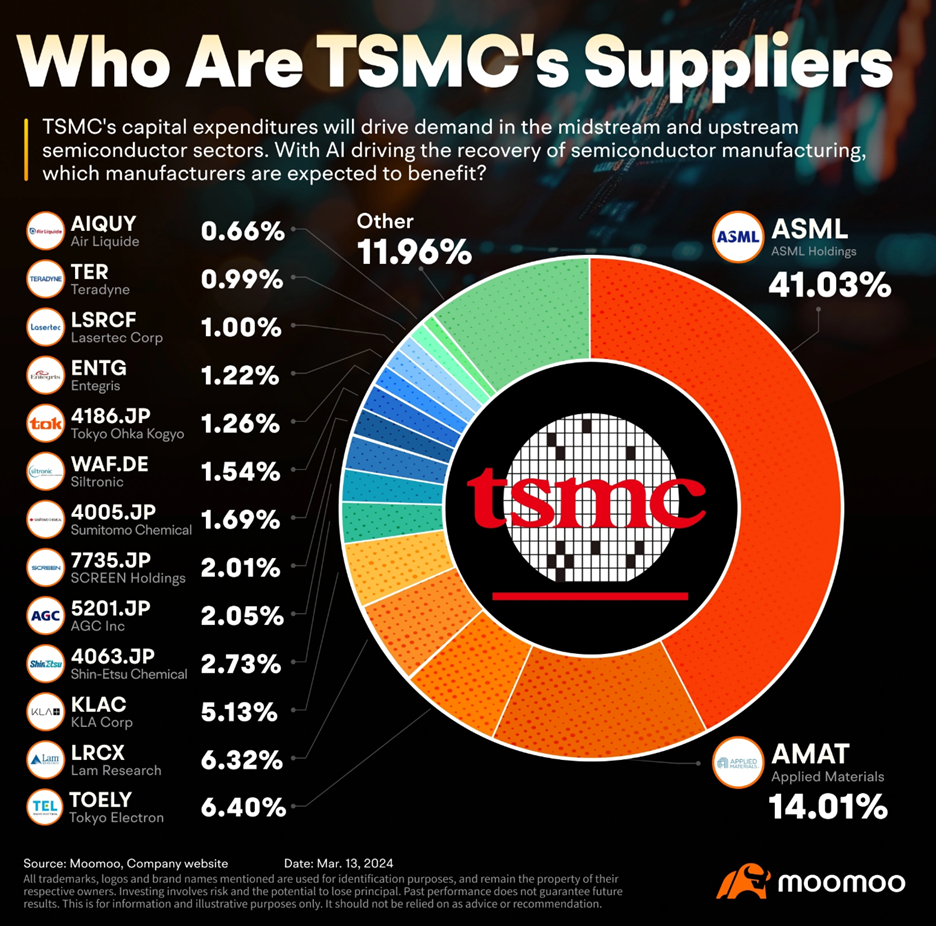
Applied Materials (AMAT) and Lam Research (LRCX) supply much of the rest.
Before You Buy
Of course, none of these companies is bulletproof.
They all sell to the same big spenders. If those spenders start worrying about the bill, orders can slow down fast.
Memory, in particular, has a long history of boom and bust. Just three years ago, Micron and SK Hynix were both losing money.
That’s why the “acceleration” part of Microsoft’s and Alphabet’s 2027 capital expenditure plans matters.
If that happens, they’re essentially writing the purchase orders for nearly every company in this article.
A bigger budget keeps the orders flowing. A smaller one could turn off the tap.
Either way, AI’s future is still uncertain. Its shopping list isn’t.
Just check the ratings before you buy and make sure you’re not overpaying for the companies filling it.
To your health and wealth,
Dawn Pennington
P.S. Recently, we added something to make checking the ratings of any stock you are considering even easier. In fact, these new “alerts” can lead to 4x gains.