 |
| By Michael A. Robinson |
A small town in Hickory, NC with a population of just 43,000 people would seem to have little in common with Silicon Valley, the heart of the AI boom.
And yet, a sprawling factory there turns out a vital product for moving data at lightning speeds.
That’s where technicians pull glass strands thinner than a human hair into spools of fiber-optic cable stretching 30 miles long.
Make no mistake. High-speed fiber that uses light to transmit data is a critical resource in the AI Supercycle.
It means the firm that owns that factory is looking at huge upside.
Irony abounds. For years, analysts told the firm to dump fiber because it was a “low-margin market.”
They didn't sell it. Instead they doubled down.
Now they’re expanding output. And why not? They just struck a deal with Nvidia (NVDA) that could be worth more than $3 billion.
Let me show you why this AI supply firm is on pace to double its earnings in three years …
Data — There’s a Lot of It
Now then, the glass used in fiber optics is so crystal clear, that if you filled an ocean with it, you could see straight to the bottom.
That clarity isn’t cosmetic — it’s everything.
It means light particles known as photons can carry massive amounts of AI data at lightning-fast speeds.
Every text message, online purchase, GPS route, medical scan and social-media post creates data — lots of it.
The world now creates roughly 400 million terabytes of data every day.
That’s enough to fill hundreds of millions of DVDs in just 24 hours.
Global data output reached an estimated 181 zettabytes in 2025.
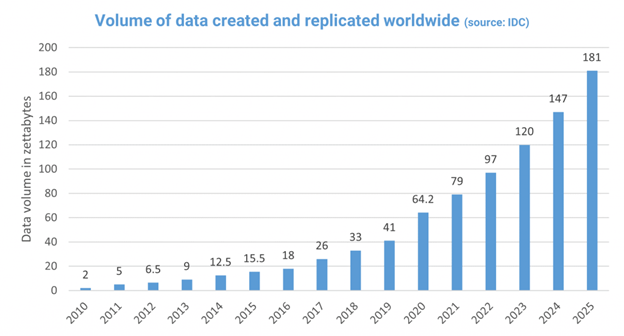
To put that in perspective, one zettabyte is equivalent to roughly 250 billion DVDs
Since ChatGPT debuted in late 2022, the AI boom has sent that growth soaring.
AI models require massive datasets for training.
Billions of interactions with AI tools generate even more information.
Users are also tapping AI to create text, images, videos, software code and more, adding to the world’s fast-growing digital footprint.
Where Does it All Go?
All that data has to travel somewhere. Increasingly, it travels through fiber-optic cables.
Fiber transmits information using pulses of light, allowing data to move faster, farther and more efficiently.
That’s especially important for AI.
Some forecasts suggest AI-centric data centers require up to 36 times more fiber than traditional facilities, helping drive a 76% increase in data-center-related fiber demand in 2025.
The global optical-interconnect market was valued at more than $16 billion in 2024. It’s on pace to exceed $34 billion by 2030.
In short, if data is the fuel powering the AI revolution, fiber is the network that moves that fuel from place to place.
Without it, the AI economy simply can’t function.
That’s what makes this company so crucial …
The Company Behind This Fiber Network
Founded in 1851, Corning (GLW) is well known for inventions such as Pyrex cookware and Gorilla Glass. But today, one of its key units is optical communications.
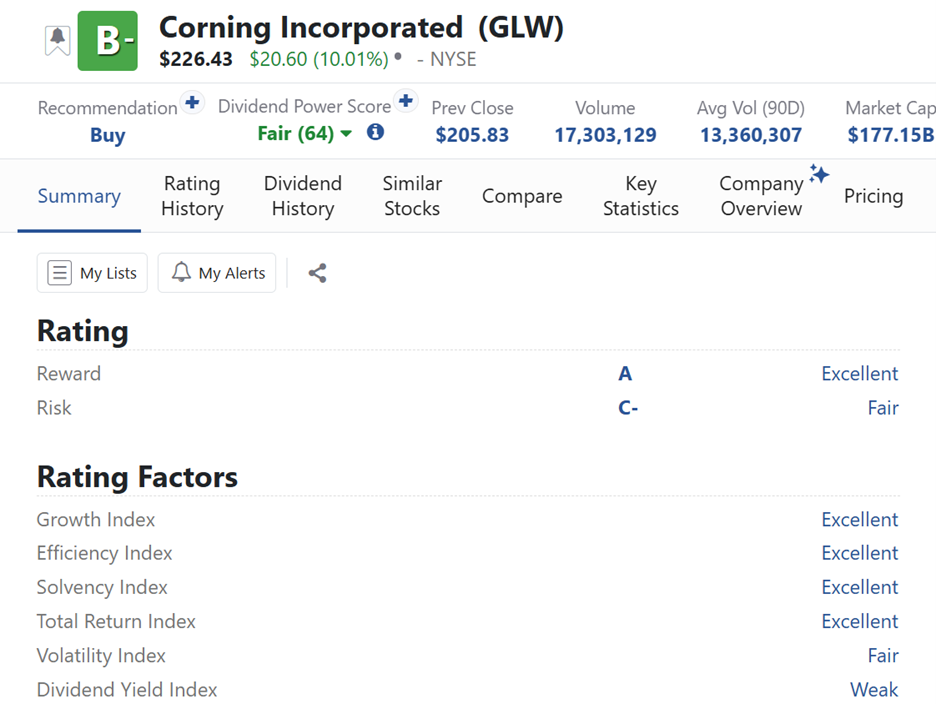
Corning makes the fiber-optic cables that connect servers, data centers and AI systems.
The division now accounts for roughly 40% of sales and has become a key supplier to the AI buildout.
Major tech firms are taking notice.
Meta (META) signed a multi-year agreement worth up to $6 billion with Corning to supply fiber-optic cable and connectivity products for its expanding AI data centers through 2030.
To support the deal, Corning is adding capacity in North Carolina, where Meta will serve as an anchor client.
More recently, Nvidia announced a $500 million pact with Corning focused on shoring up U.S. manufacturing for AI supplies.
The deal could have a total value of more than $3 billion over the next few years.
Talk about an exponential increase. Corning plans to increase optical output some tenfold.
The goal is simple: ensure that the fiber needed to connect thousands of AI chips is available as the buildout speeds up.
Together, these deals show Corning is helping build the backbone of the AI sector, with some of the world’s largest tech firms committing billions to secure fiber supply.
Patience Pays Off
Corning’s success took courage. It spent nearly two decades losing money on fiber.
Shareholders and analysts urged the firm to ditch the business. Instead, Corning doubled down.
Now it holds the pole position in the AI buildout race.
But this is no one-trick pony. Corning also makes Gorilla Glass, the durable glass used in hundreds of millions of smartphones, tablets and other devices.
Corning has long supplied specialized glass for Apple’s (AAPL) iPhone and has received steady support from the iDevice king.
But wait, there’s more.
The firm built a diversified business with exposure to several powerful long-term trends.
We’re talking display tech, auto glass and specialty materials.
Market Crushing Gains
As the world creates more data than ever before, fiber remains a growth sector. And Corning sits at the center of that trend.
Long-term deals continue to roll in but may not yet be priced into the stock.
No doubt, the Nvidia and Meta deals are huge. But Corning recently said it had signed two AI hyperscale deals that could be worth as much as $12 billion.
I first recommended this stock to members of my premium trading service, Weiss Tech Breakout, back in November 2024.
At the time, it had a market cap of roughly $30 billion, placing it well within the small-cap range.
After taking a double on half, we are now up more than 431% on our remaining holdings.
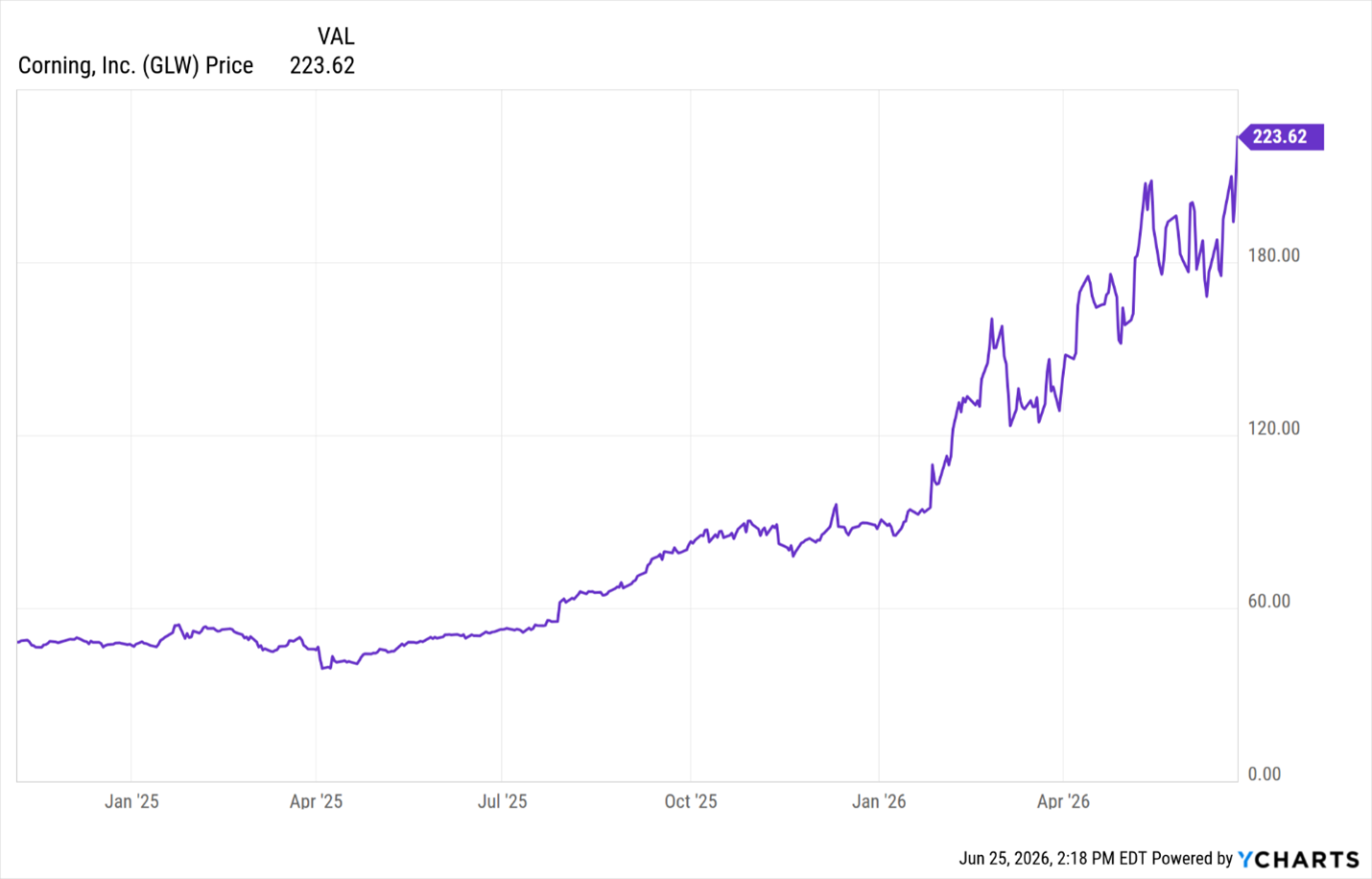
But we’re not selling this half just yet. As these deals continue to pile up, there could be more gains to be had.
Best,
Michael A. Robinson
P.S. Before all those gains, you could have said that Corning was a solid, stable dividend payer. And while it continues to pay, its price increase gives it a dividend yield of just 0.54%.
Fortunately, there is a way to have dividend income AND massive gains. On Tuesday, Dr. Martin Weiss will host an event to show you how. Join the show here.
1 https://www.red-gate.com/blog/whats-the-real-story-behind-the-explosive-growth-of-data/