The New $1.75 Billion Pentagon Contract Puts This Small-Cap in the Spotlight

 |
| By Michael A. Robinson |
The Trump administration just made a high-tech down payment on the nation's $1 trillion defense system — one that could transform the future of warfare itself.
And yet, it received almost no media attention.
I get it. The war with Iran is back on, and that is headline news across the country — if for no other reason than the conflict could have another big impact on gas prices this summer.
But step back for a moment and look at what the White House is doing behind the scenes.
Just two weeks ago, the Pentagon awarded $1.75 billion in contracts for 36 new missile-warning and missile-defense satellites.
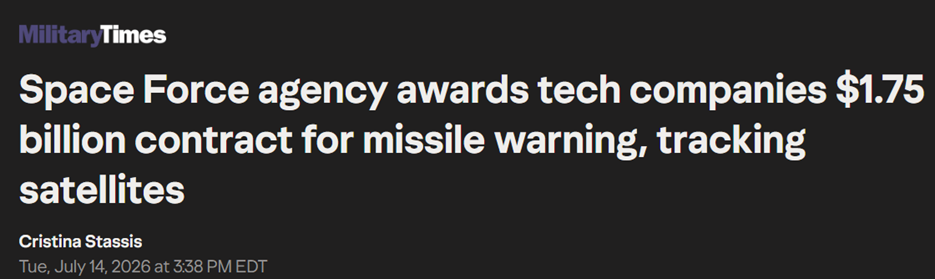
Scheduled for launch by the end of 2028, they will become part of America’s space-based missile-defense system.
Make no mistake. This technology promises to shift the global balance of power.
More to the point, it bodes especially well for a company that makes technology vital to the system’s success.
And did I mention the recently reported quarterly earnings growth of a stunning 350%?
Let me show you why there is still so much upside ahead …
45 Years in the Making
Some aspects of this anti-missile technology have been on the drawing board since the Reagan years.
And as the saying goes, it's about to become an overnight success … after more than 45 years.
Then again, the need is obvious.
The wars in the Middle East have reminded the world that missile attacks are no longer isolated events.
Since October 2023 alone, Hamas and Hezbollah have fired roughly 40,000 rockets into Israel.
Add in repeated ballistic missile and drone attacks from Iran, and Israel has faced one of the most sustained missile campaigns in modern history.
Yet its layered missile-defense network — anchored by the famous Iron Dome — has intercepted the overwhelming majority of rockets headed toward populated areas, with reported success rates approaching 99%.
That battlefield record has transformed missile defense from an interesting military experiment into a proven strategic necessity.
Nations around the world are paying attention, but none more so than the United States.
That's why Washington is pouring billions into Golden Dome, America's next-generation missile-defense shield.

Inspired by the success of Israel's Iron Dome but built on a vastly larger scale.
Golden Dome will use advanced satellites, powerful sensors and sophisticated interceptors to detect, track and destroy incoming threats long before they can reach American soil.
And one little-known company is supplying technology that could make all the difference.
The Tech Under the Hood
Enter Mercury Systems (MRCY).
The firm designs and makes the mission-critical electronics that go inside advanced military systems.
It is a classic “picks-and-shovels” supplier.
You see, the Golden Dome is going to be focused on cutting-edge tech like hypersonic missiles as well as space-based threats.
The complexity of surveilling, assessing and acting in seconds is going to take massive processing power.
Edge computing is the new wave of technology that puts that speed and power at the tip of the spear, rather than at a remote data center.
The firm’s edge computing is going to be a more powerful tool as AI advances so it can help with reconnaissance, monitoring or command and control.
Mercury is already delivering this tech for fighter aircraft, unmanned drones, as well as satellites.
Mercury also makes secure, rugged microelectronics that are used in sensors and displays in cockpits and simulators.
Its products are open architecture, so they can work with other components.
It has deep relationships with chip giants Intel (INTC)and Nvidia (NVDA)not to mention defense primes like Lockheed Martin (LMT)and Northrop Grumman (NOC).
And Golden Dome will be front and center in that evolution.
Going Beyond Defense
But Mercury isn’t just a defense company.
It’s taking secure signals, security and processing into the skies and into space.
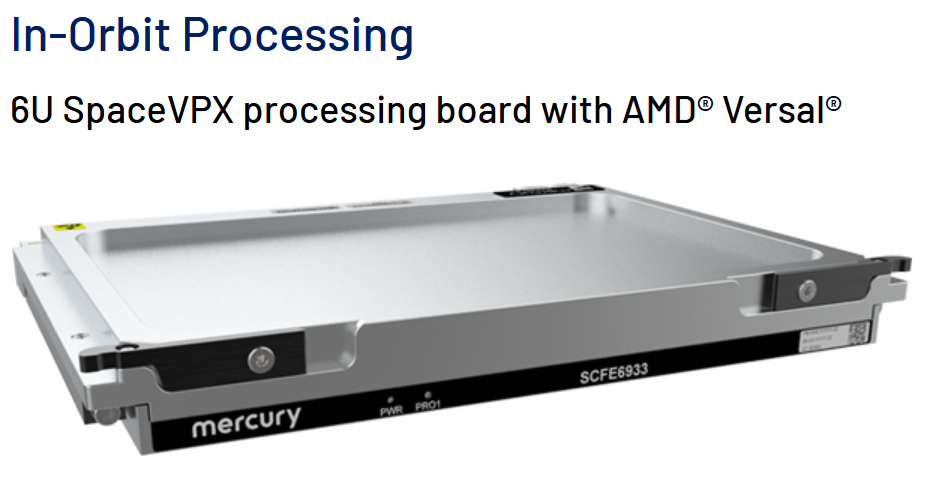
The firm is also helping power the commercial space race.
Its advanced electronics and processing systems are used in communications satellites, Earth-imaging platforms and commercial launch vehicles.
Mercury’s technology has already flown on more than 75 spacecraft. This includes every Mars mission over the past two decades.
Its space-qualified electronics and processing systems are used by leading aerospace manufacturers building satellites, launch systems and spacecraft for both government and commercial customers.
As the commercial space economy continues to expand, that’s another long-term growth engine beyond traditional defense spending.
As companies continue building massive satellite constellations to deliver broadband, navigation and data services around the globe, demand for the kind of rugged, high-performance technology Mercury provides should continue to grow.
It’s a company that’s doing well now but is primed to thrive in coming years as satellite constellations multiply and space becomes the next frontier rather than the final frontier.
That’s why its defense and civilian units combine to make Mercury a great “twofer.”
A Big Backlog & Great Earnings Growth
The good news for investors is that even without Golden Dome-related contracts, the firm is set to thrive.
It recently reported a record $1.6 billion backlog.
That gives the firm years of contracted work already in hand.
The total is roughly one-quarter of its roughly $6 billion market cap.
And the recent earnings growth is off the hook. In the most recent quarter, per-share profits soared 350%.
To be sure, that growth rate will slow for the rest of the year.
Wall Street expects this year’s earnings growth to come in at 69%.
I think that’s more impressive than it sounds.
See, it’s slightly more than the 2026 earnings forecasts for Amazon (AMZN), Apple (AAPL)and Microsoft (MSFT) — combined.
Together, those three mega-cap giants are worth roughly $10.6 trillion.
Mercury? By contrast, its entire market value is little more than a rounding error.
That’s exactly why I like finding companies like this.
Quiet technology leaders with explosive earnings growth can create enormous shareholder value — long before Wall Street catches on.
Best,
Michael A. Robinson
P.S. In fact, I found another crucial to the New Space Race and “Project Unlimited.” Check it out here.
1https://www.yahoo.com/news/science/articles/space-force-agency-awards-tech-193852148.html