The Opportunity at the Heart of the SpaceX-Tesla Merger

 |
| By Michael A. Robinson |
I was flying over the Sierra Nevada mountain range in eastern California recently when I had a tech experience that left me enthralled.
It also shows why I believe Elon Musk is the greatest technologist working today.
Sure, he has transformed several sectors from electric cars to space flights. But he also has a knack for solving everyday problems that drive people crazy and that other business leaders often ignore.
In my case, it has to do with inflight Wi-Fi.
See, as a frequent flier on Southwest, I’ve had my fair share of broadband disconnects. It’s one of the reasons I usually don’t try and do online stock research while flying.
But when the attendant announced that the jetliner bound for Houston was tapping Musk’s Starlink space-based service for Wi-Fi, you can bet I jumped at the chance to try it out.
Simply stated, I was blown away.
Instead of playing a downloaded movie, I logged in to Netflix and couldn’t believe the quality of the streaming.
So, I did what any broadband speed freak would do. I grabbed my Ookla app and tested the download speeds.
It came back at a blazing 408 megabits a second. That’s roughly 30% faster than the median speeds for U.S. households, the vast majority of which have hardwired connections.
I bring up this example because I believe it speaks volumes about how Musk just keeps on transforming the world around us.
A Stunning Tech Merger
Now, he is set to shake up Wall Street and Silicon Valley with what could well be the largest merger in U.S. history.
Musk wants to combine Tesla (TSLA) and SpaceX (SPCX) into a tech colossus with a market cap of roughly $3.5 trillion.
After weeks of speculation, Musk confirmed Tuesday that both companies have formed special committees of independent directors to explore a possible deal.
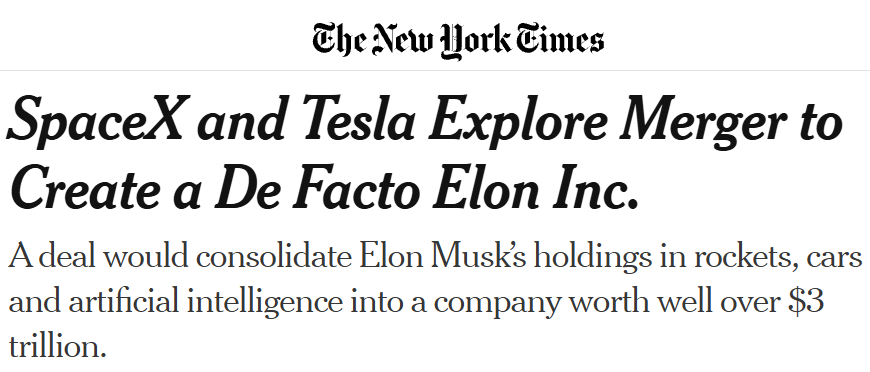
No agreement has been reached, and there's no guarantee one will happen.
Still, the potential combination is staggering.
SpaceX, which went public in June, carries a market value of roughly $2 trillion.
Tesla, meanwhile, is worth about $1.5 trillion.
The most likely scenario is an all-stock transaction, with SpaceX acquiring Tesla at a modest premium. That would put Musk's two largest companies under one corporate roof.
But here's what makes this so intriguing.
Musk isn't simply trying to combine a rocket company with an electric-vehicle manufacturer.
He's looking to unite businesses involved in artificial intelligence, robotics, satellite communications, energy storage and advanced computing.
And I believe the deal makes a lot of sense … at least based on the details that have been made public.
After all, though they operate in different sectors, they already share engineering talent and collaborate on advanced technologies.
Tesla has supplied SpaceX with hundreds of millions of dollars in energy storage systems, while the two are working with Intel (INTC) on a major semiconductor manufacturing venture in Texas.
They've even explored adapting SpaceX spacesuit technology for Tesla's Optimus humanoid robots.
A New Kind of Technology Giant
Consider what the combined company could look like.
Tesla would bring its electric vehicles, energy storage systems, robotaxis and Optimus humanoid robots.
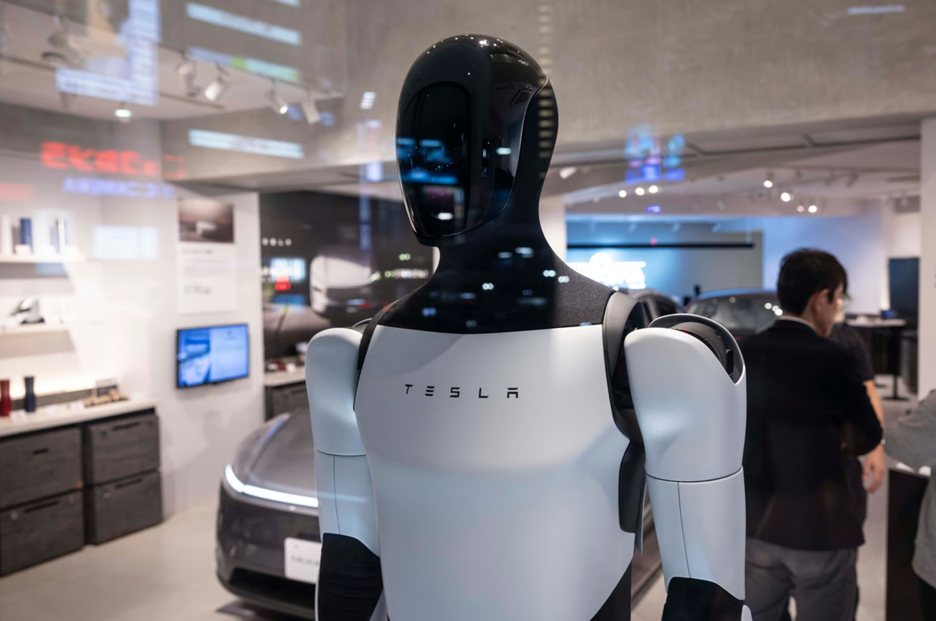
Musk envisions a future in which millions of these intelligent machines perform everything from factory work to everyday household chores.
SpaceX would bring its reusable rockets, Starlink satellite network and a growing AI business that now includes xAI, the developer of the Grok chatbot.
But here's where things get really interesting.
Musk wants to take AI computing into orbit, eventually deploying as many as one million satellites that could harness solar energy to power enormous computing systems in space.
Meanwhile, the companies are joining forces with Intel on a Texas semiconductor venture designed to produce the advanced chips needed to power this technological revolution.
Put it all together and you begin to see the possibilities.
Tesla could manufacture the robots and autonomous vehicles.
SpaceX could provide the computing infrastructure, AI intelligence and global connectivity.
Tesla's energy systems could help power the whole operation.
Instead of relying on a collection of outside suppliers, Musk could control much of the technology from the chips to the finished machines.
That's a very different business from selling cars and launching rockets.
Challenges Remain
One thing's for sure. Musk's timing couldn't be much better.
Just hours before confirming his interest in a merger, SpaceX reported blockbuster third-quarter results that blew past Wall Street's expectations.
More on that in a moment.
But first, let's be clear. Pulling off a merger of this magnitude will be no walk in the park.
For starters, the deal would face regulatory scrutiny, including potential reviews overseas.
And because Musk controls both companies, independent directors must determine whether the terms are fair to their respective shareholders.
Then there's the question of valuation.
Wall Street has a long history of assigning lower valuations to sprawling conglomerates that are not strictly speaking vertically integrated.
There's also the matter of capital.
Building advanced AI systems, semiconductor factories and orbital computing networks requires enormous sums of money, even by Musk's standards.
A Track Record of Success
And let's not forget execution.
It's one thing to develop revolutionary technologies. It's quite another to integrate them into a company operating across industries as different as space travel, artificial intelligence and robotics.
Still, if there's one entrepreneur on the planet who can pull this off, I believe it's Elon Musk.
Consider that more than 25 years ago, Musk founded X.com, the online financial services company that became part of PayPal.
Since then, he's gone on to help revolutionize electric vehicles, reusable rockets and satellite communications, while pushing the boundaries of artificial intelligence and neuroscience.
That's an extraordinary record of turning bold technological ambitions into successful businesses.
And if you want more evidence that Musk still has his touch, just look at SpaceX's latest financial results.
As I noted a moment ago, SpaceX just announced great earnings.
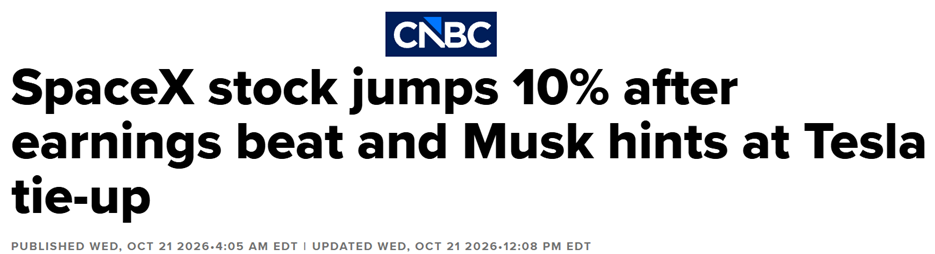
Revenue soared 161% to $14.6 billion, while the company swung from a $1.1 billion loss a year ago to a $4.4 billion profit.
Not only that but SpaceX's AI business generated $10.9 billion in sales for the first nine months of the year, according to data compiled by The Wall Street Journal.
Indeed, the Starlink service that impressed me so much aboard that Southwest flight is now installed on more than 3,800 aircraft worldwide as of Sept. 30.
Add it all up and you can see why I say this proposed merger isn’t just exciting. It could very well end up being a very profitable one as well.
Best,
Michael A. Robinson
P.S. I’ve been impressed with SpaceX long before my Southwest flight.
But that doesn’t mean I recommended shares when they went public in June. I had a better way to play it.
And today, you still can. Watch my presentation on the subject while you still can.