 |
| By Michael A. Robinson |
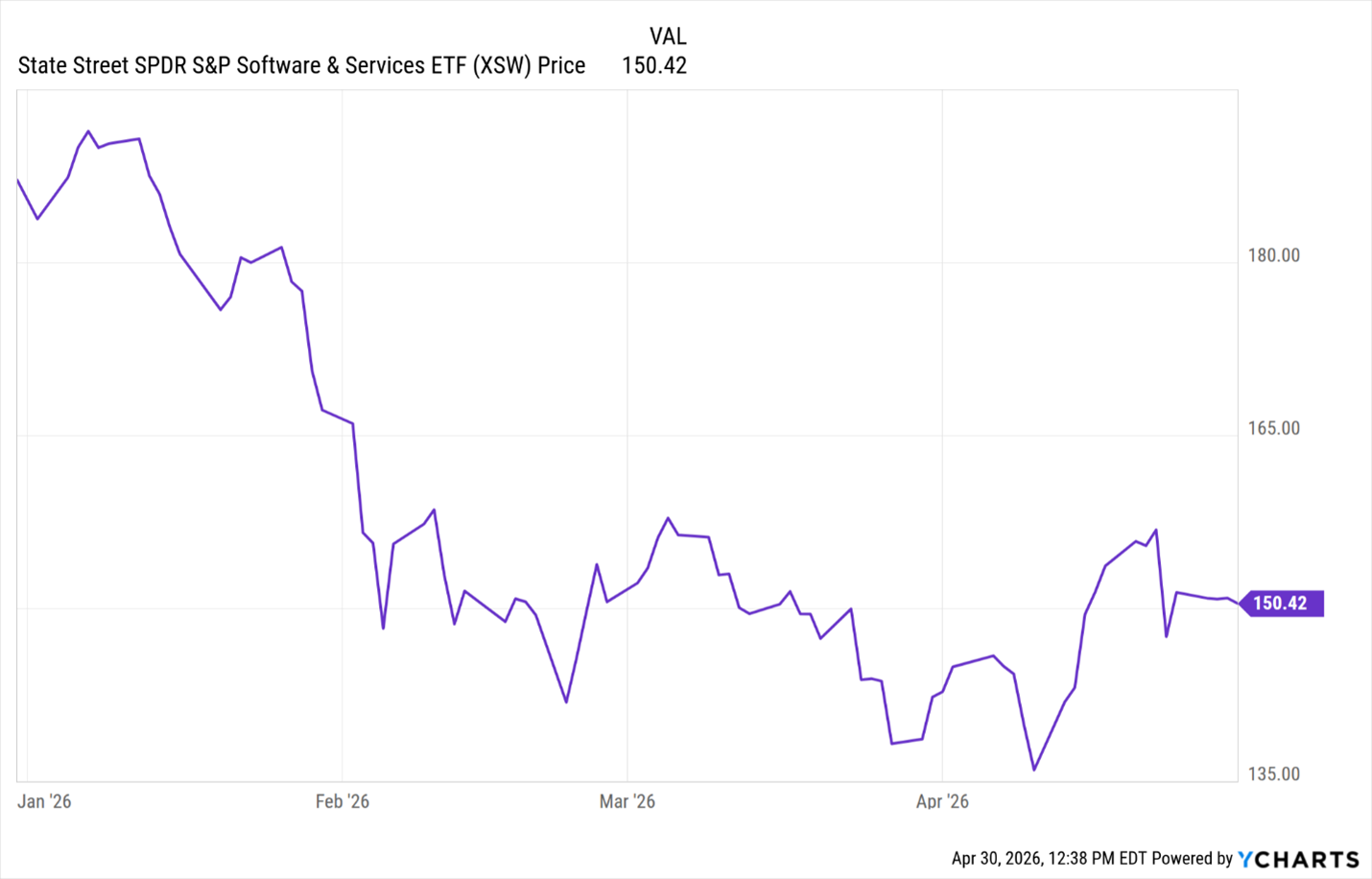
Wall Street is bracing for an AI-driven collapse in software.
Hedge funds and permabears are pushing a new thesis: that AI will make traditional software — and the companies that build it — obsolete.
Why pay for applications, they argue, when AI can simply generate what you need?
It’s a compelling story. Unfortunately, it’s grounded in nonsense. Not just in its conclusion, but in where these investors are looking.
You see, the real disruption in software will take years to occur, if it happens at all.
The real target is what’s going on underneath it, specifically in the global semiconductor industry that’s on its way to being worth $1 trillion.
Every AI model, every application and every system investors care about runs on chips.
Right now, that foundation is starting to shift.
Because while the market is focused on Nvidia (NVDA), Amazon (AMZN) has been quietly building something that could change the economics of AI entirely.
And amazingly, hardly anyone is paying attention.
I am, though. And I want to tell you about a chip supply firm that stands to gain no matter who wins this brewing AI chip war.
Please Pass the Chips
There’s a simple problem at the heart of today’s AI boom: There just aren’t enough chips to go around.
Take Nvidia.
Its newest Blackwell chips — considered the gold standard for training advanced AI models — are effectively sold out.
In fact, the company has built up a backlog of roughly 3.6 million units, with supply already committed through mid-2026.
Even more striking, CEO Jensen Huang has described demand as “insane,” with visibility into orders stretching years into the future.
This isn’t just an Nvidia issue. It’s an industry-wide bottleneck.
Critical components like high-bandwidth memory and advanced packaging are fully booked, limiting how many chips can actually be produced.
Meanwhile, Advanced Micro Devices (AMD) is racing to catch up.
Its MI300 series has gained traction. But supply constraints and the sheer scale of demand mean it can’t fully close the gap.
Even AMD-powered systems are facing long lead times measured in months, not weeks.
But a solution may be forthcoming …
Say Hello to Trainium
You see, Amazon Web Services (AWS) isn’t just renting out cloud space anymore.
It’s becoming one of the most important suppliers of AI infrastructure in the world.

And at the center of that push is its custom-built chip: Trainium.
Unlike general-purpose graphics processing units (GPUs), Trainium chips are purpose-built specifically for AI workloads — things like training large language models and running generative AI applications.
That specialization matters.
By tailoring the chips for AI, AWS can deliver better price-performance and efficiency, often beating traditional GPU-based systems by 30-40% on cost metrics.
This is part of a much bigger strategy.
In his latest shareholder letter, CEO Andy Jassy revealed that AWS’s AI services are already running at a $15+ billion annual revenue pace.
This is a stunning figure for a business that barely existed a few years ago.
Even more telling: Amazon’s broader chip segment (including Trainium) has surged past a $20 billion annual run rate, growing at triple-digit rates.
Demand is so strong that capacity for newer versions — like Trainium3 and even the not-yet-released Trainium4 — is largely spoken for.
We haven’t even touched on AWS’s other chips, which include Graviton (a general-purpose chip powering web servers and databases) and Nitro (infrastructure chips that handle networking, storage and security).
But chips don’t just appear out of thin air. They require incredibly advanced manufacturing tools to bring them to life.
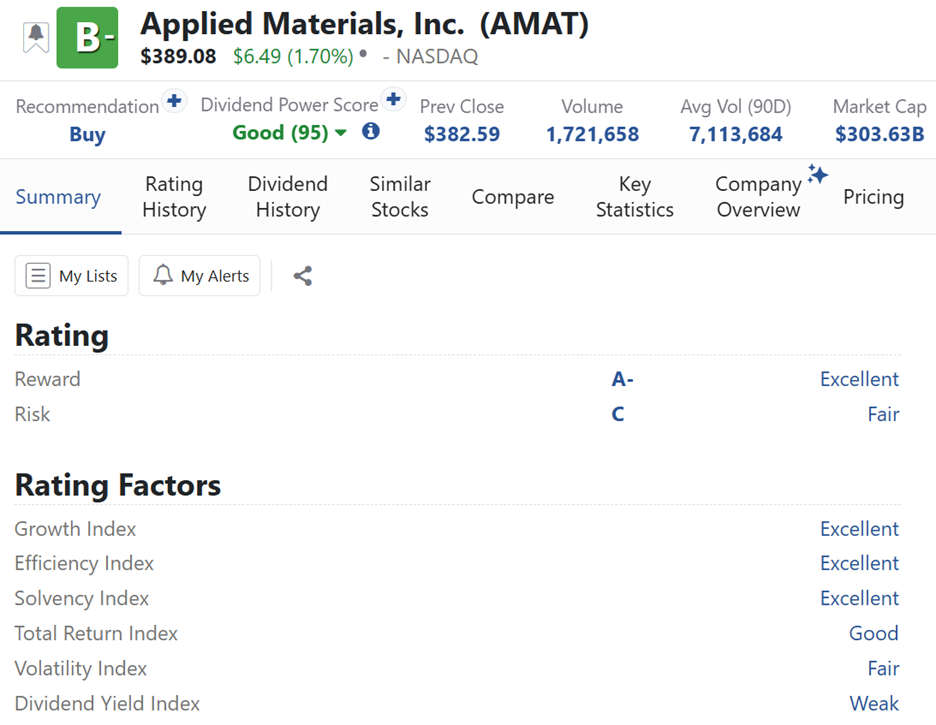
That’s where Applied Materials (AMAT) comes in.
The Company Behind the Chips
Applied Materialsis one of the most important, but least understood, companies in the semiconductor world.
Based in Santa Clara, California, the company doesn’t design chips like Nvidia or AMD.
Instead, it builds the highly specialized equipment used to manufacture them.
Think of it this way: If companies like AWS, Nvidia and Intel (INTC) are designing the brains of the AI revolution, Applied Materials is helping build the factories that make those brains possible.
The company is a global leader in materials engineering, focusing on how ultra-thin layers of materials are deposited, shaped and modified to create advanced semiconductors.
Its tools operate at the atomic level, literally controlling materials one layer at a time.
And demand for those tools is surging.
Semiconductor capital spending continues to rise, fueled by AI.
Recently, Applied Materials unveiled new chipmaking systems designed for next-generation “Angstrom Era” chips.
These are processors with features smaller than two nanometers.
These breakthroughs are critical for keeping Moore’s Law alive and enabling faster, more efficient chips.
Not surprisingly, investors are taking notice. The stock recently jumped nearly 9% on the news.
Powering the AI Revolution
Applied Materials is deeply embedded in the AI boom. And its role is only growing.
As AI models become more powerful, chipmakers must pack more performance into smaller spaces while reducing energy consumption.
That’s exactly where Applied Materials shines.
Its newest systems are designed to improve performance-per-watt, a key metric for AI workloads where power usage is a major constraint.
For example, its Precision Selective Nitride system helps reduce energy loss inside chips, while its Trillium platform enables more advanced transistor designs tailored for AI computing.
These innovations allow companies like AWS to produce chips like Trainium that are faster, more efficient and better suited for training large AI models.
Beyond AI chips, Applied Materials has a broad portfolio that includes tools for memory chips, advanced packaging and display technologies.
This gives it multiple “shots on goal” across the semiconductor ecosystem.
52% Gains, With Room to Run
The takeaway is simple: Amazon is quietly emerging as a powerhouse in AI chips. And that shift is creating opportunity behind the scenes.
While most investors focus on AWS and Trainium, the smarter play may be Applied Materials, which supplies the tools that make it all possible.
Even with the S&P 500 only recently turning positive this year, Applied Materials has surged 52%.
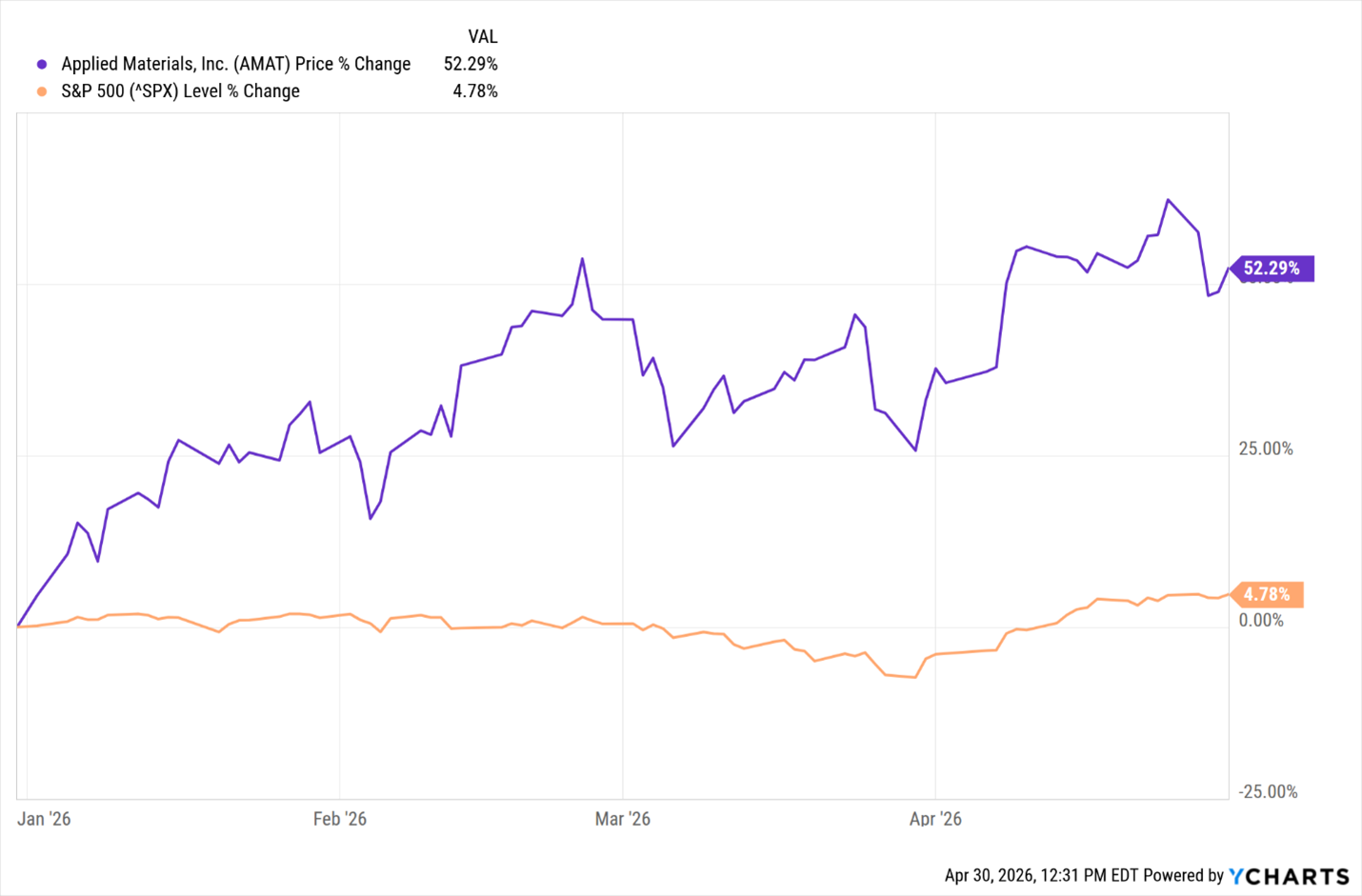
And as AI demand grows, it still looks like it has plenty of room to run.
Best,
Michael A. Robinson
Editor's Note: This article has been updated to correct the Business Insider source link.