The Real Winner in the Fight Against Data Centers

 |
| By Michael A. Robinson |
Don’t worry if you’ve never heard of Edgerton, KS. Most investors haven’t.
It’s a city with less than 2,000 residents about 45 minutes west of the Kansas City metro area.
It’s arguably best known for its sprawling railway logistics center that city leaders say is worth about $250 million.
Well, as the saying goes, that was then and this is now.
Turns out the enclave is ground zero in the national debate over AI data centers.
Local residents are trying to ban a data center that local leaders say will boost the area’s economy.

As we’ve seen this election cycle, builders of AI data centers find themselves in a political tug-of-war going into Tuesday’s midterms.
And yet, AI remains an unstoppable force reshaping the global economy.
Fact is that the industry will spend $1.5 trillion on capital expenditures in 2027. That’s up roughly 57% from $957 billion slated for this year.
What we’re looking for is a way to profit from the long-term global buildout with an investment that won’t be buffeted by the daily headlines.
I’ve found one that has beaten the broad market by a mile with plenty of upside ahead …
Now then, as a guy who grew up in Kansas City, I have to say it pains me to see that a town in the region is part of the anti-AI movement.
Indeed, a recent story in The Wall Street Journal profiled the battle lines.
Just weeks ago, many citizens at a city council meeting called for the elected members to step down.
That came after the city took the rare step of suing its own residents so it can proceed with plans to build a sprawling data center designed to help ignite the local economy.
The suit has since been dismissed, and some residents are now trying to ban data centers altogether.
And Edgerton is hardly alone.
According to the Urban Institute, more than 200 communities across 44 states have enacted restrictions temporarily halting new data center development.
Meanwhile, opposition groups have helped block or delay projects representing roughly $130 billion in investment in just the first three months of this year.
There’s even this handy interactive map to track the moratoriums and restrictions:
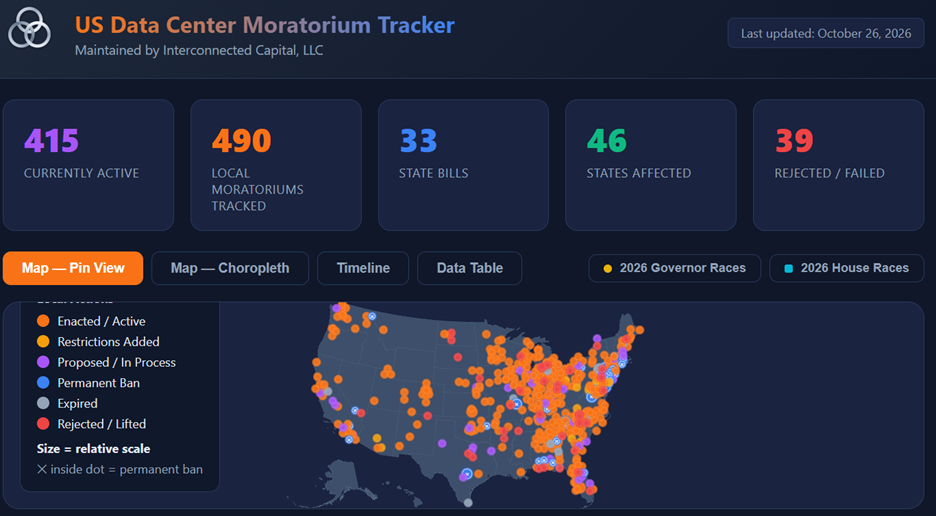
That’s a remarkable backlash against the very infrastructure needed to power the AI revolution.
Unfortunately, opponents now have allies on both sides of the aisle in Congress.
For instance, Republican Sen. Josh Hawley and Democratic Sen. Chris Murphy have backed legislation establishing liability for harms caused by AI agents.
AI agents are intelligent software programs that can independently plan and carry out complex tasks, making decisions and taking action with little human supervision.
Republican Rep. Tom Barrett of Michigan introduced the Artificial Intelligence Governance and Emerging Threats Act.
The bill would establish a new Cabinet-level office within the White House dedicated to overseeing AI and other emerging technologies.
Democratic Sen. Maria Cantwell proposed a federal AI safety and testing framework. The idea that advanced AI systems should be evaluated for risks before they are widely deployed.
A Boom for the Economy
But don’t confuse short-term market weakness with a slowdown in the AI revolution.
We’re still in the early innings of a transformation that will reach virtually every corner of the global economy.
Consider the possibilities.
AI is already accelerating drug discovery, helping financial institutions detect fraud and giving defense contractors powerful new capabilities.
And we're just getting started in manufacturing, robotics and space exploration.
AI-powered robots are moving onto factory floors, where they can work alongside humans.
Meanwhile, autonomous AI agents are beginning to handle complex assignments that once required teams of employees.
Think about what that means for productivity and corporate profits.
Indeed, I believe we're approaching a time when virtually every company and professional will have to embrace AI to remain competitive.
Make no mistake. There’s still a lot of upside ahead.
According to a 2025 study from consulting giant PwC, artificial intelligence could make the global economy as much as 15% larger by 2035 than it would be without the new breakthrough tech.
That's the equivalent of adding roughly one percentage point to global economic growth every year for the next decade.
And McKinsey estimates that generative AI alone could eventually create between $2.6 trillion and $4.4 trillion in economic value annually.
A Broad & Profitable Play
As I noted earlier, what we’re looking for is a way to profit from the long-term upside with an investment that won’t get banged around by negative headlines or politics.
Even better if it gives us broad access to the entire global tech ecosystem.
That’s where the iShares Expanded Tech Sector ETF (IGM) comes in.
This one fund gives us exposure to more than 290 companies across the tech universe.
Inside you’ll find the giants — Apple, Microsoft, Nvidia, Alphabet and Meta.
But you’ll also get smaller, fast-growing firms in software, cloud, chips and digital media. Take a look:
- Arista Networks (ANET) is a $180 billion leader in high-speed networking. Its technology powers cloud computing, enterprise networks and data centers, helping customers move enormous amounts of information quickly and reliably.
- KLA (KLAC) is a $120 billion semiconductor equipment leader. Its advanced inspection and measurement systems help chipmakers identify microscopic defects and improve manufacturing yields as chips become increasingly complex.
- Unity Software (U) is a roughly $20 billion software company best known for its real-time 3D development platform. Its technology powers video games, mobile apps, virtual reality and industrial simulations, giving it exposure to the expanding market for interactive digital experiences.
Think of it as a basket of the best ideas in tech.
If one company or sector stumbles, there are dozens of others driving ahead. That’s why it works so well in markets where change happens fast.
The beauty of IGM is that it doesn’t bet on just one stock or one trend.
Instead, it captures the full force of tech from chips and software to AI and computer networks.
And the results speak for themselves.
Over the past five years, the S&P 500 has gained about 70% — a very strong showing by any measure.
But IGM surged 131% over that same period. That means it nearly doubled the market’s gain.
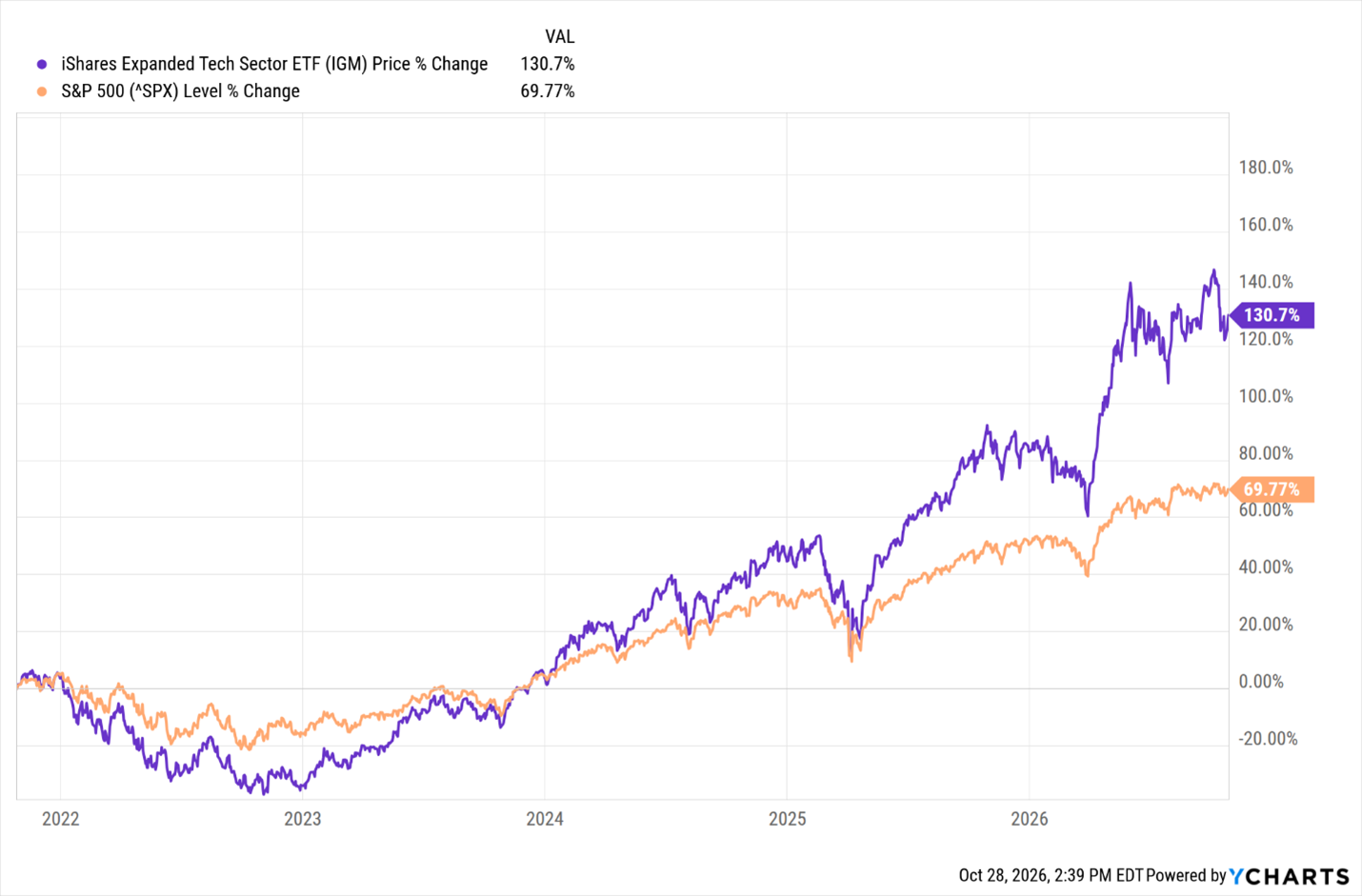
It doesn’t take many winners like this to really juice your portfolio and set you up for what we all want — financial independence.
And that makes it one of the simplest, smartest ways to ride this trillion-dollar wave for years to come.
Best,
Michael A. Robinson
P.S. For even more focused profit opportunities from AI and tech, you’ll need the tools and data to find them. That’s why my colleague just introduced these special alerts that lead investors to 310% gains.