This $8.8-Billion-a-Year Aerospace Giant Is Headed Up, Up & Away

 |
| By Michael A. Robinson |
I don’t know about you, but I’m more than willing to take a risk when the chances of something going wrong come in at a scant 0.00025%.
And yet, to hear The Wall Street Journal tell it, you might think flying has never been more dangerous.
The paper recently ran a piece warning about a growing threat in the skies — lithium-ion battery fires.
And on paper, the numbers sound scary.
The Journal notes that the number of incidents involving lithium-ion batteries has more than doubled since 2019.
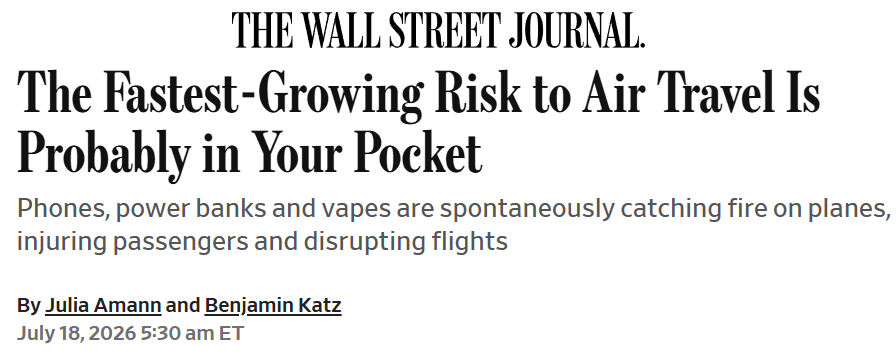
This year, they’re occurring at a rate of roughly two a week.
It’s a headline writer’s dream come true.
After all, just about everyone flies these days. And many harbor at least some fear that something bad could happen.
Here’s the thing. Flying remains very safe, in no small measure because of all the safety features added to the $1 trillion aviation industry over the last couple of decades.
Let me show you a leader in the field on pace to double its earnings in four years …
Traveling with Lots of Batteries
Now then, you can bet I clicked on the Journal story.
See, my wife and I fly several times a year.
Between the two of us, we often have eight devices and two charging bricks, all of which rely on lithium-ion batteries.
Well, I read it carefully. And on the face of it, the argument appears sound.
Lithium-ion batteries can overheat and enter what engineers call “thermal runaway.”
That can cause smoke or even a fire.
And with passengers carrying more devices, these incidents are rising.
In fact, U.S. incidents have more than doubled since 2019. The FAA recorded a record 89 incidents in 2024, and the Journal says 2026 is running at roughly two a week.
The Bigger Risk: Lost Luggage
Sounds scary. Until you do the math.
Worldwide, airlines operate about 40 million flights a year. The Boeing 737 alone made 10.8 million flights last year.
Add the Airbus A320 and A321, and those three aircraft families logged nearly 24 million flights.
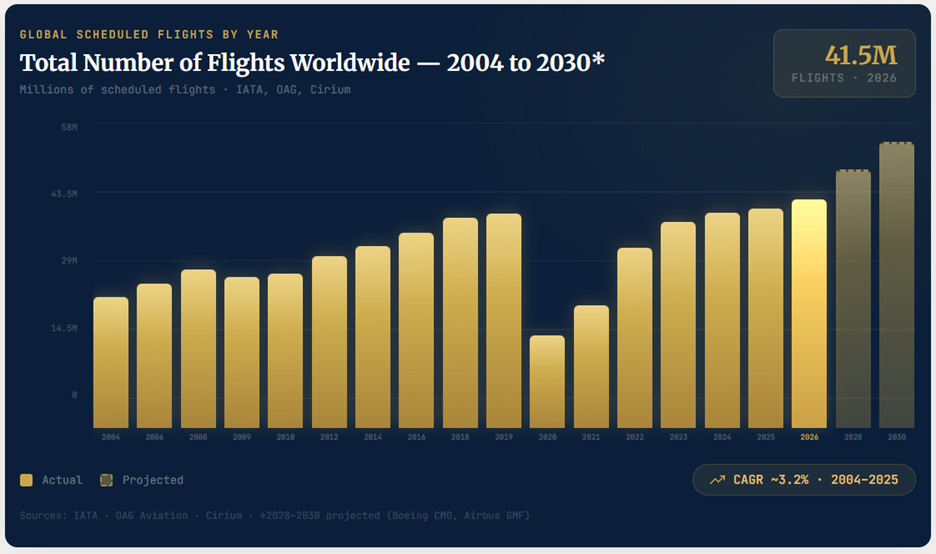
So even using 100 battery incidents a year against 40 million flights, we’re talking about an incident rate of roughly 0.00025%.
And there’s another number the scary headlines tend to obscure.
Passengers now typically carry four to five electronic devices apiece. On a packed long-haul flight, that can mean more than 2,000 battery-powered devices onboard.
And yet you are at much greater risk of losing your luggage. Airlines report five mishandled bags per 1,000 passengers, or about 0.5%.
That means you’re 2,000 times more likely to have a hassle with your bags than see a lithium-ion fire.
I believe it’s proof that aviation safety tech is doing exactly what it is designed to do — keep aircraft flying with extremely low risk of death or injury.
The Quiet Safety Giant
That brings me to TransDigm Group (TDG).
It’s a name most airline passengers have probably never heard of. But there’s a good chance you’ve trusted your life to its products many times.
TransDigm is made up of 55 independently-run operating units.
Together, they make thousands of highly engineered parts found on nearly every commercial and military aircraft platform in service today.
And safety is a big part of the story.
TransDigm makes passenger seatbelts, cockpit security systems, pumps, valves, actuators and cockpit displays.
Its AmSafe unit makes aviation restraint systems, including inflatable seatbelts designed to help protect passengers during an accident.
Of course, those are just a few examples.
TransDigm makes everything from landing-gear components to engine and flight-control parts.
In other words, it supplies many of the small but critical pieces that help keep an aircraft safely in the sky.
And that brings us back to those lithium-ion battery fires.
Flying remains remarkably safe because airlines, regulators and manufacturers have spent decades building layer after layer of safety into modern aircraft.
Steady Sales Ahead
TransDigm has quietly become an important part of that ecosystem.
But there’s another reason I like this story.
Airlines are flying their planes longer.
Supply-chain problems have slowed deliveries of new aircraft and engines.
IATA says the average age of the global airline fleet will top 15 years in 2026, an all-time high.
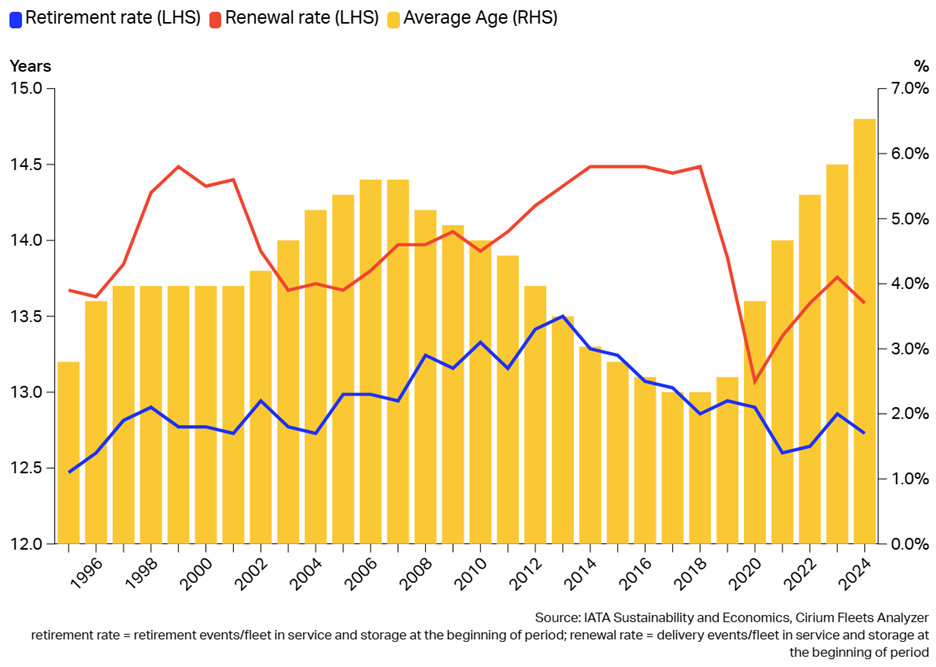
Older planes need more maintenance. More maintenance means more replacement parts.
Indeed, IATA says aging aircraft and supply-chain problems added some $3.1 billion to airline maintenance costs last year alone.
That plays right into TransDigm’s hands.
See, selling a part when an aircraft is built is only the beginning. TransDigm can continue selling replacement parts throughout the aircraft’s operating life.
And that can mean decades.
That’s one reason the commercial aftermarket has become such an important part of the business. It now accounts for roughly 43% of TransDigm’s sales.
Better still, demand isn’t tied to any one airline or aircraft maker.
TransDigm parts are found across Boeing and Airbus commercial fleets and on military platforms around the world.
That includes everything from fighter jets and military transports to helicopters.
It’s an enviable position.
Whether airlines are buying new planes or keeping old ones in the air longer, they still need parts.
They still need maintenance.
And they certainly can’t cut corners on safety.
That recurring demand has helped turn TransDigm into an $8.8 billion-a-year aviation powerhouse.
Up, Up and Away
And business remains strong.
Air travel continues to grow while the industry struggles to get enough new aircraft into service.
That combination means airlines have little choice but to squeeze more life out of the planes they already own.
For TransDigm, that means a huge installed base of aircraft that will need parts for years to come.
And it’s a profitable business model …
In the most recent quarter, per-share profit growth came in at 17%.
At that rate, we’d see earnings double in just a tad over four years.
That makes this the kind of stock you can count on to build wealth for years to come.
Best,
Michael A. Robinson
P.S. While I recommend you pick up some TDG shares today and sit on it for years, there are faster profit opportunities to be found.
That’s why my colleague Chris Graebe will host a special event … something we’ve never done here in our 55-year history.