This Backdoor eVTOL Play Gives You a Twofer Opportunity

 |
| By Michael A. Robinson |
As a guy who lives just across the bay from San Francisco, I can certainly understand all the media and Wall Street attention surrounding Waymo.
After all, robotaxis represent a huge breakthrough in robotics.
And they’re set to play a big role in how millions of city commuters get to work, shop and play.
And yet, irony abounds.
While everyone is focused on what’s happening on the ground, another breakthrough technology is literally flying under the radar.
Indeed, I believe we’ve just reached the tipping point in the mass adoption of urban air mobility.
One small upstart plans to begin carrying U.S. passengers by year-end.
It has also announced plans to develop “airports” in four U.S. states, with several more planned in Dubai.
That’s right. Urban electric aircraft are about to become a commercial reality.
Indeed, the market is forecast to hit $29 billion by 2030.
And today, I reveal a savvy supply firm that’s on pace to double earnings in 3.5 years.
2D Travel Goes 3D
Don’t get me wrong. I’m a big believer in Waymo and robotaxis. The field does have a bright future.
But it’s still a 2D solution that has the same challenges we’ve been locked into for years — driving solutions rely on aging roads, bridges, construction and maintenance.
The 3D solution — putting urban commuters in the air — is now upon us.
I’m talking about electric vertical takeoff and landing vehicles (eVTOLs).
These new aircraft either operate like helicopters or small planes that can vertically take off and land in a small area anywhere.
They can connect cities that are typical commuter routes to one another. And they use vertiports — dedicated areas for landing, takeoff, parking and servicing these aircraft.
Tiny Upstarts Get Off the Ground
For example, real estate developer Stephen Ross has invested in Archer Aviation (ACHR) eVTOLs to shuttle people from Fort Lauderdale and Miami airports to his West Palm Beach properties.
It’s a 15-minute flight versus a 75-minute drive.
In addition, the 2028 Los Angeles Olympics could become a signature event for the young sector.
Archer also will supply air taxis for venues, linking LAX, SoFi Stadium, USC, Hawthorne Airport and Hollywood Burbank.
Fortunately for the young, aggressive sector, the vital infrastructure is getting built.
There are now 14 states that are building two or more vertiports. And Texas, California, New York and Florida each have a dozen or more vertiports in development.
Joby Aviation (JOBY) recently signed a strategic partnership with Atoms, an industrial AI and infrastructure company. Atoms will build the vertiports and Joby will deliver the vehicles.

What makes this a big deal is that Uber (UBER) founder Travis Kalanick is the CEO of Atoms. Joby is also working on a joint venture with Toyota (TM).
But there’s one problem: As great as they are, Joby and Archer are small firms far more likely to have volatile trading — hence their poor ratings:
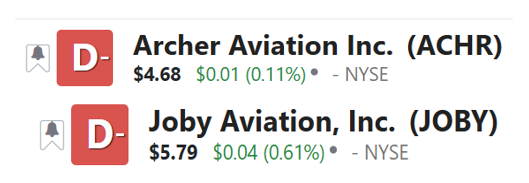
We want a broad play on the entire urban mobility sector that also gives us safety of principal.
Even better if it lets us profit from the broader aviation market.
A Deeply Embedded Player
That’s why I think it pays to take a look at aerospace and defense giant RTX (RTX).
You see, RTX has two divisions that are deeply embedded in next-generation flight and electronics systems — Collins Aerospace and Pratt & Whitney.
Both divisions are developing the electric motors, energy-management and hybrid-electric propulsion systems that this new generation of travel will need … regardless of who is building the planes.
Collins has already invested more than $3 billion over the past decade to build out electric aircraft architecture and electronics.
Just this year, Collins finished testing its newest hybrid-electric powertrain system — Scalable Turboelectric Powertrain Technology, or STEP-Tech — and it’s now being sent to its aerospace partner Airbus (EADSY) for aircraft-integration testing.
RTX’s scale allows it to test and build at volumes that startups can only dream of.
And this puts the “open for business” sign on RTX for big and small players around the globe that want to begin building these new air travel solutions.
A Great Twofer
But scale isn’t the only thing that sets RTX apart in this new industry.
It’s also experience and reputation.
RTX is central to the U.S. air and missile defense infrastructure and has been for decades.
It’s a proven entity when it comes to R&D, scaling that new tech and manufacturing to exacting standards time and again.
That’s the value of finding a large-cap aerospace technology company enthusiastically embedded in a new tech sector.
Plus, the noted aerospace leader is firing on all cylinders now.
It just landed a massive $23 billion contract to build more Tomahawk missiles for the Pentagon.

RTX will also be building out inventory for several other missile systems.
What’s more, Pratt & Whitney is the engine maker for all modern U.S. fighters. And on the commercial side, it’s the prime engine builder for Airbus.
Simply put, the firm is an in-demand prime contractor ready to enter the eVTOL sector with a bang.
Perfect Timing
Again, we’re not looking to pick the winning flying-taxi company to make money from the arrival of electric aviation.
We’re looking for an established aerospace player that will be a bedrock sector player as this new tech develops and matures.
The company meets all those criteria.
It has multiple shots on goal and a strong balance sheet that includes more than $14 billion in yearly cash flow.
And our timing is good …
In the most recent quarter, earnings growth came in at 21%. At that rate, we’ll see earnings double in about 3.5 years.
Add it all up and you can see why I say this is a great long-term way to play the burgeoning boom in urban air transport.
Best,
Michael A. Robinson
P.S. For decades, a small group of Weiss insiders has been receiving alerts on their phones from the most advanced stock-picking software ever created.
The average gain on every one of these messages is 10% … including all the losers.
Now, for the first time, we’re inviting a small group of regular investors to get their number on the distribution list.