 |
| By Chris Graebe |
Let’s go back to June 30, 2021.
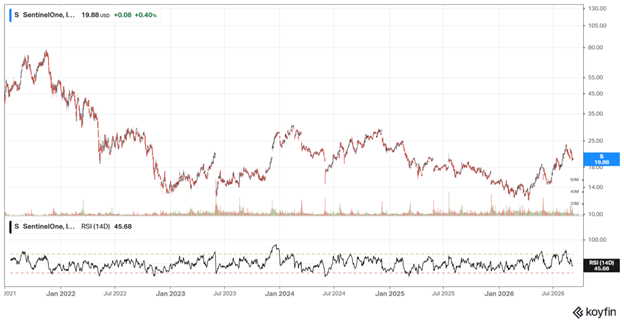
SentinelOne (S), a buzzy AI-powered cybersecurity company, priced its IPO at $35 a share on the New York Stock Exchange.
This was the largest cybersecurity IPO in history at the time, raising $1.2 billion and valuing the company at nearly $9 billion.
The stock opened at $46 on its first day of trading and exploded 31% before lunch.
And then five months later, the stock climbed to an all-time high of $76.30.
Overjoyed investors who bought on day one were sitting on a 66% gain.
And then the floor dropped out …
The stock has lost 80% of its value since its peak.
Opening-day investors have watched a $46 investment shrink to less than half of that.
Here's the part of this story I find most interesting.
When we backtested SentinelOne's IPO characteristics against data collected to build our Apex IPO System, it became clear our system could spot what was to come.
In our backtesting, the system scored it as “Uninvestable.”
It would have predicted how this would play out …
At its peak, SentinelOne's market cap swelled to $13.5 billion, or 66 times the revenue it would eventually generate in FY 2022.
And the company was unprofitable.
The stock was riding a wave of pure market enthusiasm.
Our system saw what the headlines couldn't.
What 3,300 IPOs Actually Teach You
Our research found a treasure trove of information when we dug into more than three decades of data on 3,300 IPOs …
About 30% of new issues go on to beat the market by 10% or more.
That’s impressive, but the real story is in the top 10%.
The strongest IPOs have historically outperformed the market by 75% in year one, roughly 175% by year two and as much as 300% by year three.
But there’s a flip side to that data …
The worst IPOs don't just underperform. They destroy wealth. And it’s almost always the same pattern.
They attract enormous amounts of investor enthusiasm, price at valuations that reflect years of expected growth, pop on day one and then hand investors losses they spend years trying to recover from.
SentinelOne is a textbook example. So is Rivian (RIVN). So is Peloton (PTON). And so are many more.
The challenge has always been separating the potential winners from the disappointments before you commit.
That’s exactly what we built the Apex IPO System to do.
How the Apex IPO System Works
Every new IPO that has filed SEC paperwork but isn't yet trading, now gets a Weiss IPO Score based on the same factors our research identified across 3,300 historical deals.
There are three possible scores.
Think of them as a traffic light for new stock listings.
Uninvestable is the red light.
These are cash-burning hype-machines with serious warning signs. Maybe there’s no clear profitability. Or insiders might be racing for the exits.
Think SentinelOne, Rivian, Peloton and any other hyped IPO you’ve seen. We want nothing to do with them.
Next is Investable — Added Caution. Think of it like a yellow light.
This isn't a stock we want you holding for years.
Long-term, the business might not have what it takes to be a true Apex IPO.
But over the next few months? The IPO is positioned for a quick surge. Get in, capture the short-term run, and get out.
And then there’s Investable. This is your green light.
The stock has backers with a track record of making investors rich.
There’s real, organic growth.
And the valuation is fair right out of the gate.
That is ultimately what the Apex IPO System is designed to do: help us avoid the SentinelOnes, Rivians and Pelotons — while identifying the rare IPOs with the characteristics of past market-beaters.
Because our research shows you don’t need to own every IPO.
You need to know which ones are actually worth your money.
You can see how the Apex IPO System works right here.
Happy hunting!
Chris Graebe