This Unlikely Innovator Solves the Biggest AI Challenge

 |
| By Michael A. Robinson |
If you’re a Boomer of a certain age, you’ve made peace with the fact that your eyesight ain’t what it used to be.
Truth be told, I lean on my glasses so much, I can barely think without them on.
Yet even at their strongest, there’s no way I could spot something 240,000 miles away.
I say that in jest, of course. But also to make a larger point.
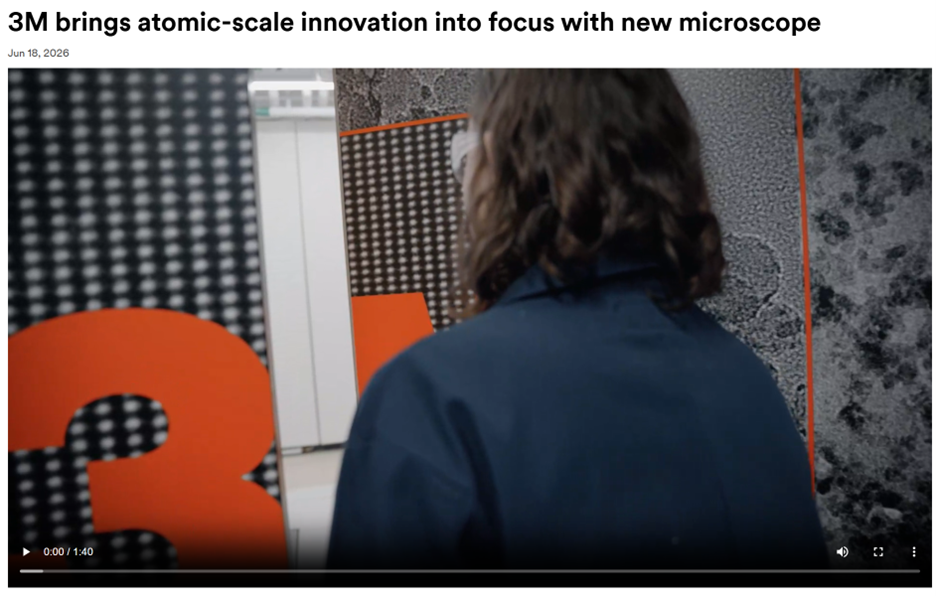
A 122-year-old materials giant with a growing foothold in a $500 billion AI sector recently unveiled a new electron microscope.
This device is so advanced, it could read the date on a coin sitting on the surface of the Moon.
It’s not a party trick. It’s the kind of breakthrough that reveals how materials are built one at a time — the same atomic-level insight that’s helping this “old economy” company engineer the adhesives, connectors and materials powering today’s AI data centers.
It’s exactly this innovation that’s built a century-old industrial name into the vanguard of the AI boom.
And it explains why this company just turned in a classic beat-and-raise quarter, with plenty more growth ahead …
Out with the Old … In with the New
For more than a century, this company has been solving practical problems with materials, manufacturing and engineering.
It isn’t the type of business that usually dominates headlines.
Instead, its products quietly keep factories running, hospitals operating and construction projects moving forward.
From industrial adhesives and specialty abrasives to filtration systems, electrical components and advanced films, its technology often sits behind the scenes.
Most consumers never notice it.
That “old economy” reputation has caused many investors to overlook the company.
They assume it’s simply a mature manufacturer with modest growth prospects.
But they’re missing something important.
The same materials-science expertise that once helped build factories, automobiles and modern industry is now becoming increasingly valuable in one of today’s fastest-growing markets: AI.
As AI infrastructure expands, the physical materials that make these systems work are becoming just as important as the software running on them.
That’s creating an opportunity many investors haven’t yet recognized.
Its new Expanded Beam Optical technology is designed to help data centers move information more quickly and reliably than traditional fiber-optic connections.

Because the connectors are more resistant to dust and contamination, they can be installed faster and require less maintenance.
The technology has gained enough traction that the company recently announced plans to more than double manufacturing capacity.
And Microsoft has selected it for deployment in its Azure AI data centers.
The Materials-Science Giant with 1,000 New Products
In other words, this isn’t just another industrial company selling legacy products.
It’s using decades of expertise in materials science to solve some of the biggest engineering challenges facing the AI Supercycle.
And yes … it’s also the company that invented the Post-it Note.
The company is 3M (MMM).
Most people know it as the maker of Scotch Tape, Scotchgard and Post-it Notes. But those familiar brands tell only a small part of the story.
Today, 3M is a global technology company that generates roughly $25 billion in annual revenue and sells more than 60,000 products.
Its customers include manufacturers, hospitals, automakers and governments.
The common thread running through all those businesses is materials science.
For more than 120 years, 3M has built its reputation by developing specialized materials that solve difficult engineering problems.
Its scientists and engineers have created everything from advanced ceramics and specialty films to industrial adhesives and electrical components.
Many of these products aren’t flashy. In fact, they’re designed to disappear into the background.
They make products stronger, lighter, cleaner, safer or more efficient without consumers ever realizing they’re there.
That quiet approach has helped make 3M one of the world’s most diversified industrial companies.
Simply put, wherever advanced manufacturing exists, there’s a good chance 3M has a role to play, one set to get bigger.
3M recently said it’s on track to launch more than 350 new products this year alone. By the end of next year that figure will climb to 1,000.
Built on Innovation
Innovation has always been at the center of 3M’s strategy.
It’s earned well over 100,000 patents worldwide, while generations of scientists and engineers have developed technologies that became industry standards.
Even after more than a century in business, the company continues to spend more than $1 billion annually on R&D, giving its engineers the resources to create new materials and improve existing ones.
Just as important, breakthroughs made for one industry often find applications in many others.
A technology originally developed for electronics might later be adapted for healthcare or communications.
That’s a huge competitive advantage.
Now, the company finds itself at another important moment.
The rapid buildout of AI infrastructure is creating demand for entirely new classes of advanced materials.
Those are precisely the kinds of engineering challenges 3M has spent decades solving.
Beating the Forecasts
In its latest quarter, 3M delivered better-than-expected results, beating Wall Street’s forecasts for both revenue and earnings while raising its full-year guidance.
Those results reflect the strength of its core materials-science business, which continues to generate healthy cash flow.
As companies pour hundreds of billions of dollars into AI infrastructure, demand is growing for the advanced materials and optical technologies needed to make that buildout possible.
Thanks to innovations like its Expanded Beam Optical platform, 3M is well positioned to participate in that trend.
In other words, investors don’t have to choose between stability and growth.
With 3M, they have a company whose established industrial business helps fund innovation, while its expanding role in AI infrastructure could provide meaningful upside in the years ahead.
Best,
Michael A. Robinson
P.S. The companies that rely on 3M’s advanced technology are some of the biggest AI players, including Anthropic.
Anthropic is not publicly traded yet. But I recently found a backdoor way in. I lay out how that works here.
2https://news.3m.com/3M-brings-atomic-scale-innovation-into-focus-with-new-microscope