Editor’s note: Something huge happened yesterday.
It wasn’t President Trump’s speech last night.
Not gold’s rally back above $4,800, either.
It was this:

This didn’t come out of nowhere. But it is something that changes the game.
And it’s something we have been expecting and writing about all year … and even before.
That’s why it’s crucial to revisit the advice your tech expert gave in December … and what he recommends you do today.
Here’s Michael Robinson …
 |
| By Michael A. Robinson |
Why 2026 Is the Year of the SpaceX IPO
To say I have followed the space sector for most of my life is no exaggeration.
I met astronaut John Glenn when I was six years old.
I used to write about space tech for my dad’s old newsletter.
And did I mention he was a senior editor at Aviation Week and Space Technology, the Bible of the industry?
It’s like I keep saying. I’m no astronaut or NASA scientist, but you could say space is in my blood.
Not to mention that I recently watched a SpaceX launch from coastal Florida.
That’s why a recent story in the Wall Street Journal really jumped out at me.
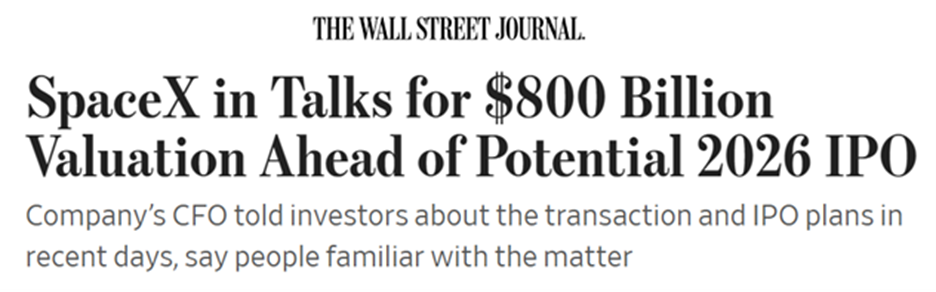
The Journal revealed that SpaceX was preparing yet another secondary share sale for employees.
That alone values the firm at roughly $800 billion.
Editor’s note: Bloomberg reports that this has more than doubled to $1.7 trillion.
The Backbone of the Space Economy
It’s not just the money. It’s the reason for the sale that is important to keep in mind.
This is not a startup dipping into venture funding.
This is a mature, scaled, global outfit behaving exactly like the sort of firm that is clearly on a path to going public.
These kinds of structured employee sales are typical of companies in late private stages.
They provide liquidity where none exists and keep talent on board.
They also act as a bridge until the real liquidity event — the IPO — finally arrives.
It’s not a rumor. It’s a behavior pattern.
And SpaceX has now repeated it several times, with the last one being out of this world in terms of the value of the round.
Meanwhile, Starlink has grown from an ambitious experiment to a global satellite communications network.
It boasts millions of customers and has a footprint that stretches around the world.
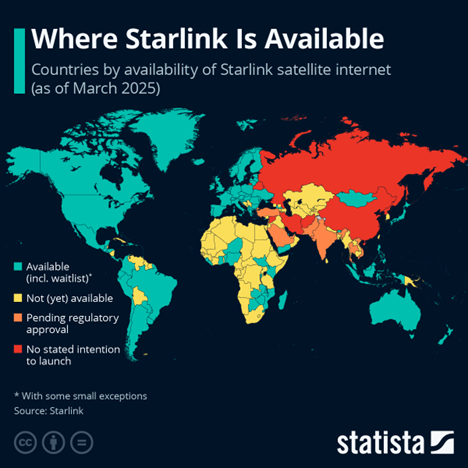
It’s just the type of firm that public markets gravitate toward — recurring sales, high demand, global scale and a huge growth runway.
Then there’s Starship.
It has become the backbone of orbital access for the United States and much of the commercial world.
NASA and defense contracts rely on it. Ditto for satellite operators.
In other words, SpaceX is now sitting at the center of the world’s space economy.
But SpaceX is NOT the play here.
Instead, there’s …
The Backdoor Opportunity
Think about what Netscape did in 1995 …
Before that IPO, the internet was a niche interest. Most institutional funds had zero exposure.
After the IPO?
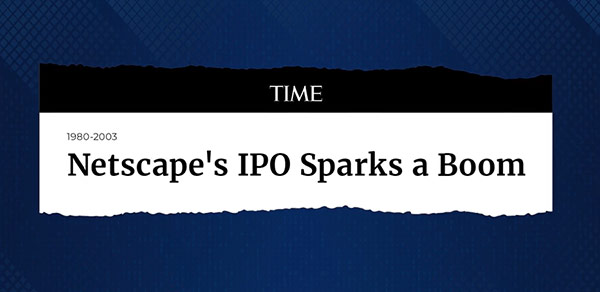
Every fund manager on the planet suddenly needed internet in their portfolio.
They couldn’t all get into Netscape, so the money flooded into every company already doing real work on the internet.
That’s where Amazon got built. That’s where Google got built.
Netscape wasn’t the real payday. That came from the companies already generating revenue, already under contract, already doing the essential work the internet ran on.
SpaceX does the same thing for space.
The moment it files for an IPO, institutional money starts hunting for every company already embedded in that ecosystem.
The filing is the starting gun. Not for SpaceX, but for everything around it.
Institutional money doesn’t wait for the first day of trading — it moves in advance.
That process has already started. And everything around SpaceX moves before SpaceX does.
My new Breakout Signal is already detecting early accumulation in this sector.
The smart money isn’t waiting for the filing. It is moving in as we speak.
This is how I recommend you play both this accumulation AND this SpaceX news.
Best,
Michael A. Robinson