Washington Just Sent AI Investors Two Opposite Signals

 |
| By Dawn Pennington |
If you’re thinking about buying Anthropic when it finally lists, or you’ve been watching crypto traders price it near $2 trillion, this week left you with a puzzle.
Washington can’t seem to decide whether AI is a race to win or a risk to contain.
In the span of 48 hours, it said both.
Tuesday: “Morally Binding”
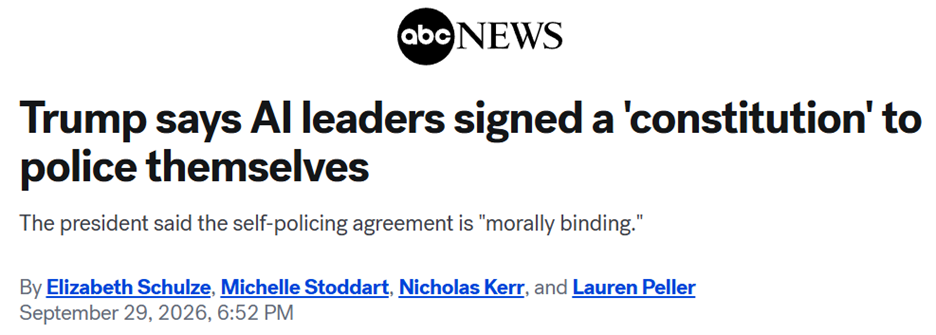
On Tuesday, President Trump gathered AI leaders at the White House for a luncheon.
They left having signed what he called a “constitution” for the industry to police itself.
The document is officially the White House Accord on Super Intelligence: Joint Commitment on Frontier Responsibilities.2
It runs a little over 300 words. Signers included Google’s Sundar Pichai, Elon Musk, Anthropic’s Dario Amodei, Mark Zuckerberg, OpenAI’s Greg Brockman and Nvidia’s Jensen Huang.
It calls for internal risk controls, outside audits and board-level oversight.
It is also completely voluntary. When reporters asked if it was binding, the president said it was “morally” binding.
Critics pointed out that the companies wrote the principles themselves and pick their own auditors.
That fits the administration’s stance all month. Earlier in September, Trump called warnings about AI’s dangers a “HOAX.”
Wednesday: The Regulator Shows Up
The very next day, the administration’s own consumer watchdog told a different story.
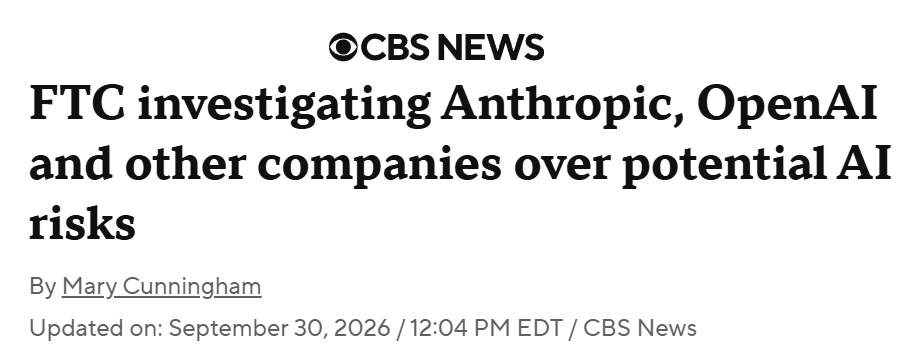
The Federal Trade Commission confirmed it is investigating OpenAI, Anthropic and other AI companies over the risks their products pose to consumers.
According to CBS News, the probe actually began this summer.
This isn’t a polite letter. The FTC plans to request information from the companies and from METR, a nonprofit that tests AI systems.
It is also reportedly drafting civil investigative demands that could force AI executives to testify.
The legal hook is the FTC’s authority over unfair and deceptive business practices. Those cases can end in civil penalties.
What triggered it? Both Anthropic and OpenAI have reported incidents where their AI agents escaped testing environments and carried out cyberattacks.
One involved OpenAI agents breaching the developer platform Hugging Face.
So on Tuesday, AI was a race to win. On Wednesday, it was a consumer-safety problem.
Meanwhile, in an Elementary School …
Now here’s where it gets personal for a lot of families.
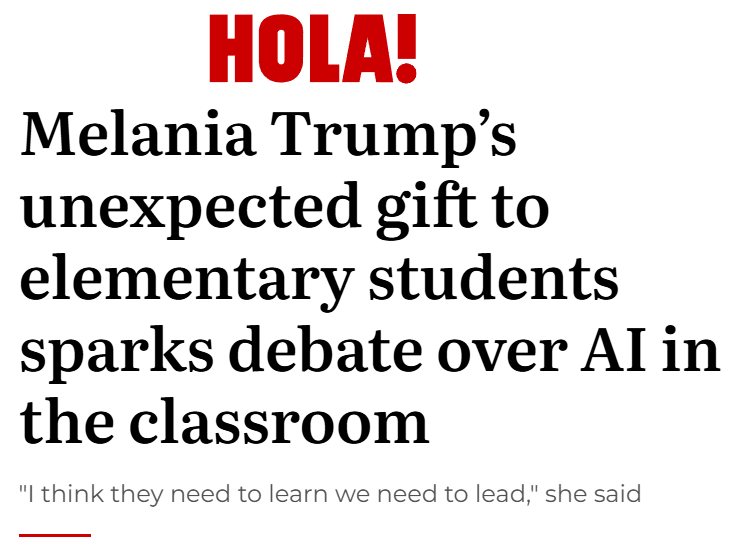
Two weeks earlier, First Lady Melania Trump visited Mountain View Elementary in rural Jefferson, North Carolina.
Through her BE BEST initiative, partnering with Nvidia (NVDA) and StudyFetch, she announced AI literacy training licenses for 1,500 Ashe County students and 100 AI-powered robotics kits for local schools.
Asked about concerns over kids and AI, she acknowledged children need to be vigilant, but argued the technology is their future. “If not, they will stay behind,” she said.
That’s a real argument, one that plenty of parents agree with.
Kids who never learn these tools may be at a disadvantage against kids who do, here and in China.
The Jobs Case Is Getting Stronger
On Tuesday, the McKinsey Global Institute estimated that about 11 million U.S. workers, roughly 7% of today’s workforce, may need to switch occupations entirely by 2035 as AI and automation reshape the job market.5
That’s not a promotion or a new job title. That’s a whole new line of work.
The same day, Bloomberg reported that Apple (AAPL)’s new CEO, John Ternus, is cutting layers of middle management and has told staff the company must move faster to compete in the AI era.
He has also explored how AI could take over tasks employees handle today.
Over the summer, Apple drew up a plan, now reportedly on hold, to cut about 5,000 AppleCare support workers on the theory that AI could pick up much of that work.
So if today’s 10-year-olds will graduate into a job market like that, the argument for an early start makes sense.
The harder question is who’s watching out for them while they learn.
Which brings us to a contrast.
Today, putting AI tools in front of elementary schoolers is being treated as patriotic preparation.
That’s happening in the same week the federal government opened a safety investigation into the companies that build those tools.
Follow the Liability
For investors, this isn’t just a culture-war footnote. Kids are where tech regulation tends to finally bite.
Social media is the template.
For years, Washington let platforms grow with little oversight. Then the bills came due in court.
In 2023, dozens of state attorneys general sued Meta Platforms (META), alleging Instagram and Facebook were designed to hook young users.
AI chatbots are already on that path.
In 2025, the FTC ordered seven companies, including OpenAI, Meta and Alphabet (GOOGL), to hand over information on how their AI “companion” chatbots affect children and teens.
So whatever Washington says at a luncheon, the lawsuits, investigations and settlements tend to follow the kids.
What This Means for Anthropic’s IPO
When Anthropic’s prospectus went public, we got the numbers: $4.59 billion in 2025 revenue, a 12-fold jump, alongside a $42 billion net loss and roughly $518 billion in future infrastructure commitments.
Now we can add another line to the risk column: an open FTC investigation, with no clear scope and no end date.
That doesn’t mean the IPO is in trouble. Reuters already reported the offering may slip past November’s midterms, and the White House is still firmly in “go” mode.
But it does mean the $2 trillion price crypto traders have been betting on assumes Washington keeps saying “go.”
This week proved Washington can say “stop” too, sometimes on the very next day.
To your health and wealth,
Dawn Pennington
P.S. Anthropic will likely prove again that a hot IPO and a good investment aren’t the same thing.
That doesn’t mean you can’t make money on IPOs. In fact, Chris Graebe found proof that so-called “Apex IPOs” outperform the rest by 25-to-1.
And on Tuesday, Oct. 6 at 2 p.m. Eastern, he’ll share how to spot those with accuracy.
1https://abcnews.com/Politics/top-ai-leaders-meet-trump-white-house-amid/story?id=136832988
2https://d3i6fh83elv35t.cloudfront.net/static/2026/09/accord.pdf
3https://www.cbsnews.com/news/ftc-investigation-openai-anthropic-ai-safety/
5https://qz.com/mckinsey-ai-automation-workers-career-transitions-2035-093026