Where to Find Profits & Protection Before Q-Day

 |
| By Chris Graebe |
I’d like to follow up on my recent article about quantum computing …
Let’s talk more about a threat that most investors aren't paying attention to yet.
Most people aren’t aware of it because it doesn't have a stock ticker, a press conference or a celebrity CEO attached to it.
It's called Q-Day.

Q-Day is the moment when a quantum computer becomes powerful enough to crack the encryption that protects virtually everything in the digital world.
Banking transactions, government communications, medical records, defense systems … they’re all at risk.
The entire infrastructure of modern civilization runs on encryption standards that quantum computing will eventually render useless.
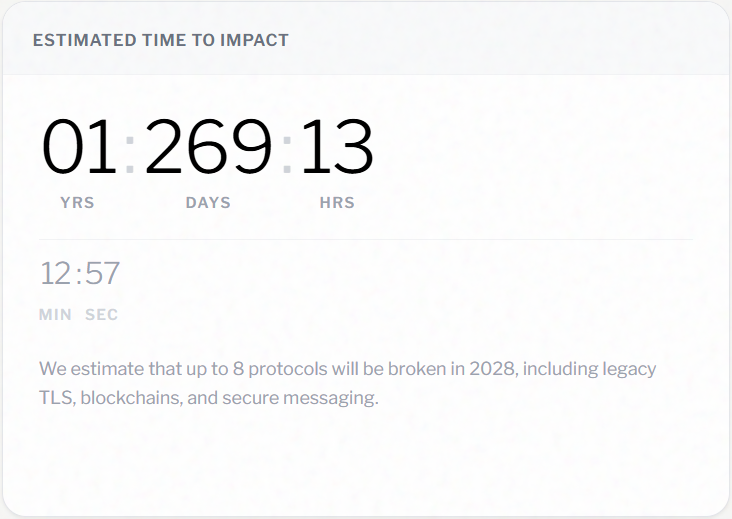
And Q-Day is coming sooner than almost anyone expected. Check out this Q-Day clock that estimates the “time to impact.”
The Clock Is Moving Faster Than You Think
Here's a number that should get your attention …
The estimated computing power needed to crack RSA encryption, the foundation of most internet security, has fallen by roughly 99.5% in less than a decade.
And it’s not because quantum hardware got dramatically better. Rather, the underlying mathematics got much, much smarter.
That distinction matters.
Hardware improvements are slow, visible and trackable.
Algorithmic breakthroughs can happen in a single research paper, overnight, without warning.
Alphabet (GOOGL) saw this coming. That's why the company set an internal post-quantum migration deadline of 2029, years ahead of most government mandates.
Speaking of mandates, the NSA has required that all new national security system acquisitions must be quantum-safe by January 2027.
And the National Institute of Standards and Technology (NIST) has set a hard deadline of 2035 for the full phase-out of quantum-vulnerable algorithms.
Regulators aren't waiting.
The Threat That's Already Here
Here's the part of the Q-Day story that keeps me up at night …
You don't have to wait for Q-Day to be at risk.
Sophisticated threats, including state-sponsored groups, are already executing what's known as "Harvest Now, Decrypt Later" attacks.
These aren't attacks that wait for quantum computers to exist.
Bad actors are already operating under a simple and chilling logic. They aim to grab the encrypted data now, store it cheaply and wait.
Think about what that means.
By the time a powerful enough quantum computer exists, the data is already in hand and ready to be unlocked.
I’m talking about government secrets, financial records, medical histories, trade secrets and more.
The clock on that data already started the moment it was stolen, not the moment quantum computing matures.
Teams at Palo Alto Networks (PANW) found that the fastest quartile of intrusions reached data exfiltration in just 72 minutes in 2025. That’s a sharp decrease from 285 minutes in 2024.
The threat isn't in the future. It's in the present.
And the organizations most at risk are the ones that haven't started preparing.
According to recent research, the global average quantum-safe readiness score is currently just 25 on a 100-point scale.
Most organizations have no plans and no defenses in place.
A Global Arms Race with Very High Stakes
Meanwhile, the geopolitical dimension of this story is intensifying.
The United States, China and other major powers are investing billions in quantum computing research.
And there is a very real possibility that one of these nations will achieve a meaningful quantum breakthrough in secret and will deploy it strategically before the rest of the world even realizes what has happened.
It might sound like science fiction but it’s very real …
And it's the kind of scenario that defense planners are actively war-gaming right now.
Quantum Computing's Upside & Its Risk Coincide
Know this …
The very technology that threatens to crack open every encrypted system on the planet is the same technology that could unlock cures for diseases, transform how goods move around the world and supercharge artificial intelligence.
None of this is a case against quantum computing.
But it is a reason to take the security side of this equation just as seriously as the threat … and to start doing it now, before the window closes.
There Is Good News
Quantum computing gives with one hand and takes with the other.
That irony points directly to where I think the most interesting investment opportunity sits right now.
It’s not in the quantum computers themselves. Those plays are already well-covered and well-priced by the time most investors find them.
Instead, I've been hunting for the companies building the defenses for a post-quantum world.
These are the ones developing the encryption standards, the security protocols and the protective infrastructure that organizations are going to need desperately as Q-Day approaches.
Every company with sensitive data has a legal obligation to protect it.
All of them are facing the same migration challenge on the same compressed timeline.
That's not a niche market. That's a mandate.
And most of the early-stage companies serving that mandate are still flying completely under the radar.
I've been looking for the best of them for months, and guess what …
I found one that checks every box — pre-IPO, early-stage and directly in the path of one of the most powerful regulatory and security tailwinds I've seen in years.
I sat down recently for an interview and laid out the full case — the company, the technology, the opportunity …
And most importantly for us, how to get positioned before this one gets discovered.
Watch the replay here while it's still available.
Q-Day is coming. The question is whether you're on the right side of it when it arrives.
Happy hunting!
Chris Graebe