While Americans Voted Against AI, Apple’s $5 Trillion Man Found a Partner

|
Key Takeaways
|
 |
| By Michael A. Robinson Reviewed by: Jim Nelson |
Silicon Valley just learned a hard lesson about the American electoral process.
I can sum it up with one of the oldest political sayings around. In the end, remember that on some level “all politics is local.”
That credo reflects a simple political truth — voters tend to judge elected officials by how government decisions affect their own communities, livelihoods and pocketbooks.
Sure, national issues may dominate the headlines. But local concerns often play a huge role in voter turnout.
Make no mistake. In last week’s midterms, AI was on ballots across the country.
Sometimes that came through direct votes on proposed data centers and sometimes through the platforms advanced by candidates.
Just look at Texas where three-term Republican Governor Greg Abbott lost his bid for a fourth term.
No doubt the blue wave for Democrats affected the outcome. But his opponent ran on a platform to curb AI as part of a growing national backlash.
That’s why I want to tell you about a tech leader that redefines “local AI.”
And I believe it’s a big reason why — despite the AI political backlash, the stock has gained more than 21.6% in just the last six months.
AI Loses at the Ballot Box
Now then, let’s take a page out of James Carville’s playbook. He helped Bill Clinton win the White House in 1992 with the slogan, “It's the economy, stupid.”
Well, as the saying goes, that was then and this is now.
When it comes to AI, it's not the economics, stupid. It's the politics.
Quite simply, Americans have fallen in love with using AI.
The St. Louis Fed says 61.8% of Americans ages 18 to 64 used generative AI in May 2026. That’s up from 44.6% in 2024’s third quarter.
Consider that ChatGPT reached 100 million monthly active users in just two months after its November 2022 launch. That made it one of the fastest-growing consumer applications in history.
But when you drill down, that dichotomy makes sense. Folks want all the features but they don’t want higher power and water bills associated with the roughly $7 trillion AI buildout.
But don’t take my word for it. Redbud Consulting tracked 47 AI referendums across 44 municipalities in 12 states. Of the 45 contests with completed counts, 44 favored restrictions on data centers.
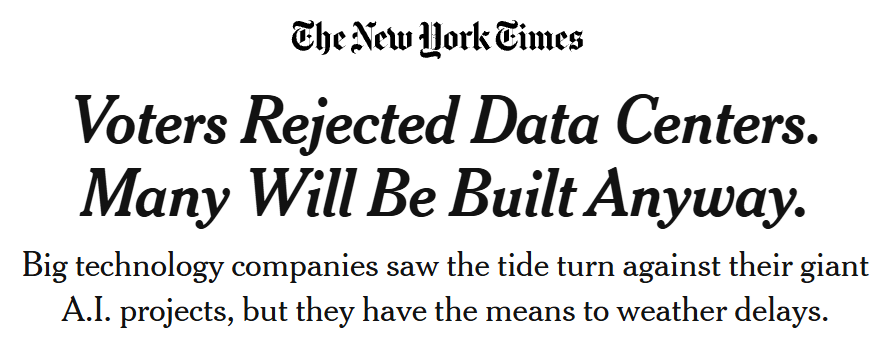
That’s an AI backlash win of a stunning 98%.
No wonder Wall Street freaked out last week. It dumped tech stocks across the board on the basis that the AI buildout buoying the sector now faces an intense backlash.
The tech-centric Nasdaq Composite fell last Thursday by 5.5% on heavy volume. That put the index into a correction, defined as a 10% drop from a previous high.
Meet the 'Local AI’ Leader
As tech investors, what we’re looking for is a firm that can profit from the AI buildout over the next decade. But we also want to find one that doesn’t need massive new data centers to succeed.
That’s where Silicon Valley legend Apple (AAPL, “B”) comes into play.
Just months ago, it was clearly an AI laggard behind other Big Tech players.
But in a dramatic recent shift in its strategy, the company announced it is going to focus on what I call “local AI.”
On Oct. 15, Apple and Meta Platforms (META, “B-”) announced a surprising partnership involving Meta’s newest AI technology.
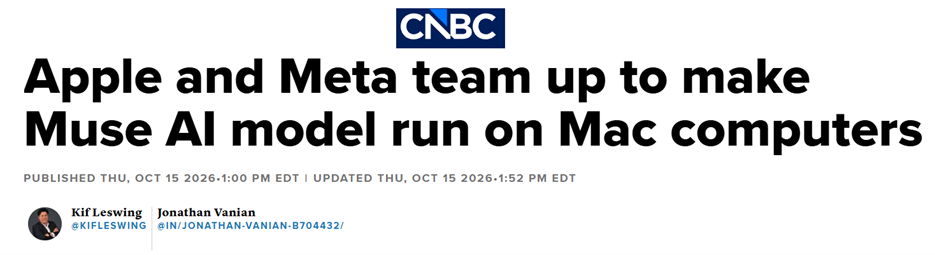
The centerpiece is a powerful AI model called Muse Spark Open.
Unlike many AI systems that rely on massive remote data centers, this model has been optimized to run directly on Apple’s high-end Mac Studio computers.
Running AI locally can give users greater control over their data while reducing their dependence on outside computing services.
For Apple, the partnership also provides something it desperately needs — access to advanced AI technology developed by another industry leader.
And Meta gets an opportunity to put its technology in the hands of developers using Apple’s powerful computers.
It’s a win-win.
To be clear, this partnership isn’t a replacement for Apple’s entire AI strategy. The company is also working with Google to improve Siri.
The revamped Siri can find information buried in emails and messages, understand what's on a user's screen and carry out tasks across apps.
Apple’s $5 Trillion Man
Apple designed the system to handle some AI processing directly on its devices, while sending more demanding tasks to secure cloud servers.
The advantages of local AI are faster speeds, greater privacy and less reliance on expensive cloud computing.
It’s not every day that a new CEO inherits a $5 trillion empire. But that’s exactly what John Ternus did last month when he succeeded Tim Cook as Apple’s CEO.
On Oct. 14, Apple became just the second company in history to close with a market value above $5 trillion.
And Ternus, who worked under Steve Jobs and Cook, is already putting his stamp on the company.
Beyond AI, Apple has unveiled two promising new products.
The first is the $1,999 iPhone Duo. It unfolds into a display that doubles the room for watching videos, working and multitasking.
The device gives Apple a new hook in the $613 billion global market where it already has a commanding 50% share of sales.
Then there's HomeView, Apple's new $299 smart-home device. Unveiled last month, it features a seven-inch touchscreen, facial recognition and an upgraded Siri assistant.
HomeView can recognize individual household members and deliver personalized information, from calendars and reminders to other everyday tasks.
It gives Apple a new hook in the smart-home market that Grand View Research says will be worth $887 billion by 2033.
No wonder Apple’s stock is crushing the tech-centric index, which after the recent correction, is off about 2.8% over the last six months.
By contrast, over that same period, Apple has gained 21.6%.
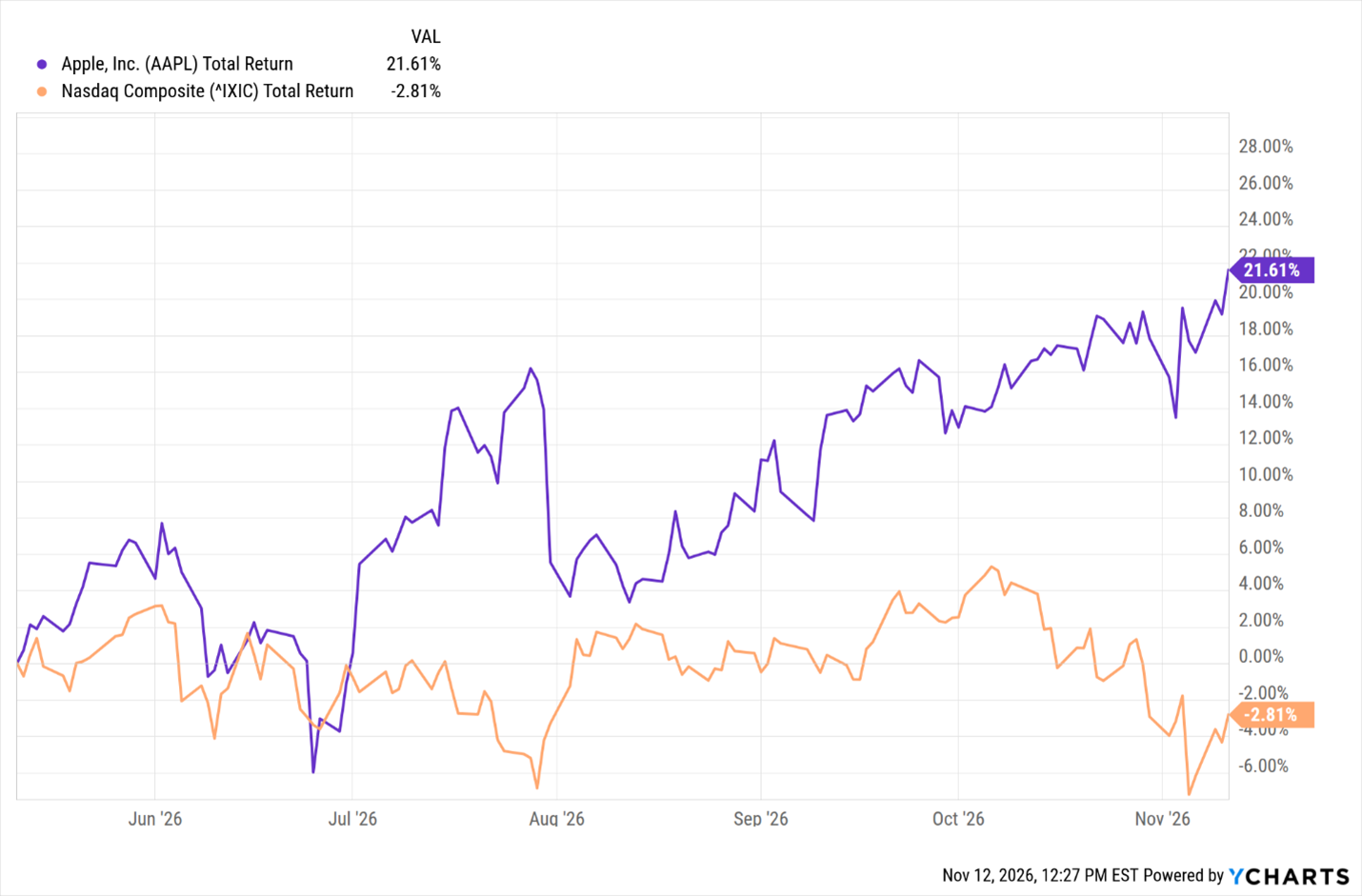
In other words, despite the AI backlash — or perhaps because of it — Apple remains a great long-term investment.
Best,
Michael A. Robinson
P.S. The political landscape surrounding AI is also one reason why I’m not betting on Anthropic’s IPO just yet. Instead, I found an “Anthropic IPO Loophole” to play it.