Why Big Pharma Is Suddenly Obsessed with Zero Gravity
 |
| By Michael A. Robinson |
Space is still the hottest trade of the summer.
SpaceX (SPCX) shares fell after its record-breaking IPO.
But even if individual stocks fluctuate day to day, the space-tech industry is unstoppable. That’s according to my colleague Sean Brodrick, an expert on market supercycles.
Now more than ever, Sean believes select space stocks belong in your investment orbit. And he’s mining for the next stocks to ride the growing space-tech wave.
Or, should we say, the coming space-biotech wave. One that SpaceX is part of, as well!
Commercialization Is Now the Watchword for This Sector
Indeed, Morgan Stanley predicts the space economy will hit $1 trillion-plus by 2040.
Thanks to SpaceX and others, we have greatly improved our ability to launch rockets and satellites into low-Earth orbit.
Turning far-out ideas and theories into new paths to sales and profits is fast becoming a new reality.
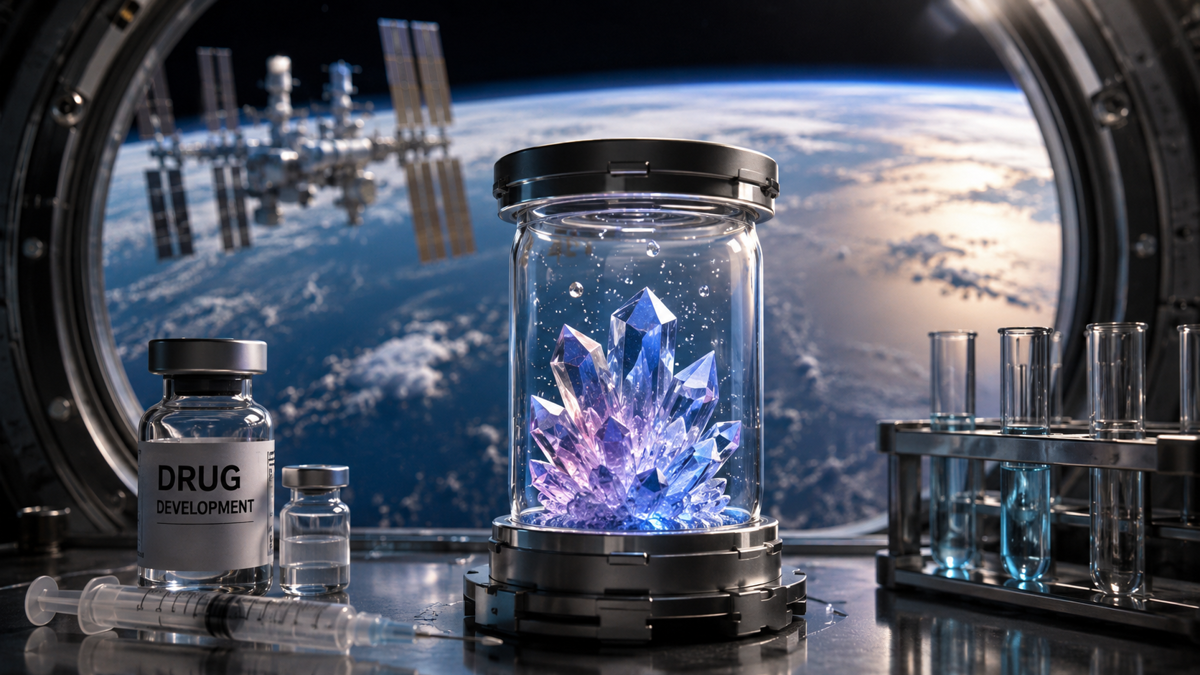
And that's just what we're seeing with the out-of-this-world business of space-based drug development.
From Skylab to a Pharma Contract
Don’t get me wrong.
Even though it sounds far out, crafting drugs in outer space is not a new idea.
In the 1970s, NASA and the European Space Agency ran the first microgravity experiments aboard Skylab and Spacelab.
Researchers poked at how spaceflight changed microbial growth, cell behavior and, crucially, how proteins formed without the effects of gravity.
One breakthrough they found is that in orbit, protein crystals grow cleaner.
Eventually, the International Space Station made a space lab.
Firms like Merck (MRK) and Bristol-Myers Squibb (BMY) started running experiments.
Then came the proof point …
Merck used ISS research to make bigger, more pure crystals of its best-selling cancer drug Keytruda — which hauled in nearly $32 billion in global sales last year — in microgravity.
That opened a path to remake the drug back on Earth from a two-hour IV drip every three weeks into a quick subcutaneous shot.
That reformulation won FDA approval in 2025.
This kicked off a new industry of space-based R&D and, ultimately, products for paying customers.
United’s New Pharmaceutical Payloads
On May 13, United Therapeutics (UTHR) signed a deal to pay Varda Space Industries, a private startup most investors have never heard of, to develop new drugs for it in orbit.
Varda flies small, autonomous, hypersonic capsules — it just brought its sixth capsule back through the atmosphere over Australia — buying rides to orbit on SpaceX's Transporter missions.
It runs its manufacturing step in microgravity. Then it parachutes the payload back to a desert landing site within weeks.

Varda also built a new 10,000-square-foot manufacturing plant in El Segundo, California, to test new apps before trying them in space.
UTHR is paying Varda to hunt for new crystal forms, or polymorphs, of its rare pulmonary-disease drugs. The goal is to chase better stability and the same IV-to-injectable upgrade Merck pulled off.
“What we’re doing is we’re introducing a gravity knob to the pharmaceutical industry in the same way that refrigeration introduced a temperature knob 100 years ago,” said Varda CEO and co-founder Will Bruey.
Varda spends about 80% of the hundreds of millions it has raised so far for dual-use re-entry vehicles that can be used for defense or pharma missions.
The idea is that the defense missions for the U.S. government can help spread the upfront risk to drugmakers for their own commercial aims in space.
Why Making Drugs Without Gravity Works
On Earth, gravity makes crystals sink and currents churn, leaving drug defects.
Remove gravity and proteins crystallize uniformly, with fewer flaws and sharper structure.
That uniformity lowers a biologic drug’s viscosity, which is precisely what helps convert a hospital IV into an at-home injection.
The same trick lets cells grow into better 3D tissues and organoids. And it lets researchers model osteoporosis, cancer and aging in ways no ground lab can match.
The payloads are tiny. An active ingredient that can make hundreds of millions of vaccine doses fits in a couple of milk jugs, but the value is enormous.
The Only Liquid Way to Play It
For investors looking for a public company diving into the trend, Redwire (RDW) is a solid play in the space.
NASA gave Redwire a $25 million, five-year contract back in August 2025, for biotech and other mission services.
And this March, NASA gave the company another $4 million contract for drug-development work using its PIL-BOX lab hardware.
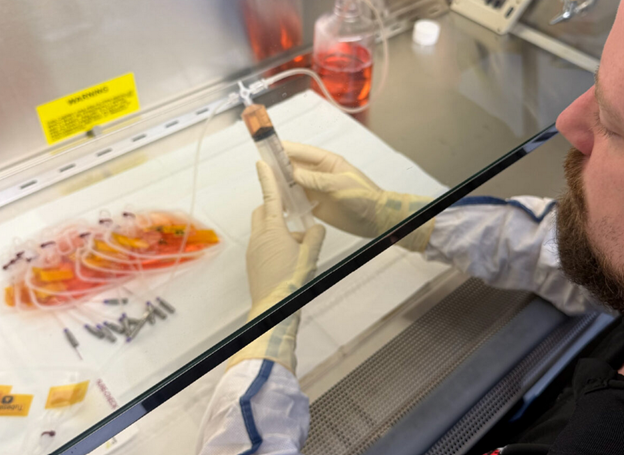
Redwire’s PIL-BOX is the firm’s microgravity platform used by researchers to grow high-quality protein and drug crystals in space.
The company has launched 54 PIL-BOXes to date.
Its customers include the Eli Lilly (LLY), Bristol-Myers Squibb and Aspera Biomedicines, whose space-grown cancer compound Rebecsinib launched on a recent SpaceX crew mission.
Redwire's SpaceMD venture aims to grow seed crystals in orbit and replicate them cheaply on Earth — a less risky path to drug development of this kind.
Azenta (AZTA) also inked its own orbital-research partnership in February.
Both RDW and AZTA are still speculative Weiss-rated plays at the moment, but worth keeping an eye on as the sector advances.
Of course, there are plenty of other ways to profit from the space industry’s trillion-dollar boom.
In fact, Sean is hosting special event in just one week on his favorite ways to play it. None of them are SpaceX.
Best,
Michael A. Robinson