20 Low-Debt, Weiss ‘Buy’-Rated Stocks That Beat the Market by 15 Points or More

|
Key Takeaways
|
 |
| By Mandeep Rai Reviewed by: Dawn Pennington |
A technology selloff can become a bigger investment story when its effects reach beyond technology.
The heavily exposed Philadelphia Stock Exchange Semiconductor Index (SOX) fell 20% from early October to current.
Some names fell even harder. Intel (INTC, “D+”), Teradyne (TER, “C+”) and Marvell (MRVL, “C”) each gave back 40% or more.
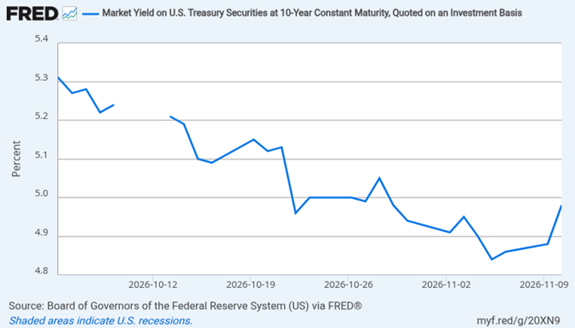
The 10-year Treasury yield fell roughly 45 basis points at its low point in early November, and the breakdown suggests investors were responding to more than a flight to safety.
Changing expectations for monetary policy account for the largest share of the move for much of the period. Risk sentiment also contributed heavily in recent weeks.
The implication deserves attention …
If expectations for AI spending weaken, investors may need to consider the consequences for suppliers, business investment and economic growth. Not just the prices of today’s hottest technology stocks.
Why This Matters For Your Stock Portfolio
AI exposure can extend beyond an obvious holding in a chipmaker or software company.
Equipment suppliers, construction firms and other businesses serving the infrastructure buildout can also depend on continued investment.
That raises the question: How many of your holdings ultimately rely on the same spending cycle?
The bond move is a reason to examine portfolio exposure, not a forecast of an AI-driven economic downturn. For stock selection, the practical response is to broaden the research list.
Look Beyond the AI trade
Our Weiss screen looks for “Buy”-rated stocks that are holding their ground in a weaker market, with financial strength and business drivers that can be examined outside the direct AI infrastructure chain.
To qualify, a stock had to meet every one of these requirements:
- A current Weiss “Buy” rating (“B-” or better), with a rating index stable or improving compared with a month earlier.
- A primary listing on a major U.S. exchange.
- Positive net income over the trailing 12 months.
- A debt-to-equity ratio of 0.50 or less, meaning no more than 50 cents of total debt for every dollar of common shareholders’ equity.
- A market cap of at least $500 million, a share price of at least $5 and average daily trading volume of at least $2 million
- A positive total return and outperformance of the S&P 500 total return over the last 30 days.
Financial-sector companies were excluded because their balance sheets call for a different approach to evaluating leverage.
Here’s that list of the top 20 stocks ordered by outperformance %.
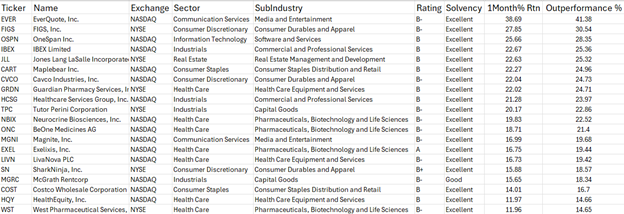
The S&P 500 fell about 2.7% over the period, so even the weakest performer on the list, West Pharmaceutical Services at 11.96%, beat the index by nearly 15 percentage points.
A few things stand out.
Healthcare accounts for seven of the 20 names, so the list swaps one concentration for another.
Four are industrials, three consumer discretionary, two each communication services and consumer staples, and one each information technology and real estate.
All but one carry a Weiss solvency grade of “Excellent.”
McGrath RentCorp (MGRC, “B-”) is rated Good, and Exelixis (EXEL, “A”) is the only “A”-rated stock on the list.
Names closest to technology by sector label, such as OneSpan (OSPN, “B”) and Magnite (MGNI, “B-”), deserve the closest look at where their revenue comes from.
These characteristics make the companies worth examining further, although they do not guarantee continued outperformance.
Lower Yields Call For A Closer Look, Too
A bond rally can open another avenue for research: companies that may benefit from lower financing costs. But the reason yields fall matters.
Cheaper financing can help some businesses, while weaker demand can hurt the earnings of others. Lower Treasury yields also do not guarantee a matching decline in corporate borrowing costs.
That makes financial strength an important part of the selection process. A company with manageable obligations and resilient operations is a different proposition from one that needs falling rates to relieve financial pressure.
The bond market is raising a broader question about the economic reach of the AI investment cycle, and Weiss ratings help bring that question back to individual stocks. The next step for readers is to look at which Buy-rated companies are maintaining their strength, and how dependent their prospects are on the investment theme driving the headlines.
Best,
Mandeep