 |
| By Marija Matic |
It’s a tough market out there.
With Bitcoin still sitting near what Juan Villaverde’s Crypto Timing Model suggests could be a long-term bottom, the broad sentiment remains cautious and fearful.
At least, it is if your strategy relies on capital gains. But with DeFi, your options greatly expand.
My Crypto Yield Hunter members, for example, target yield opportunities on the blockchain. This approach means we can pull value from our crypto, no matter the market.
When times are good, we enter “risk-on” mode to target high double- and even triple-digit yields.
And when times are tougher, we go “risk-off” with delta-neutral strategies. Insulated from the broad volatility, this method allows us to earn … even when the market drops.
Related story: Earn Income from Your Bitcoin, No Matter the Market
But not all yield opportunities are the same.
The median APY trend in crypto, based on DeFiLlama data, is barely 1%.
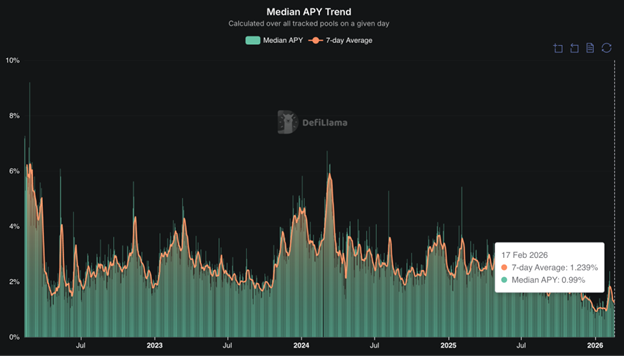
The highest in the past 365 days was only around 3.5%.
Meanwhile, the delta-neutral strategies my Crypto Yield Hunter Members go for typically yield around 10%, though our more niche plays can go over 17%.
That’s a massive outperformance!
And remember, this is the quiet version of our portfolio, due to market conditions. When prices run and trading volume explodes, yield soars to match.
Naturally, this raises a question: If these opportunities exist, why isn’t everyone doing them?
Because finding them isn’t easy.
Being good at DeFi isn’t just about chasing high APY numbers on dashboards. In fact, that’s usually how people end up in the worst positions.
The real skill lies in understanding what’s behind the yield.
Your DeFi Yield Checklist
To consistently find good opportunities, you need several layers of knowledge.
First, you need to understand the assets themselves.
Namely, you’ll want to be able to answer …
- If a stablecoin is used, what backs it?
- Where does the yield actually come from — trading fees, funding rates, emissions, leverage, etc.?
- Is the mechanism sustainable, or is it slowly draining itself?
These questions are all concerned with how sustainable the yield opportunity is. Many pools look attractive on the surface … but fall apart once you examine the mechanics like this.
Second, you need to understand the platforms.
A strategy is only as strong as the infrastructure it runs on. Which is why you need to know as much as possible about the platforms promising the yield.
That includes who built it and what experience they have …
What stress-tests and audits have been done …
Whether there is sufficient liquidity …
And whether there is an active, engaged usership … or if users are being subsidized to stay.
The answers will tell you a lot about the strength, resilience and potential growth of a platform. Which directly play into how secure your deposit will be … and how sustainable the yield is.
Third, you need to understand market structure.
Some of the best opportunities appear only under specific conditions — high funding rates, volatility spikes or temporary liquidity imbalances.
If you don’t understand what drives those conditions, you won’t recognize the opportunity when it appears.
And just as importantly, you won’t know when it’s time to exit.
Fourth, you need patience and selectivity.
Good opportunities are not evenly distributed through time. Weeks can pass with nothing interesting to do. Then suddenly, three strong setups appear at once!
Most people lose money because they feel the need to always be in something.
I used to make that same mistake. But in DeFi, the importance of patience means that doing nothing is often a position.
Finally, you need risk awareness.
Smart contract risk, liquidity risk, oracle risk, counterparty risk …
None is theoretical. They are all part of the landscape. And all need to be understood and weighed before you can enter a pool.
A good strategy isn’t just about maximizing yield; it’s about maximizing yield per unit of risk.
That’s the real game.
This is why I don’t jump into every new farm. And why most of what I and my members do might tend to look boring on the surface. Especially in certain market conditions.
But our goal isn’t excitement; it’s steady, repeatable returns.
When you approach DeFi that way, the difference between a 1% market and a strong portfolio stops looking like luck.
And reveals itself to be a carefully thought-out process.
I hope that this checklist will be the start of your own careful process to beat the market.
Best,
Marija Matić
P.S. Each month, I give more DeFi insight in my Weiss Crypto Investor column. If you’re interested in learning more — and hearing directly from cycle’s expert Juan Villaverde which cryptos his Timing Model says to buy next — click here.