A Single CBDC Reveals Weakness in USD Dominance
 |
| By Bob Czeschin |
The GENIUS Act specifically prohibits U.S. stablecoins from paying interest to those who hold them.
This was done at the behest of the banking lobby. U.S. banks didn’t want any competition for the depositors they need as a source of low-cost funds for commercial loans.
And that’s unlikely to change once the CLARITY Act is finally passed. Again, the banking lobby stepped in, asking for a distinction between stablecoin yield earned from real economic activity — like staking or transaction fees — and a stablecoin that accrues passive interest.
The former is still ok. But it is increasingly likely that the latter will remain banned in the U.S.
This concession doesn’t just have domestic ramifications, however. The impact echoes out all the way across the globe. To China.
In fact, it opened a door so enticing that Beijing walked right through it.
Last month, the digital yuan (e-CNY) became a yield-bearing instrument.
Technically, the digital yuan isn’t actually a stablecoin at all. First launched in 2020, it’s a legal-tender tokenized deposit, issued by the central bank and distributed through commercial banks.
More simply put, it’s a central bank digital currency, or CBDC.
My colleague Jurica Dujmovic has argued the pros and cons of CBDCs versus stablecoins before. But in this case, the distinction means the e-CNY remains a liability on the balance sheet of the commercial bank. It’s also covered by deposit insurance — just like regular deposits. Commercial banks pay interest on e-CNY and can invest or loan them to others.
In phased rollouts across China, the e-CNY has been widely used for tax rebates, subsidies, medical insurance payments and other public-sector disbursements.
Inside China, you can open an e-CNY account with only a phone number. The app lives on your mobile phone (or tablet) and connects to popular online payment platforms — such as Alipay and WeChat.
Moreover, it’s engineered to work with or without an internet connection. If you’re at a coffee shop with no Internet, you can still pay for your brew.

Chinese tourists in Hong Kong, Macau, Laos, Thailand, Cambodia and Singapore can use their e-CNY wallets to pay local merchants.
There are also pilot programs that allow foreign visitors to China to open e-CNY wallets. And top them up using credit and debit cards from outside China.
Five years after its first pilot launch, the e-CNY stands alone as the world’s largest central bank digital currency experiment. As of November 2025, it processed more than 3.4 billion transactions worth roughly $2.3 trillion (16.7 trillion e-CNY).
That represents a more than 800% increase from 2023. And that’s likely just a drop in the bucket compared to what lies ahead.
But what caught my attention is the fact that the e-CNY is bearish for the U.S. dollar in two big ways.
Bear Attack 1: Dollar Stablecoins in the Crosshairs
The first bearish impact is that the e-CNY is a small but not insignificant attack on U.S. dollar dominance in the still-young stablecoin market.
See, cryptocurrency trading and mining are prohibited inside mainland China. But that hasn’t kept U.S. dollar stablecoins from becoming a significant source of liquidity and a growing tool for cross-border payments.
This is a bit of an embarrassment to Beijing — especially after Trump made “being No. 1 in crypto” a national priority.
Accordingly, a key aim of the e-CNY is first to end dollar dominance of the stablecoin market inside China. And then, the rest of the world.
To do this, the Chinese identified a flaw in America’s stablecoin model. And are quietly positioning the e-CNY to exploit it.
And we can trace it back once again to the GENIUS act, which requires regulated stablecoins be 100% backed by U.S. Treasuries.
This prohibits interest payments to token holders and effectively ensures that issuers focus entirely on facilitating payments. And NOT making commercial loans — that could go bad in an economic downturn.
But e-CNY designers say this is not enough to ensure real safety.
Because even when regulated, U.S. dollar stablecoins won’t be federally insured.
What happens when coin holders rush to redeem their tokens for dollars? Will issuers have no option but to raise money by dumping Treasury bills in a fire sale?
I say that’s likely.
In fact, somebody is going to get a haircut. Because regulated stablecoin issuers have no access to government guarantees or the Fed as a lender of last resort.
There’s only one way to be bulletproof in such a crisis. That is for the stablecoin NOT to be some kind of intermediary or custodian of money. But actual, legal-tender digital money itself, issued by a sovereign country central bank.
And in this respect, the e-CNY is already No. 1 in the world.
Bear Attack 2: The Dollar’s Vehicle Currency Advantage
The e-CNY follows up its first hit with a skillful combo.
Not only does it threaten the dollar’s supremacy on-chain. It also accelerates the global move away from dollars for cross-border payments.
In roughly 40% of currency transactions involving the dollar, the greenback functions as a vehicle currency.
Someone in Zurich needs to pay a bill in Manila. But the Swiss franc and the Philippine peso are not a widely traded pair. So, to get this done, you first convert francs to dollars, and then dollars to pesos.
A tokenized, interest-paying e-CNY can potentially remove the dollar from its place in the process.
That’s thanks to mBridge, a cross-border digital payments platform to enable direct settlement between central bank digital currencies. Member countries presently include …
- China,
- Hong Kong,
- Thailand,
- the United Arab Emirates
- And, most recently, Saudi Arabia.
Since its inception in 2022, more than 4,000 cross-border transactions have taken place — with a cumulative value of approximately $55.4 billion.
All without the need for USD.
Notably, the e-CNY accounts for more than 95% of the settlement value.
Looking ahead, there are reports that India may be looking to link up. And possibly Russia, which has been locked out of the dollar-based global payment settlement system since President Biden was in office.
Rather than seeking to wreck the dollar outright — which would likely worsen relations with the current U.S. administration — China is playing a long game. By building parallel settlement rails that avoid dollar-based systems.
Every time another crisis raises doubt about the future reliability of America’s currency, mBridge gets another vote of confidence as a non-dollar alternative.
And the trend is moving in Beijing’s favor.
Same for stablecoins. Beijing is betting that lightly regulated U.S. stablecoins without government guarantees may not be broadly trusted outside the United States.
As that reality dawns, the e-CNY will be ready to step into the breach.
Investment Implications
Chinese policymakers are known for their long-term view of history and decades-long planning horizon. And Beijing’s economic policymakers have been watching the dollar’s fall ever since President Nixon cut it loose from gold in 1971.
Initially, the decline was modest. But it accelerated sharply during the 2008 global financial crisis, and again during COVID.
2025 was another down year. And 2026 is shaping up to give us a similar result.
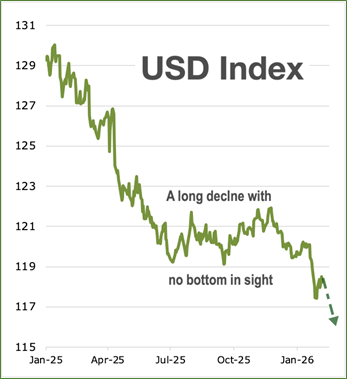
So, it’s no surprise Beijing’s e-CNY policies are not only congruent with a falling dollar … but poised to benefit from it.
You could do the same thing.
If you’re a U.S. investor, consider adding non-dollar stocks to your portfolio. The easiest way to do that is with a global stock ETF such as Vanguard Total World Stock ETF (VT).
Here’s another idea: Pick a sector you like — and maybe are already invested in domestically. Then look for non-U.S. stocks in the same sector.
Instead of chasing AI darlings on Wall Street, consider AI stocks in Taiwan, Japan, South Korea or Hong Kong.
To help you narrow down your options, Weiss Ratings Plus is a great tool to have in your kit. It helps you monitor in real time which stocks are most promising and which (if any) are best avoided.
You could also consider expanding your on-chain exposure.
Bitcoin (BTC, “B+”) in particular benefits from a falling dollar. You could even make the case — as DeFi expert Marija Matić did — that BTC has a stronger long-term bullish outlook than gold.
And, of course, as more TradFi assets are tokenized, it’ll become easier to find those non-U.S. equities on-chain, as well.
The best way to follow in Beijing’s example depends on your risk tolerance and financial goals. But no matter what, the continued threat to USD dominance in the digital economy is something no investor should ignore.
Best,
Bob Czeschin