Bitcoin Sets the Alarm for Every Altcoin Rally

 |
| By Juan Villaverde |
People constantly ask why I don't cover this or that altcoin in my weekly updates.
Why every video, every issue, every model I run … always comes back to Bitcoin (BTC, “A-”).
That’s because there’s only one timekeeper in crypto. And it’s Bitcoin.
Yes, if you zoom in, individual projects may have their own cycles.
But their strengths are nothing when compared to Bitcoin’s.
Because, ultimately, when Bitcoin runs to its peak or bottoms to its trough, it’ll pull the altcoins wherever it wants.
Take Ethereum (ETH, “B+”) for example.
It’s the largest altcoin by market cap, it’s the most established project in crypto after Bitcoin. And it has decorrelated from Bitcoin in the past … to a limit.
But the timing of Ethereum's 320-day-cycle highs and lows and the timing of Bitcoin's highs and lows are the same. Not similar — the same.
Draw a vertical line at a Bitcoin turning point and it lands on Ethereum's turning point too.
Marching to the Same Beat
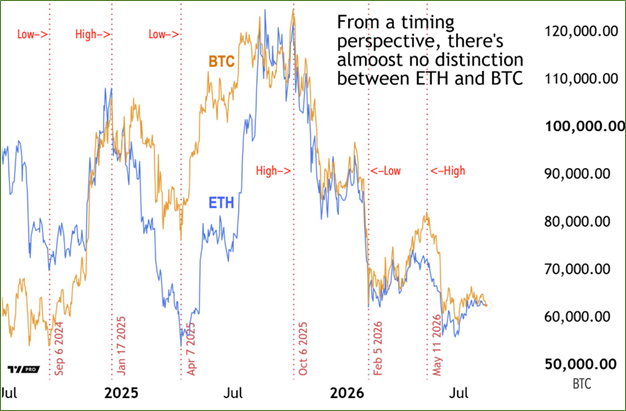
It’s the same for all altcoins. In terms of time, you are looking at the same asset.
This isn't unique to crypto. It's what happens whenever you have a family of assets of the same kind.
That’s why I never bother with a silver chart when it comes to seeing where we are in the cycle. Because it’s the same as gold, in timing terms. The highs and lows line up.
There is no separate silver clock to study.
Same with the stock market. Every major U.S. share index tops and bottoms at roughly the same time. Study one, and you've got the turning points for all of them.
Now, this doesn't apply across borders. If you want to know when the Chinese stock market turns, study China, not the U.S.
But within a family, one clock rules.
In crypto, it’s Bitcoin.
It's where I get every date and every turning point. And Bitcoin is the one asset that Japanese liquidity actually predicts — which is why my forecasting work runs on Bitcoin and, deliberately, only on Bitcoin.
This is the part a lot of folks get backwards.
They think I'm ignoring their coin. I'm not.
I'm giving them the dates for their coin — I just have to read those dates off Bitcoin.
One Question Tells You Everything
So, if the timing is handed to you, what's left to figure out?
Magnitude.
Which is where the real money is.
Because knowing when crypto turns doesn't tell you how far your particular coin will travel between turns. For that, you don't need a model. You just need to ask one question …
Did your asset rally when the market made clear it was time to move?
That's it. The One-Question Test.
Bitcoin rallying indicates the broad market should follow. So, if BTC leads the broad market higher … but your altcoin just sits there, going sideways? That is a big red flag flying.
It means there are no buyers. Not "fewer" buyers. Not "buyers waiting for a better entry." No buyers. Zip. Nada. At the exact moment in the cycle when buyers are supposed to show up.
And when the clock turns down, sellers will show up anyway. They always do, because these assets are correlated in time.
In other words, any asset that doesn’t rally when Bitcoin moves up will still fall when the broad market pulls back.
That’s a coin that’s going to make new lows. No ifs, ands, or buts!
Which is why my Crypto Timing Model sent out a wave of fresh “buy” alerts for my long-term investors over the past week.
When Bitcoin woke up and went for a run … the altcoin projects with legs joined it.
Here’s the kicker: They were identifiable in advance.
Because these projects don’t just run with Bitcoin when the big moves come. The ones most likely to keep time to Bitcoin’s rhythm even flinch when the OG crypto does.
So, even though I still foresee a sideways chop through October — potentially even a retest of support — my model said now was the time to act.
Bottom Line
To be clear, we are still solidly in the accumulation phase. Which means you still have the chance to load up on crypto’s most promising projects.
Just be sure you review the data to see if your pick can pass the One Question test. And has kept time with Bitcoin and the broad market.
Or, if you prefer, you can let my Crypto Timing Model do that work for you.
You can learn more about it here.
Best,
Juan Villaverde