 |
| By Marija Matic |
There’s something about the buzz of a convention center packed with like-minded investors.
I’ve been brimming with energy since I traveled to Miami for Consensus 2026 last week.
My goal was to gather as much information as I could from crypto’s movers and shakers to give you an edge in your 2026 strategy.
And one of the biggest X factors weighing on the market today is regulation.
What third-party platforms can do and offer with stablecoins will trickle down to almost every sector. And it can significantly impact your strategy moving forward.
That’s why the debate around The CLARITY Act has dominated headlines this year.
Last week, Beth Canova wrote about the bullish comments given by White House Advisor Patrick Witt and Sen. Kristen Gillibrand (D-NY) regarding the hotly contested bill.
Today, we got an even bigger update: CLARITY is finally headed to its committee markup.
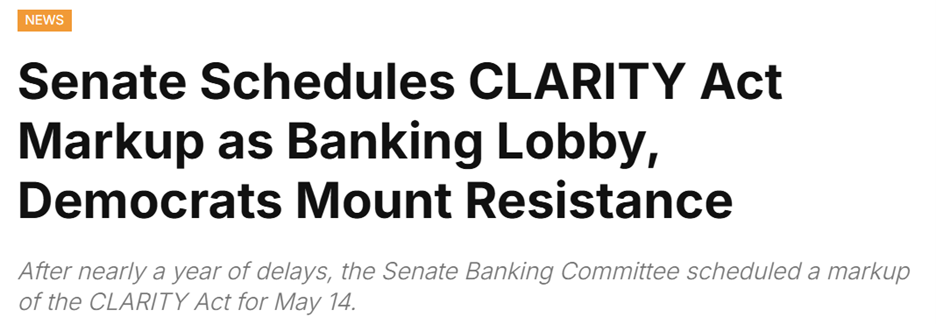
If it can pass this step, it’ll head to the Senate floor for an official vote.
In light of this, I want to share with you an interview I did with Ron Hammond at Consensus.
He’s the Head of Policy and Advocacy at Wintermute, one of the largest crypto market makers in the world. And at this time, he’s also leading Wintermute's U.S. expansion in New York.

More importantly, he brings to the conversation nearly a decade of regulatory experience and the crypto perspective on negotiations so far.
And, in our conversation, he revealed some interesting insight on not just CLARITY, but what investors can expect in a post-CLARITY world.
Marija Matić: You spent years on Capitol Hill advocating for crypto. Now, you are the Head of Policy of Wintermute and are helping shape the regulations from the industry’s side.
How do you navigate this? Does Washington treat you differently now that you are on the industry side? Was it different when you were there?
Ron Hammond: It's evolved so much. Back in 2018, I worked on the Token Taxonomy Act. But back then, no one really cared much about crypto. Fast forward eight years, and now we are at the CLARITY Act.
I've been personally involved in this stuff for almost a decade now. I am personally passionate about it. And coming from the congressional side, I know how to make this work.
A lot of the folks in Congress are older, they don't really know how this technology works. So, you have to educate them.
That’s why a lot of the legwork is done by the staff — twenty and thirty-year-olds. These junior lawyers and such, they are the ones who are really writing the day-to-day texts. Because when it comes to regulation, it’s really important to get every single word right. It’s definitely a tedious process, and there’s a lot of education involved.
And because crypto technology moves like crazy … it’s really tough to write future-proof legislation. But that’s what we are here for.
But it’s a complicated issue and there are a lot of forces, like banks, who see this industry as a threat. They have been trying to clamp down on it.
So, it’s never boring. I’ll put it that way.
Marija: We've seen a lot of lobbying on both sides from institutions regarding the language of the CLARITY Act. It seems to me that institutions will end up being well off either way.
But who's lobbying for DeFi and American retail?
After the CLARITY Act passes, will ordinary American DeFi users end up with more yield opportunities or less?
Ron: The goal is hopefully more.
But that’s why DeFi has been a tough issue to deal with — it’s tough to regulate, and a lot of regulators internationally still have not tackled DeFi.
It takes a lot of education to understand why other international regulators have not been able to touch DeFi, because it is a very different beast.
But I would say, on the lobbying side, we've seen the industry really coalesce around defending DeFi. Even centralized crypto companies that might not have a vested interest to do so. Or those where DeFi is their secondary business line, like Coinbase, for example.
I would say the industry has done a really good job of uniting around very important issues for DeFi, not just their own business. The crypto forces are really combined together to work for the ecosystem as a whole, rather than trying to push for one chain or push for one exchange or push for one type of business model.
We want to make sure that we are all united, and we remain united very well on this front.
We're going against other very united groups like the banks, who have a lot of firepower. I'd say, as a lobbyist we are making sure we have a strong defense, messaging and narrative, to stay aligned.
And as you know by just looking at Crypto Twitter, it’s kind of hard to get a lot of crypto folks to agree on anything. So for that to happen in D.C. has been really refreshing.
Marija: Let’s turn to the CLARITY Act itself. As of now, it uses a very vague language when it comes to passive versus active stablecoin yield. This intentionally allows details to be decided by the agencies — SEC, CFTC, Treasury, etc. — after the act passes.
Are there any realistic timeframes for these agencies to decide on those details?
Ron: Detailed language will be decided by the agencies in about 2-3 years, if we get to that point.
Of course, the entire time the banks are going to be sending comment letters. They will be trying to lobby the agencies to try to get their side. The other side will do that, too.
So the fight's not over. Even if the CLARITY Act gets signed into law, a lot of the sticky issues are going to get kicked to the agencies.
It'll be a lot tamer than right now, though. It won't be active lobbying as much as comments, letters and public submissions. Agencies will have a tough job of coming up with very precise language, because a lot of people care about it.
Marija: So, will retail users in the U.S. continue to navigate a fluid situation regarding DeFi yields for the next 2-3 years?
Ron: Yes, but it looks like we're not having the hostile approach we had with the last administration, which went after companies that were potentially in a gray zone.
Folks who do outright fraud are still getting sued by the SEC, and rightfully so. But at least when it comes to the gray area or questions, a lot of regulators are now saying, "Come and chat with us before you launch your products, we're happy to advise as best we can.”
That's very different!
Now, at least the door is a lot more open. And we've had plenty of conversations with the SEC about our operations.
Every other company is doing the same.
Marija: In your opinion, what is holding up the Act right now? The yield issue?
Ron: The yield issue should be done. Both centers have come up with that compromise language. But as I said, I am sure the banks are going to keep fighting it and try to upend the bill in other ways.
And again, they might not put their name on it, but they're definitely going to try to tweak it further, or maybe just try to tank the bill entirely.
So, I do not think they're going to go down without a fight, so we'll see what happens from them.
There is another issue, though — the ethics issue. And it is more political, focused on the Trump family and the World Liberty Financial project.
We are in an election year in the U.S., so for a lot of Democrats, this is a great political issue to show the American people that, in their mind, the administration is corrupt.
Now, we’re seeing the political election narrative seeping into this very important bill. One camp says we need all these ethics, another camp says no.
We need about 10 Democrats to support the bill for it to move forward. They’ll need to meet in the middle, so we’ll see what happens.
Marija: Do you think the ethical questions may also be pushed to the agencies, after the bill is passed? Like with the yield issue?
Ron: Unfortunately not, since it's more political.
And the ethics issue has gone pretty mainstream. There are a lot of conversations on national television about the various things the Trump family's been involved in, with potential ethical concerns.
It is something that the American people talk about, and the Democrats are going to try to use that to get more votes in November.
It's unfortunate, but this is how Congress works sometimes.
Marija: Do you think the CLARITY Act will fragment or consolidate DeFi liquidity? And are the market makers and players already positioning around that outcome?
Ron: This could be a major unlock for DeFi liquidity.
We are seeing the institutional and retail capital flowing back into crypto post-CLARITY Act updates.
It’s weird because the bank lobbies are fighting so heavily against it. But in New York, where we're based, a lot of the counterparties we're bringing on board are the banks themselves, and they're very excited!
So, we’ll see. But I think consolidation is more likely.
Marija: What are the timelines now for the CLARITY Act itself?
Ron: The sooner the better. We're trying to do it before the end of summer. That’s when because Congress is out and on the campaign trail.
They have just three weeks in September, two weeks in November and two or three weeks in December to get this done if we miss the summer deadlines.
It's a very small window, and you have to remember there’s a lot of other stuff in U. S. politics — funding national defense, funding agriculture subsidies, etc. And every time they vote on something, it sometimes takes hours or days to vote on it.
Crypto, while big for us, may be the third or fourth priority for elected officials. So that's a very real situation to be aware of.
The time is going to be a factor.
Marija: We are seeing the crypto market reacting positively to CLARITY Act news. Do you think this means we might see continued positive price movements?
Ron: That's a hope. I think the reaction to the Genius Act was a really good example, and I think we might see that again.
It’s an example of how much money can be unlocked when there is clear, defined legislation.
Today’s news means the CLARITY Act has a path back to a potential summer vote, after a four-month stall.
If Thursday’s markup clears the committee, CLARITY could reach a Senate floor vote by summer,
That would be massive news.
But it’s important to keep in mind that passage in the Senate is not the finish line.
Thanks to the new language, CLARITY would need to go back to the House for another vote. And, as Ron pointed out, the detailed rules, especially for DeFi, still won't exist until regulators complete a joint rulemaking process that could take 2-3 years.
The opportunities will emerge in stages, not all at once.
This is where patience pays out.
Best,
Marija Matić