Crypto Discovered the Buyback. Here’s How to Read One.

 |
| By Juan Villaverde |
Before 1982, a U.S. company that bought its own shares looked like it was rigging the price.
Back then, the law was murky. Rather than risk any sort of legal trouble, most boards stayed away.
Then the SEC wrote a rule that gave them cover.
And the financial floodgates opened.
In 2026, American companies are on pace to spend about $1.4 trillion buying back their own stock.
Goldman Sachs (GS) expects buybacks to outpace all the new shares companies issue this year.

Meaning, stock repurchases are now removing more shares from the market than new issuance is adding.
That makes buybacks one of the biggest sources of demand in the market today.
Crypto has started doing the same thing.
A handful of crypto projects now spend what they earn buying their own tokens.
Billions have already moved.
And because the numbers are public, you can size up one of these programs in five minutes … once you know which number to read.
First, let’s define what you’re set to look at.
What a Crypto Token Buyback Is
Some crypto apps charge fees. A trading venue takes a cut of each trade. A lending app takes a cut of each loan.
For years, that money went to the team or sat in a treasury.
Holders of the token got nothing back. It was a voting chip.
A buyback changes the wiring.
The app takes that fee income and buys its own token on the open market.
Some then destroy what they bought, which crypto calls a burn. Others hold it.
Either way, real money is bidding for that token every day.
It is the same idea Apple (AAPL) uses when it shrinks its share count.
Two Numbers, and Only One of Them Counts
Every crypto project publishes its revenue. That is what the business collects in total.
What matters to a token holder is a second, smaller number. How much of that revenue goes out and buys the token.
The tracker DefiLlama publishes both. The first line is called Revenue. The second is called Holders Revenue, and the two are often far apart.
Take Aave (AAVE), a lending app. Over the past year, it collected about $108 million in revenue.
The amount that reached the token was about $25 million.
Same app, same year, 4-to-1 apart.
Read the big one and assume it is the one buying the token, and you have overstated the program by 300%.

Sizing the Program
One division tells you how big the program really is. Take what reached the token over the past 12 months, and divide by what the whole token is worth today.
Call it the buyback yield. It is the crypto version of a dividend yield.
Here are the five largest programs running today:
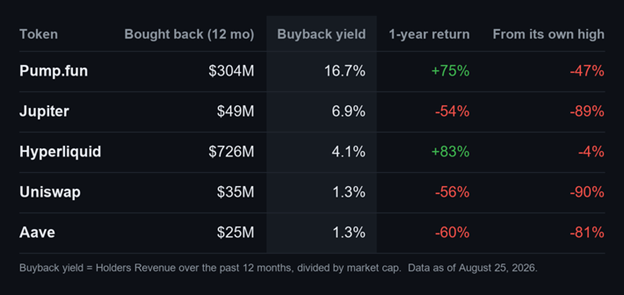
Pump.fun (PUMP) bought about $300 million of its own token against a $1.8 billion value. That is nearly 17%.
Jupiter (JUP) bought about $49 million against $710 million. That is about 7%.
Hyperliquid (HYPE) bought about $725 million, the largest sum in crypto, against $17.8 billion. That is about 4%.
Uniswap (UNI) bought about $35 million against $2.7 billion. That is about 1.3%.
Aave bought about $25 million against $2 billion. Also about 1.3%.
For scale, the S&P 500 buys back about 2.4% of itself each year. So two of these five hand back less than a basket of blue chips.
Careful With the Next Step
The urge now is to line those yields up against price and see which ones worked.
That check is worth doing. But the answer shifts with the day you start counting, and these assets are young enough that the gap is wide.
Pump.fun shows it. Over the past year it is up 75%. From its own high last September, the same token is down 47%.
Both are true. They just begin on different days.
Measured from each token's own record, only one of the five is close. Hyperliquid sits about 4% below a high it set in late August. Pump.fun is 47% off. Jupiter and Uniswap are both near 90% off. Aave is 81% off.
Five programs over two windows will not prove that buybacks move prices. It does show what the yield is good for, and what it is not.
What the Number Actually Tells You
A buyback yield does not forecast a price. It sizes a standing bid.
That is useful in two directions.
Below about 2%, it rules things out.
Uniswap and Aave both run real, automatic programs. Both hand back about 1% a year. Whatever the news release said, a bid that small will not hold a token up.
These programs can also pause. Aave's buying has gone quiet in recent weeks, which is a reminder to check the last 30 days, not just the yearly figure.
Above 2%, it earns a closer look.
The money comes from trading fees, so the program grows only if volume grows.
That is why the interesting cases have three things at once …
A large buyback, a token well below its highs, and a believable reason volume could return.
Two out of three is a trap. Jupiter shows the shape of it.
The program pays about 7% … the token trades close to 90% below its high … and fee income is still falling.
Two boxes ticked, one open.
3 Ways These Programs Can Disappoint
While share repurchases are generally viewed as favorable in the TradFi world, crypto token buybacks still have some challenges.
Buying is not always burning. Some projects destroy what they buy. Others park it in a fund while holders decide later. Both create daily demand. Only one cuts supply for good.
New supply can outrun the buying. A project can spend $300 million a year on its own token and still release more than that through unlocks and airdrops. The bucket has a hole in it.
The income swings hard. Crypto industry revenue fell 23% in the first half of this year, from $61 billion to $47 billion. These programs shrink just when a token most needs help.
What to Do Before You Buy a Crypto for Its Buyback
Crypto spent a decade selling stories about what tokens might one day be worth. A buyback is the first common way to tie a token to something you can count.
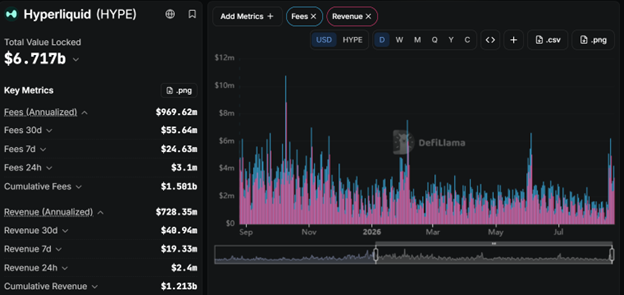
Look the project up on DefiLlama, find the Holders Revenue line instead of the Revenue line, take the past 12 months, and divide by what the token is worth.
Under 2%, the story is doing all the work.
Above it, you have to ask the same question you would ask of any firm buying back its own shares. Is the business growing?
That one is harder. It is also the only one that matters.
Best,
Juan