 |
| By Marija Matic |
A few days ago, someone on Cow Protocol — a well-regarded decentralized exchange aggregator — made a mistake they won’t soon forget.
This user accidentally swapped $50 million Tether (USDT, stablecoin) … for approximately $36,000 worth of Aave (AAVE, “B-”).
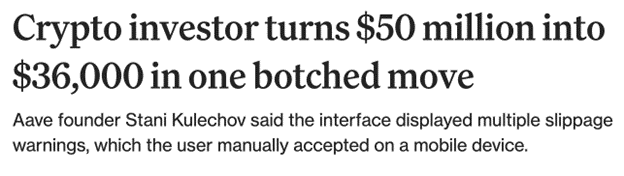
In practical terms, they lost $49,964,000 in a single transaction.
Here’s the kicker: It was entirely a user error.
The platform had warned them this would happen. A pop-up explicitly flagged that the trade would result in extraordinary slippage. They clicked through it anyway.
That’s why the community is still buzzing about it.
And that’s why I’m revealing the lesson this user should have learned. Before you do something similar.
Trading pools with shallow liquidity are easily moved.
And AAVE, unlike Bitcoin (BTC, “B+”) or Ethereum (ETH, “B+”), is a smaller-cap cryptocurrency. It has limited liquidity across most decentralized venues.
So, trying to buy $50 million of it in one transaction … is a bit like trying to drain a lake with a garden hose.
The moment you start, you've already moved the market against yourself.
That’s exactly what happened in the Cow Protocol transaction. In response, Aave has now added a hard 25% slippage cap to its interface.
This means that transactions with a price impact above that threshold simply won't go through.
It's a reasonable guardrail, though it doesn't fully substitute for understanding what you're doing before you click “Confirm.”
The incident is a useful, if expensive, reminder: decentralized finance operates differently from a traditional exchange.
There's no customer support line. No reversal. No one to call. The blockchain executed exactly what it was instructed to do.
Which means you need to be exact in your instructions.
So, here's what you should know before buying crypto on a DEX.
1. Always check liquidity.
This is one “X” factor that most people forget. And it’s easy to see why: Liquidity isn’t really a concern for the large-cap blue chips most people trade.
Trading pools on DEXes for BTC, ETH, Solana (SOL, “B-”) and the like are deep enough that most retail-sized purchases barely register.
But once you move into smaller assets — and smaller DEXes — liquidity becomes the variable that determines whether your trade executes cleanly … or tears a hole in the price.
Fortunately, there is a simple way to check the liquidity for the coin on your watchlist.
Just go to CoinGecko, find your crypto, then scroll down a bit to the Markets section on its price page. Next, look at the +2% depth figure.
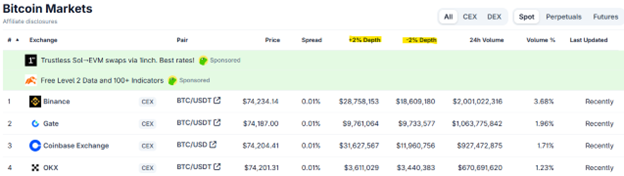
This number tells you how much you can buy before your purchase alone drives the price up by more than 2%. Above, you can see this figure for Bitcoin across its markets.
(Notice how it changes based on the exchange.)
The -2% depth shows the same on the sell side.
Now, compare that to AAVE’s markets page, filtered to show only DEXes.
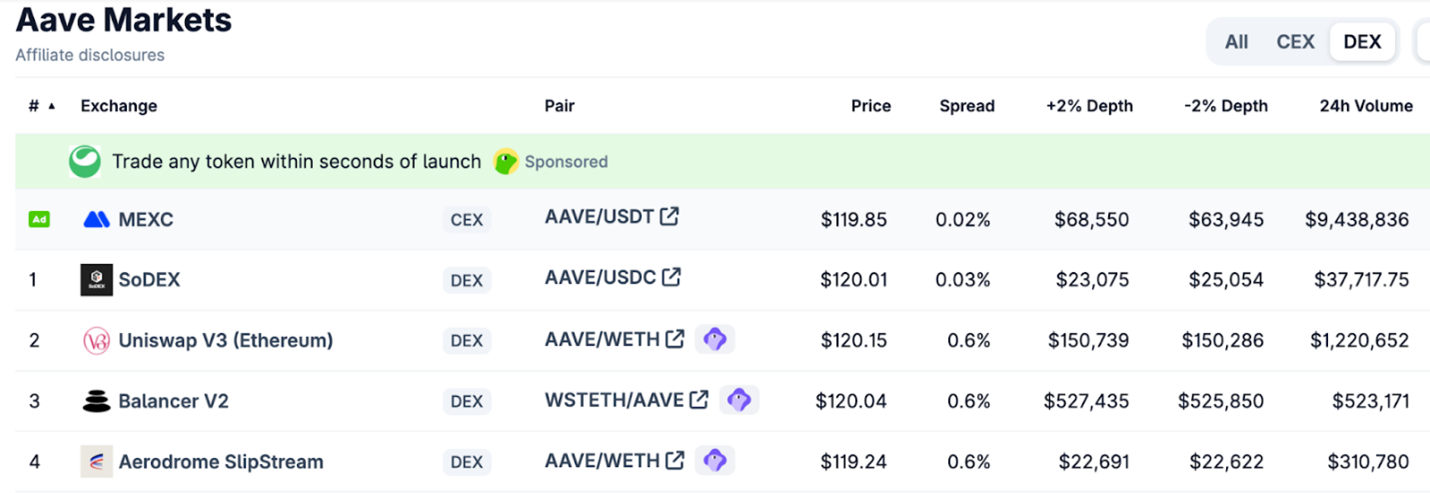
The contrast is telling.
Some centralized exchanges may carry enough depth to absorb a $5 million AAVE purchase in a single transaction without much drama.
But on the decentralized side, your situation changes.
Buying $100,000 worth of AAVE on Uniswap (UNI, “B-”) in one go is perfectly reasonable. As you can see above, the liquidity is there.
But $50 million in a single transaction? The pool simply can't handle it cleanly.
Which means the price impact will eat you alive.
That's not a flaw in decentralized exchanges so much as a reflection of how liquidity naturally concentrates differently across market structures.
2. Always read the quote before confirming your transaction.
Every reputable DEX interface will show you a route and price impact estimate before you hit the swap button.
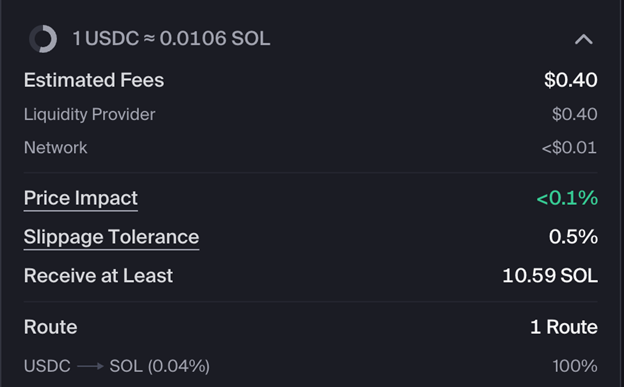
This step takes a second and exists precisely to prevent what happened last week.
If the price impact number looks alarming, it's because it is alarming.
Whatever you do, don’t just ignore the price impact and hoping for the best.
3. Use an aggregator for larger trades.
A decentralized aggregator can help you get your crypto for the best price.
That’s because they don’t just offer a single route, like most DEXes do. Aggregators search the network you’re on for multiple paths. Then, they split your order behind the scenes, routing pieces of it through multiple liquidity pools simultaneously before delivering the purchased token to your wallet.
The effort it abstracted away so users never see it. But the difference in practice is meaningful.
Two Ways to Control Your Transactions
Let’s say you did your research.
You found an aggregator with sufficient liquidity on your target asset that will use the most cost-effective routes.
But you have a large order. So even though the price impact is low, it is still worth it to run the numbers.
Take the example below:
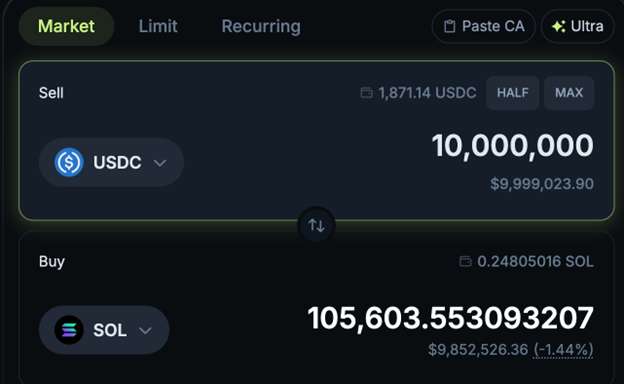
This shows a potential $10 million SOL purchase on Jupiter. A quick look at the lower right corner shows a 1.44% price impact.
Scaled up for this trade, that would result in you walking away with roughly $9.85 million in actual value. A whopping $147,000 eaten by the price impact.
So, how do you limit the loss further?
Cut your trades down to size. Run that same $10 million as ten separate $1 million trades instead, and the impact per transaction falls to around 0.07%.
A few extra clicks to save $140,000 is probably worth your time.
The principle is straightforward: The larger the trade relative to available liquidity, the more it should be broken up.
Two or three transactions instead of one is a minor inconvenience. A sizeable chunk of your large transaction evaporating is not.
And for smaller transactions, be sure to confirm your slippage allowance. You can always adjust it to narrow the amount you want to tolerate.
You Hold All the Control
Decentralized finance offers something centralized exchanges genuinely can't: Complete control over your assets.
No frozen funds. No corporate counterparty making bad decisions with your assets. No single point of failure.
But the flip side to this ultimate control is ultimate responsibility.
Using DeFi to its full potential requires a few extra seconds of attention before you hit “Confirm.” Check the liquidity, adjust your slippage, read the quote and break up large trades.
Yes, it is more effort than you put into your transactions on CEXes. Or even in TradFi.
But the $50 million lesson has already been paid for by someone else.
You might as well learn from it for free.
Best,
Marija Matic