Ethereum’s Staking Boom Sends a Broad Bullish Signal

 |
| By Marija Matic |
The recent rally wasn’t just a cause for celebration for those chasing capital gains. It’s created a new harvest for yield hunters!
A record share of Ethereum is staked. That is, it’s now locked up earning yield — and almost nobody is trying to leave.
If you come from the traditional markets, here's how it works: Staking is when you put your ETH to work to secure the Ethereum network. In return, you’re paid a yield for it.
The process is conceptually closer to earning interest on a deposit or coupon on a bond than to day-trading.
The current network rewards sit near 2.62% a year. The catch is that locked ETH isn't instantly spendable — there's a waiting line to enter and a waiting line to exit, a bit like the settlement and redemption windows on certain fixed-income products.
That’s the background information. Here’s the story: The line to get in is long. The line to get out? Empty.
As of Aug. 17, ETH reached a 34.9% staking ratio, the highest ever.
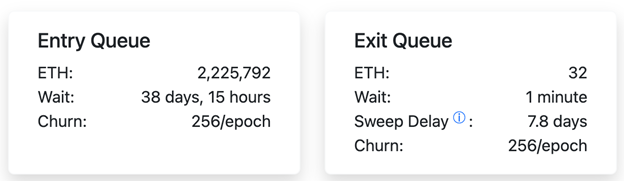
To keep the network stable, only about 57,600 ETH can be activated per day. So new stakers form a queue.
More than 2,200,000 ETH is waiting in line, translating to a wait of roughly 38+ days before your capital even starts earning.
That's actually an improvement. The wait was over 40 days for most of this year (blue line):
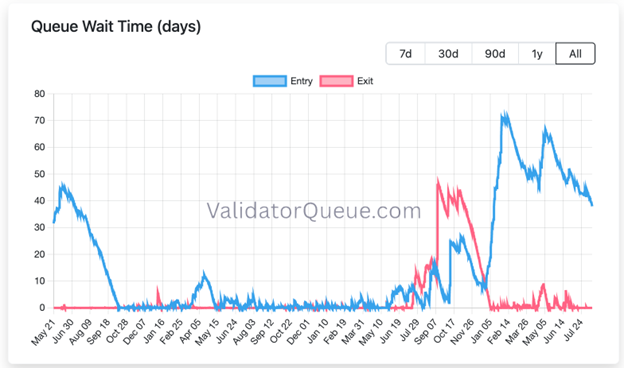
Now look at the other door (red line). The exit queue wait time — people trying to unstake — is sitting at essentially zero.
Think about what that means in plain terms: Thousands of participants are willing to wait over a month, tie up capital they can't touch and nobody wants to redeem.
When the entry line is around the block and the exit is deserted, that's a conviction signal in any market.
Who's Doing All This Staking?
A few years ago, staking was mostly a crypto-native activity. In 2026, Wall Street is sneaking in. And there are two names that deserve a plain-English introduction.
Lido (LDO, “C-”) is the largest liquid staking provider.
"Liquid staking" solves the lock-up problem: You deposit ETH with Lido, and it hands you back a receipt token called stETH. That token represents the ETH you locked up and shares its value. While that keeps earning yield, the stETH can be used elsewhere.
Think of it like a tradeable certificate of deposit that you can spend while it still pays interest. This is how a lot of smaller stakers lock up their ETH in a non-custodial way.
Bitmine(BMNR) is the new heavyweight.
It's a publicly traded company that stakes ETH on its own balance sheet through a platform it brands MAVAN — "Made in America Validator Network."
As of Aug. 17, it holds 5.81 million ETH in treasury,with about 5.07 million actively staked. That position generates over $257 million in annualized staking revenue — making it the single largest corporate staker on Earth.
How People Actually Stake
There are two main ways to stake your ETH and earn some extra income while you hold for capital gains without diving into the realm of decentralized finance (DeFi).
The first uses a non-custodial centralized approach. That is, you keep control of your own keys and assets.
Top of this category is Lido. Just connect a self-custody wallet — like MetaMask — choose an amount of ETH and stake.
In return, you instantly receive stETH, which continues to earn and can be used across DeFi as collateral. No lock-up on your side — you can even swap stETH back to ETH on the open market (for example, on Uniswap).
Alternatively, you can simply buy a wrapped version of stETH (called wsETH) on Uniswap, which means owning a yield-bearing staked Ethereum.
Another option is Rocket Pool. It fits a similar idea for those who want to maintain control of their own funds. Deposit ETH, receive rETH (its yield-bearing receipt token), hold or use it as you like.
The second type of staking approach is custodial. That is when you trust a company to hold the keys for you.
While you lose a bit of control, this strategy is simplest for newcomers.
Especially if you already have an account on Coinbase!
On the centralized exchange giant, staking is as easy as a few clicks if you already own some ETH on the site. Simply navigate to your ETH holding, choose "stake," then confirm.
Coinbase runs the validators and pays you a share of the rewards, minus its fee. You give up self-custody in exchange for a familiar, hands-off experience — the closest thing to a brokerage-style button.
Nuances Worth Understanding
1. Yields are falling. Demand is rising anyway.
Base staking yield has almost halved, from 5.2% in mid-2023 to 2.62% as of Aug. 17.
A big reason: Most everyday activity has migrated to Ethereum’s own cheaper "Layer-2" networks.
Normally, falling yield cools demand for staking. But recently, it's done the opposite.
When people keep buying in as the payout shrinks, they're usually betting on something bigger than the yield: the asset itself.
2. The concentration question has changed.
For years, the worry was that Lido would grow too big. Ethereum has a critical threshold at 33% of validators — cross it, and a single bug or bad governance vote at one provider could, in theory, stall the network for some time.
The community-run Lido once approached that line, peaking above 32%).
The good news: Lido has shrunk back to ~23%, partly through self-imposed limits and a major overhaul of its validator setup.
The new wrinkle: Some of that share has moved to Bitmine, a single U.S.-based public company.
So, the concern shifts from "one protocol is too big" to "one corporate board, under one government's jurisdiction, controls ~12% of the network."
A "Made in America" validator network is a great marketing line. But it also means a meaningful slice of Ethereum's security now sits squarely under U.S. legal reach.
It’s a genuine concern to be mindful of.
The Bottom Line
Strip away the jargon and look at the behavior: A record share of Ethereum is being locked away for the long haul.
The queue to get in stretches past a month. The queue to get out is empty.
Institutions — public companies, ETFs, the most conservative money in the space — are the ones leading the charge. And they're doing all of this even as the yield continues to shrink.
That tells you they're in it for more than the coupon.
This kind of conviction — patient, sticky and increasingly institutional — is about as bullish a signal as staking behavior can send.
Which leaves one question: Will you choose to boost your crypto strategy with staking?
Best,
Marija Matić
P.S. I mentioned above concern when it comes to Ethereum’s potential weak point, thanks to a concentration of stakers acting as validators on the network.
A vulnerability like that would be a bright target for any hackers with quantum computing on their side. Which is why I believe quantum security will become increasingly important for market-wide stability.
And why I want to draw your attention to what my colleague, Chris Graebe, has found: A pre-IPO company at the forefront of a disruption that “eclipses even artificial intelligence in its economic impact.”