How to Find the Strongest Tokens in Crypto

 |
| By Juan Villaverde |
Think about the best restaurant in your town.
You eat there twice a month. You know the owner. You are certain the place is going to be huge.
So, you buy $10,000 in gift cards.
Five years later, your instincts prove to be right. The owner opened four more locations and sold the company for a fortune.
But all you have are gift cards still worth the $10,000 you paid for them.
You backed the right business. You just put your money in the wrong spot to benefit from it. A gift card is a claim on a meal. A share is a claim on the profits. They were never the same thing.
Most crypto tokens are closer to the gift card than to the share.
And one of the biggest names in the industry is proving it right now. In public, with numbers anyone can look up.
The Company Tripled. The Coin Is Still Down 60%.
Ripple is the firm behind XRP (XRP), one of the oldest and best-known cryptocurrencies. It builds payment plumbing for banks.
Ripple is doing fine. Very fine.
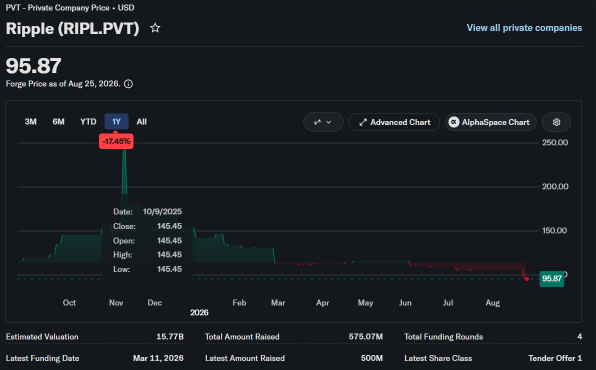
Private investors valued the company at $15 billion in March 2025.1 By June it was $28 billion. By November, $40 billion.
Then in March of this year, Ripple bought back $750 million of its own stock at a price that valued the whole firm at $50 billion.2 One tracker now ranks it the ninth-largest company waiting to go public anywhere in the world.3
Now look at its coin …
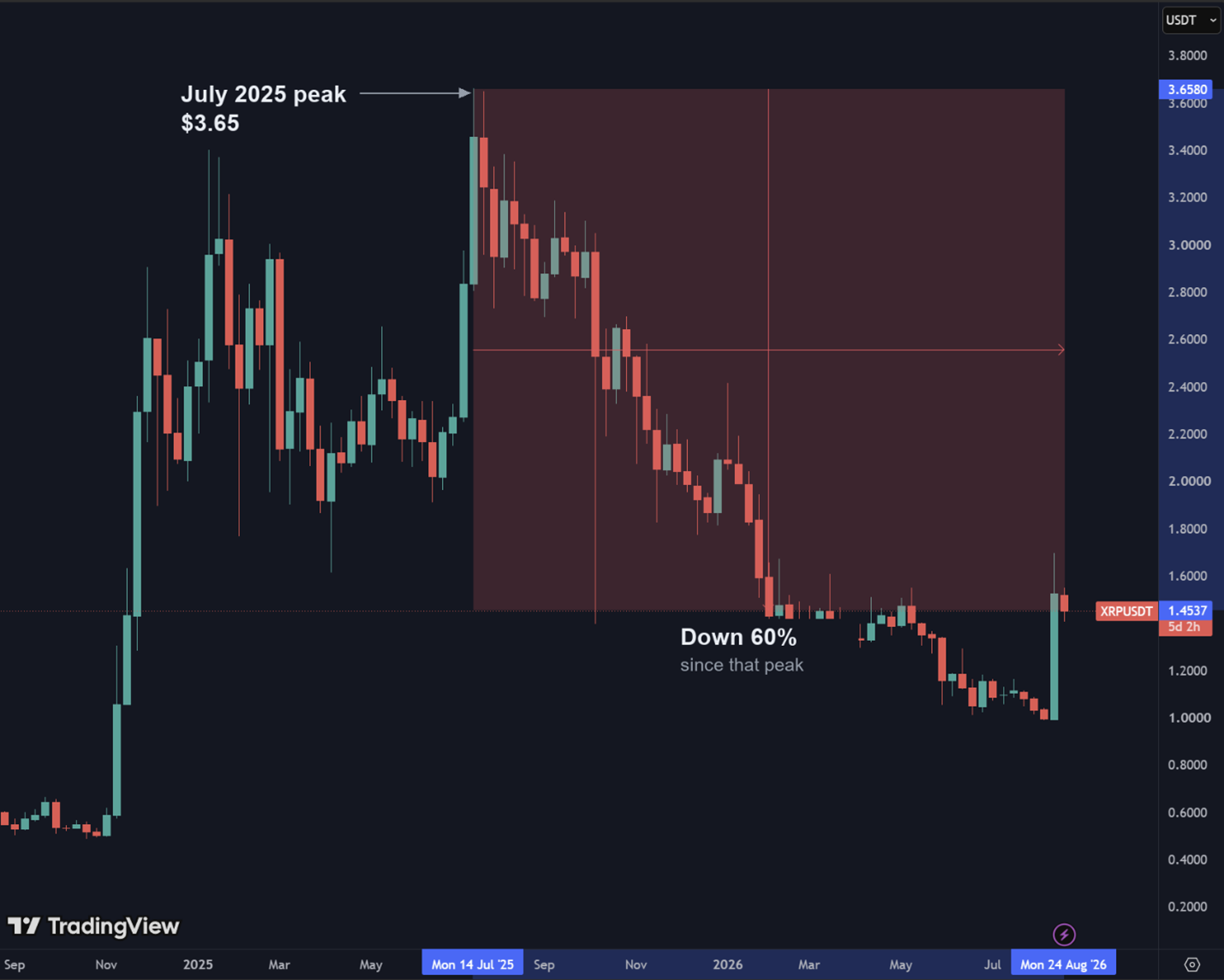
XRP closed out August with strength. Between Aug. 17-24, It jumped more than 50%, its sharpest run since 2025.
And it is still 60% below its peak of $3.65, set in July 2025. Over the past year it is down about 50%.
Same team. Same technology. Same story.
Two very different outcomes.
Where the Money Actually Goes
The gap is not a fluke. It is how the business is built.
Ripple's income does not touch XRP holders. It’s designed to consolidate for shareholders as Ripple’s prime broker arm has tripled its take.
Its dollar-backed token, RLUSD, has grown past $2 billion. The CEO has said the firm is aiming for $1 billion in yearly revenue by the end of this year.4
Every dollar of that belongs to shareholders. Not to token holders.
And here is the detail that should stop you cold …
Ripple holds somewhere between 38 and 40 billion XRP, roughly 40% of every coin that will ever exist. It sells some of that XRP into the market. And it has used proceeds to fund buybacks of its own stock.
Read that again. The token gets converted into value for shareholders. Not the other way around.
One more number puts it in focus. Every XRP in the world is worth about $93 billion today. The company that built it, holds 40% of it, and earns all the revenue is valued at $50 billion.
The coin is worth almost twice the company. Think about what that says about which one is priced on hope.
The Cleanest Example in Crypto
The crux of the issue with Ripple is that the company isn’t publicly traded. Which leaves investors like us out in the cold.
But investors interested in crypto companies that trade on TradFi markets can find a loophole in the system.
USD Coin (USDC) is a digital dollar issued by Circle (CRCL). One token, one dollar. You can cash it in any time.
There are about $74 billion of them out in the world.
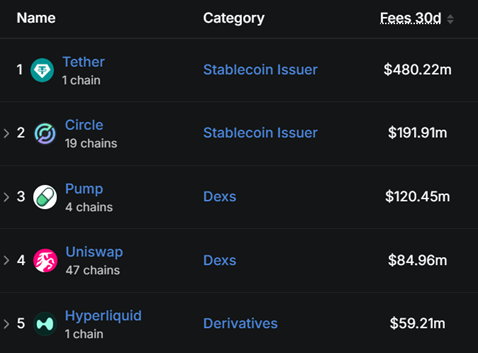
Circle takes those dollars and parks them in short-term U.S. Treasury bills. Those bills pay interest. Over the past 30 days, Circle earned roughly $191 million from it. Call it $2.3 billion a year.
How much of that goes to the people holding the $74 billion?
Nothing. Not a cent.
That is not a scandal. It is the deal, printed plainly in Circle's own documents. A USDC holder owns the right to swap it back for a dollar. A Circle shareholder owns the interest that dollar earns.
Two different products. Same three letters on the front.
And how much you benefit depends on how well you read and understand the fine print of what you’re buying.
When the Token Is the Business
None of this means tokens are a con. It just means you need to be smarter about how your investment capital works for you.
Because some coins are wired the other way. They’re backed by teams dedicated to increasing the value for token holders.
Hyperliquid (HYPE) is a decentralized perpetuals exchange with no separate company skimming the profits. It routes roughly 97% of its fees into buying its own token on the open market, every day.
If the platform does well, the token does, as well.
Uniswap (UNI) switched to a version of this method in January. Aave (AAVE) did too.
Now, all these tokens have a direct connection to the success of the underlying platform. Which means token holders actually get a slice of the platforms’ success.
3 Questions Before You Buy
How can you tell a token with real revenue behind it, or a glorified gift card? By asking the following three questions.
Even better, all sit in the project's own public docs. All you need to do is google them. The answers will often on a page called “tokenomics.”
- Does the token have a written claim on revenue? Not "the team plans to." You want to see a hard rule, in code or in a contract.
- Is there a separate company? If yes, it has shareholders. They get paid first. And they may hold a huge pile of the token too. If the company is public, that may be the stronger play.
- If this project wins, what exactly makes this token go up? Trace the mechanism. If the only answer is "more people will want it," you are holding a gift card, not a share in the profits.
Loving the project is not the hard part. Owning the right piece of it is.
Due diligence, starting with these three questions, will help you determine if your capital is being put to work in the right place.
Best,
Juan Villaverde
3https://finance.yahoo.com/news/ripple-now-ranked-9th-largest-143847831.html
4https://finance.yahoo.com/markets/crypto/articles/ripple-targets-1-billion-revenue-113445620.html