 |
| By Bob Czeschin |
War is a great destroyer of paper currency.
Which is why, since March 2, with Iran reeling under aerial onslaught, the USD/Iranian rial free market exchange rate hit 1 USD = 1,659,500 IRR.
That being the case, a mere $602.60 in your pocket qualifies you as a rial billionaire.
The rial — which had a conversion rate between 32,000 and 42,000 per USD across the mid-2010s — is no stranger to long-running depreciation. But a new phase began with Trump’s “maximum pressure” sanctions on Iran’s nuclear program.
They severely squeezed oil exports — which once funded half the national budget. By 2022, the rial was down to 400,000 (per USD), as domestic inflation ran hot at 40%.
Last year, however, ushered in the most acute phase of Iran’s currency crisis. The rial entered 2025 with its free-market exchange rate near 817,500 (per USD).
Panic in the Streets
The year only continued to weigh on the rial. Between the 12-day war with Israel, additional UN sanctions and massive oil revenue shortfalls, its value went into freefall.
By December, it was down to 1.2 million (per USD). Enough to ignite panic in the streets.
In a mad stampede, millions of ordinary Iranians rushed to convert cash and savings into dollars, gold or crypto — even 50-kg bags of rice. In Tehran's Grand Bazaar, shop shelves were stripped clean by hordes of frantic buyers. Desperate to unload rapidly falling rials for almost any tangible good.

Iran’s ruling mullahs were alarmed by massive protests about the plunging currency and roaring inflation. So, they sent heavily armed Revolutionary Guards into the streets to crush the demonstrators.
When they retreated, they left behind thousands of unarmed dead.
This was the regime’s “crossing the Rubicon” moment. It transformed a deep but normally quiet reservoir of economic malaise into a raging torrent of anti-regime fury.
And that’s what makes these mass demonstrations completely different from those that rocked the nation in 2009, 2017, 2019 and 2022.
All of them were brutally suppressed. But previous outpourings of dissent mostly centered around Sunnis, Kurds and other minorities.
By contrast, Bazaar-led unrest signals that economic breakdown has reached the commercial core of society. Because apart from the politically well-connected and the ultra-rich, very few Iranians can escape the impact of an imploding currency.
And now, under the combined aerial assault of the U.S. and Israel, the rial has fallen as low as 1,659,500 (per USD). That’s down another 50% just since December.
Accordingly, this popular uprising has a lot more momentum than any previous one. And therefore, a much greater chance of actually leading to meaningful regime change.
Or if that fails, civil war.
Crypto Rises Amid Rial Collapse
The Iranian crisis has also been a real-world, live-fire test of the central promise of the crypto revolution …
Honest, censorship-resistant money.
Crypto not only passed the test. It became the Iranian government’s chief lifeline in evading economic sanctions against Iran.
- Iran's Central Bank acquired at least $507 million in Tether (USDT, stablecoin) last year. This was part of what it called a "sophisticated strategy” to bypass the global banking system.
- Iran’s Revolutionary Guards Corps (IRGC) accounted for 56% of total trading volume on two leading UK crypto exchanges between 2023 and 2025.
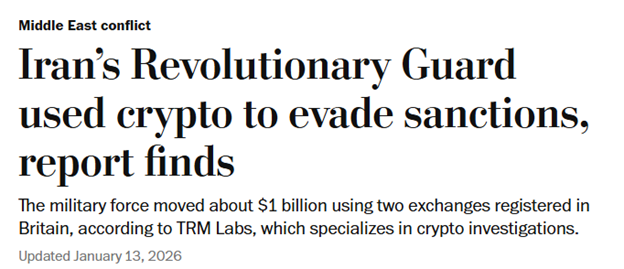
- Between 2023 and early 2025, the IRGC transferred $1.05 billion to 187 sanctioned wallet addresses, including $10 million to a wallet linked to Yemen’s Houthi rebels.
- Promotional materials from Iran’s Ministry of Defense Export Center offer ballistic missiles, drones and warships for sale — with crypto payment capabilities.
But here’s the piece that matters the most …
Not even a national internet blackout can halt crypto transactions.
When U.S. and Israeli bombs began raining down on Iran, internet connectivity inside Iran fell roughly 99%.
As you would expect, crypto transaction volumes also fell sharply. But it notably did not stop. Exchanges and wallet holders simply shifted into defensive mode.
For example, some exchanges accumulated new transactions in a queue. This allows them to transmit in batches whenever connectivity briefly reappears.
Some self-custody digital wallets let you do something similar. Initiate a transaction offline. Sign it. Hold for broadcast later, whenever connectivity pops back up again.
Other alternative methods include:
Blockchain from space. You probably think that’s Elon Musk’s Starlink. Battle-tested in Ukraine, it provides high-quality connectivity almost anywhere on earth.
Problem is subscriptions and hardware are not cheap.
But at least one company broadcasts the Bitcoin blockchain around the world, 24/7, for free. (That said, you do have to buy special hardware. And of course, pay for your own electricity.)
Mesh Networks. Your smartphone has certain short-range radio technologies — like Bluetooth or RFID — built in. Mesh uses them to link to enabled handsets nearby forming a network.
As long as at least one handset on the network has internet access, anyone on the network can transmit a signed encrypted trade instruction over it.
Bitcoin via SMS. Download an SMS-enabled digital wallet. Create an account and type in your phone number. Sign a transaction offline, compress it and send it via SMS to a gateway phone number. Which then broadcasts it to the blockchain.
Like the Ukraine War, Operation Epic Fury pretty much destroyed conventional internet access. And even that couldn’t stop crypto transactions completely.
That’s further real-world proof that the crypto revolution rests on foundations so robust not even the gods of war can shake them.
Investment Implications
Bitcoin closed at $67,000 and change the day Trump released the dogs of war over Iran. As I write, it’s $73,600 and climbing.
And after Bitcoin’s miserable February, there are probably very few sellers left. That suggests this is a good time to get ready for a spirited rally.
If you’re new to crypto, Weiss Crypto Investor is a great way stick to get your feet wet. Juan Villaverde uses his Crypto Timing Model to help members target the best times to load up on their favorite crypto for long-term investment.
To learn more, click here.
Best,
Bob Czeschin