Oil Shocks Are Bullish for Gold. So, How Come Gold’s Down $1,200?
 |
| By Bob Czeschin |
In times of crisis, capital flees to safe-haven assets. Which is why global oil supply shocks, like the one we’re seeing now, are supposed to lead to rising gold prices.
Indeed, historical examples abound.
Consider the Yom Kippur War, the first of the 1970s’ two epic oil supply shocks. On the holiest day of the Hebrew calendar, Egypt and Syria coordinated simultaneous attacks on Israel — from opposite directions. And achieved total tactical surprise.
With her country an inch from being utterly overrun, Prime Minister Golda Meir made a desperate appeal to America. For massive emergency resupply of munitions, spare parts, fuel and medicine.
President Nixon promptly dispatched what became the biggest round-the-clock airlift in military history. Resupplied, the Israelis fought back from the edge of extinction.
Enraged by this turn of events, Israel’s attackers — who had the support of major Arab oil producers — cut off petroleum exports to America and Europe. This supply shock caused world oil prices to nearly quadruple.
Gold shot up from $90 to $180 in 12 months.
The second oil shock of the 1970s came roughly six years later, after the Shah of Iran was deposed. The Ayatollah Khomeini swept in from exile in France to the halls of power in Tehran.
To further cement his grip on power, he rounded up the officer corps of the Iranian Army. Fearing they might still secretly like the Shah, he executed them.
Observing the unbridled bloodletting from across the border, lraqi dictator Saddam Hussein could hardly believe his good fortune. A bitter regional rival, he had long locked horns with the Shah over disputed border regions claimed by both countries.
But with the Shah gone, radical mullahs were destroying Iran’s once-formidable military. With his own army intact, Saddam figured the time was ripe to invade his near-defenseless neighbor. And pretty much just take whatever he wanted.
Thus began the bloodiest Mideast war seen since the Mongol hordes. And because both antagonists were oil powers, oil prices went ballistic. For the second time in a decade.
Gold prices surged from $220 to $850.
Fast forward to 2026. Missiles fly across the Mideast and the Strait of Hormuz remains closed. This has sparked a supply shock that ricochets among global markets like depleted uranium slugs from a 30-mm chain gun.
And yet, the price of gold is dropping.
Why Operation Epic Fury Is Different
Despite the rising tsunami of global chaos, gold prices never even made a run at their late January peak.
Indeed, as I write, they’re down about $1,200 from all-time highs.
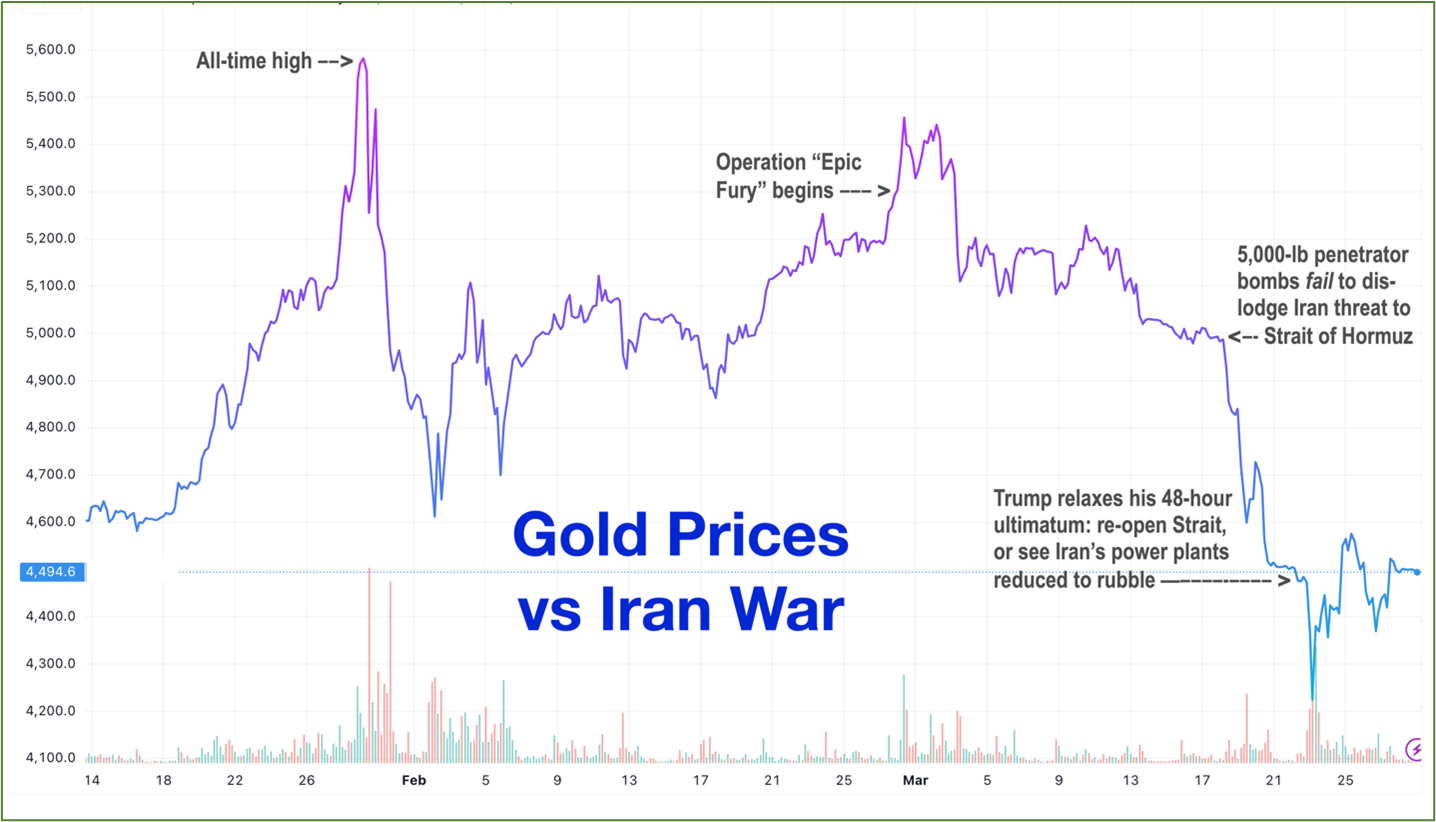
What happened to gold as a hedge against oil shocks and global chaos? Answer: Very little.
Less has changed than meets the eye.
As you can see (above), gold initially tried to rally as Epic Fury got underway. It just didn’t get very far.
And that’s mainly due to a pair of bearish factors — both more or less unique to the present situation.
Factor 1: Gulf State Scramble for Liquidity
Along the Persian Gulf, oil exports are the government’s main source of income. And because many of these countries’ currencies are informally pegged to the greenback, they must also hold large dollar balances.
To defend the peg if necessary.
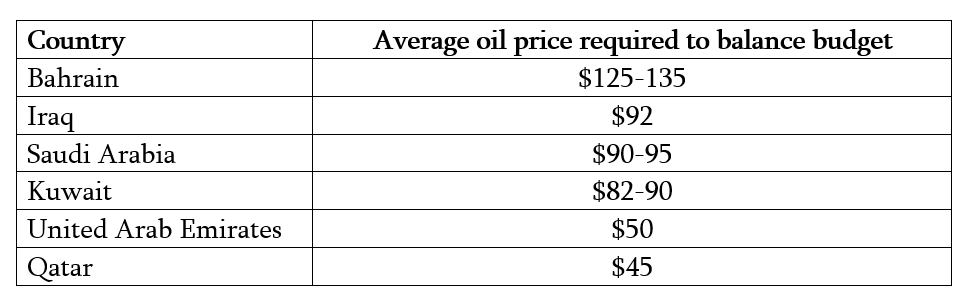
When oil prices crashed to $25 a barrel (in 1983), it left these governments drowning in red ink. Forcing many to dip deeply into savings — which were mostly in gold — to make up the shortfall.
Ironically, the same thing is happening today.
Again, these countries are drowning in red ink. Not because oil prices are too low. But because closure of the Strait has locked them out of export markets.
If oil can’t flow, they don’t get paid. So, again, they’re selling gold to raise cash … and pushing the price of gold down in the process.
On the right-hand side of Figure 1, observe what happened immediately prior to two of gold’s biggest declines in March.
- 5,000-lb deep penetrator bombs fail to dislodge firing positions embedded in rocky formations along Iran’s side of the Strait.
- President Trump backs away from his 48-hour ultimatum to obliterate Iran’s civilian power plants if the Strait is not reopened.
In both cases, gold prices lurched lower on the unfavorable news.
Of course, all this will stop once exports resume. And the Gulf States revert to their traditional role as gold buyers.
Problem is, nobody can be sure how long it might take to achieve this happy result.
Factor 2: A New Kind of Forced Liquidation
Gold had a terrific rally in 2025, rising from $2,650 to nearly $5,600.
While that run was incredible to watch play out, it also meant that gold quickly became overbought as leveraged and overleveraged players alike piled in.
Eventually, however, there were no buyers left to buy. After which, the first little tick down in prices resulted in margin calls, first to the most overleveraged players.
This in turn led to a self-reinforcing downward spiral of liquidations and lower prices …
Until excess leverage got purged from the market at substantially lower price levels.
This process is as old as time itself. What’s new is the mechanism.
Last year, gold investors piled into exchange-traded funds (ETFs) like never before, according to the Bank of International Settlements. And as greed intensified, lots of them were double and triple leveraged ETFs.
Unlike ordinary ETFs, leveraged products are hardwired to maintain a fixed daily leverage ratio. That means they must rebalance every trading day.
When gold goes up, they buy more metal to maintain their leverage target. When prices fall, they have to sell. Even in “normal” times this amplifies volatility.
In twitchy, crisis-prone times like now — with hot wars on two continents — they could be the tail that wags the dog!
Which is something you’ll want to keep a close eye on going forward.
For now, though, the good news is that gold has already corrected — from just under $5,600 to as low as near $4,200 before clambering back above $4,500, as I write.
So, the door is likely open for a fresh run to new all-time highs.
Investment impact
One easy way to benefit from rising oil prices is with an ETF — such as SPDR S&P Oil & Gas Exploration & Production ETF (XOP).
XOP buys U.S. stocks in the S&P Oil & Gas Exploration & Production Select Industry Index (E&P companies maximize your exposure to rising oil prices.)
It’s already up more than 18% since Epic Fury began and will almost certainly go higher still — especially if the fighting drags on.
Or, if you live outside the U.S., real-world asset (RWA) projects give you exposure to stocks on-chain.
Ondo Finance (ONDO, “C+”), for example, offers its United States Oil Fund (USOON, Not Yet Rated). This is a blockchain-based token representing ownership in the United States Oil Fund (USO) and offers exposure to oil price movements.
But, as I said, this isn’t available to U.S. residents just yet.
Gold, however, is. And now that it’s pulled back, current prices represent an opportunity to load up.
You can also do that on the blockchain thanks to PAX Gold (PAXG, stablecoin), which is pegged to the value of gold per ounce.
Best,
Bob Czeschin
P.S. While you boost your exposure to oil and gold, there’s another asset class to add to your watchlist: AI.
My colleague Michael Robinson lives on the edge of technology. He bought Bitcoin when it was near $300. And he was watching Nvidia (NVDA) well before it was a household name.
And thanks to his Breakout Signal, he’s been able to use this edge to his advantage and go for triple-digit gains on some of AI’s biggest names.
Now, his signal says the next big AI breakthrough is almost here. And it identified three stocks to buy soon.
To see what it has to say, be sure to save a seat for Michael’s latest briefing tomorrow at 2 p.m. Eastern.