On-Chain Activity Reveals Bitcoin’s Invisible Industrial Revolution
 |
| By Marija Matic |
If you looked at the surface of the Bitcoin (BTC, “B+”) network today, you might think the activity had quieted down.
Active user addresses have dipped since last November. And the frantic bidding wars that once sent fees into the stratosphere have vanished.
Transaction fees on Bitcoin are now at a multiyear low of roughly 17 cents.
Yet, beneath this calm exterior, the network’s gears are turning fast.
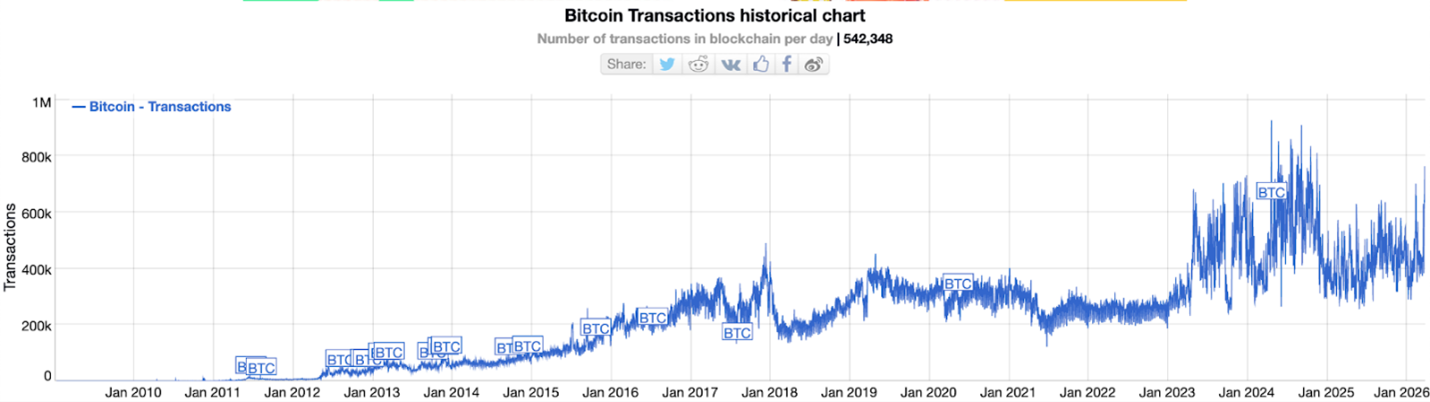
On March 28, 2026, Bitcoin processed 763,304 transactions — nearly double the volume of the same day last year.
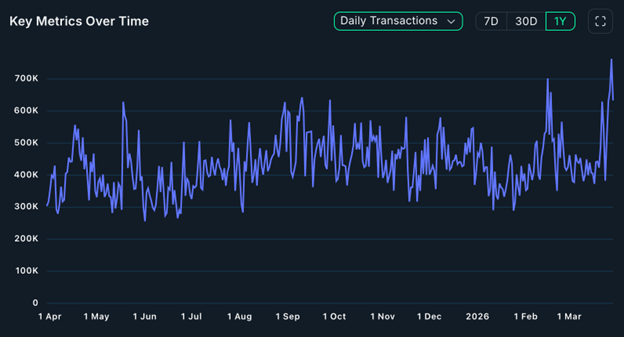
So, what do we make of this paradox of rising transaction counts paired with fewer "active users" and rock-bottom fees?
To me, it marks the beginning of Bitcoin’s industrial age.
The network is evolving from a crowded digital bazaar into a higher-efficiency settlement engine.
Bitcoin’s Industrial Revolution
To understand why transactions are skyrocketing while fees are plummeting, we have to look at how data is packed.
Up to a year ago, the network was often strained by "Inscriptions" and BRC-20 tokens.
These were the digital equivalent of mailing a brick in a standard envelope. Inscriptions took up massive amounts of space (up to 4MB), clogged the pipes and forced everyone to pay a premium to get noticed by miners.
Of course, miners loved that, since they earned more. But users wanted better.
Enter Runes.
This standard has effectively replaced the older, clunkier tech by using a much leaner method called OP_RETURN.
If the old tokens were copper cables, Runes are digital fiber optics, requiring only about 80 bytes of data.
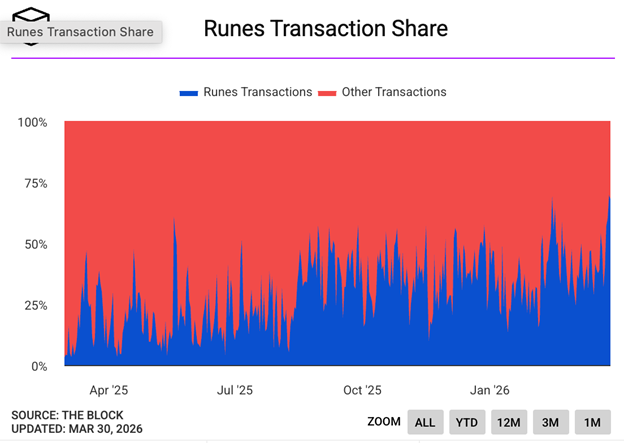
On March 28, Runes accounted for a staggering 70% of all Bitcoin transactions.
Because they are so small, the network can process over half a million of them without breaking a sweat or triggering any kind of fee spike. Miners hate it as it brings them less fees, but retail users love it.
This technical shift has paved the way for the "Runes Zoo" mania. That is, a flood of animal-themed tokens being minted at high speeds.
It’s a meme-driven frenzy running on the most efficient rails Bitcoin has ever seen.
The Great Consolidation: The Rise of Batching
The drop in "active users" is perhaps the most misunderstood metric in the current market.
Rather than a decline in engagement, we are seeing network activity migrate toward more scalable, bundled settlement methods that do more work with a smaller footprint.
See, in the past, we got used to each retail investor sending their own individual payment. But now, big players — exchanges, ETFs, institutional custodians, etc. — are increasingly using a process called aggressive batching.
This means a single on-chain transaction can now represent the activity of 400 to 600 individual retail movements.
Think of it this way: Before, we were all driving in individual cars to the Bitcoin stadium … and getting stuck at the parking booths to pay our fees.
Now, big players are taking the train to the stadium.
So, when you see the total transaction count hit record highs while unique addresses drop, you are seeing "smart money" efficiency.
The network is becoming denser. We see fewer "cars" on the road, but each "train" is packed to capacity with economic intent.
Lightning and the Second Floor
While the main Bitcoin blockchain acts as the high-security vault, the Lightning Network has become the city’s bustling checkout counter.
By late 2025, Lightning crossed a massive milestone, reaching $1.1 billion in monthly volume.
That’s a 400% increase year over year.
It’s not just the volume that’s changing. The nature of these payments is maturing, too. Initially designed for small purchases — like your morning coffee — the average payment rose to $223 in late 2025.
Institutions have even started using it for serious business. In January, Kraken settled a $1 million transfer on Lightning in under a second. This gradual shift to Bitcoin’s Layer-2 networks like Lightning and Stacks — which saw a 20% jump in daily transactions this quarter — is significant.
It means some activity is moving off the main chain. That leaves the base layer free for heavy-duty settlement and high-frequency Runes.
The Whale's Whisper
In all this shuffling, the smart money is making big moves under the radar.
While retail traders play in the "Runes Zoo," the largest holders are quietly moving in a different direction. Since March 10, the number of "Whale" addresses holding over 100 BTC has climbed past 20,000, continuing a steady accumulation trend from a year ago.
While the average transaction value sits at a massive $50,000 (driven by these whales and ETF flows), the median transaction is a modest $60.
This tells the real story: Bitcoin has successfully bifurcated.
It is simultaneously …
- A playground for retail memes,
- A lightning-fast payment rail for global business
- And a digital fortress where the world's largest entities are steadily accumulating.
Bitcoin and its users have learned how to do more work with less waste.
And the results are starting to show.
Which means that, with Bitcoin back below $70,000 — and cycles expert Juan Villaverde seeing a key reversal on the horizon — savvy investors may consider following the whales’ lead …
And start building their BTC exposure now.
Or, you can learn what Juan’s Crypto Timing Model has to say for yourself here.
Best,
Marija Matić