Passive Crypto Income Is Within Reach with This Automated DeFi Tool

 |
| By Marija Matic Reviewed by: Beth Canova |
When the market stalls, traders are left out in the cold.
But for yield farmers, there’s a whole harvest ready to reap.
That’s because when the market trades in a set range, yield on decentralized finance platforms can get exciting.
Yield farming is a strategy in DeFi where you lend liquidity to platforms on the blockchain — such as Uniswap (UNI, “C-”), Aave, (AAVE, “C-”), Jupiter (JUP, “D”) and Orca (ORCA, “D-”). That liquidity then supports the platform’s operations.
In return, you earn a yield.
With this strategy, your crypto could earn 50%, 100% or even more in annual yield … without having to sell it.
Just look at some of the latest yields available for pools on Orca. You can see APYs of 63% … 78% … 129% … and even over 3,000%!
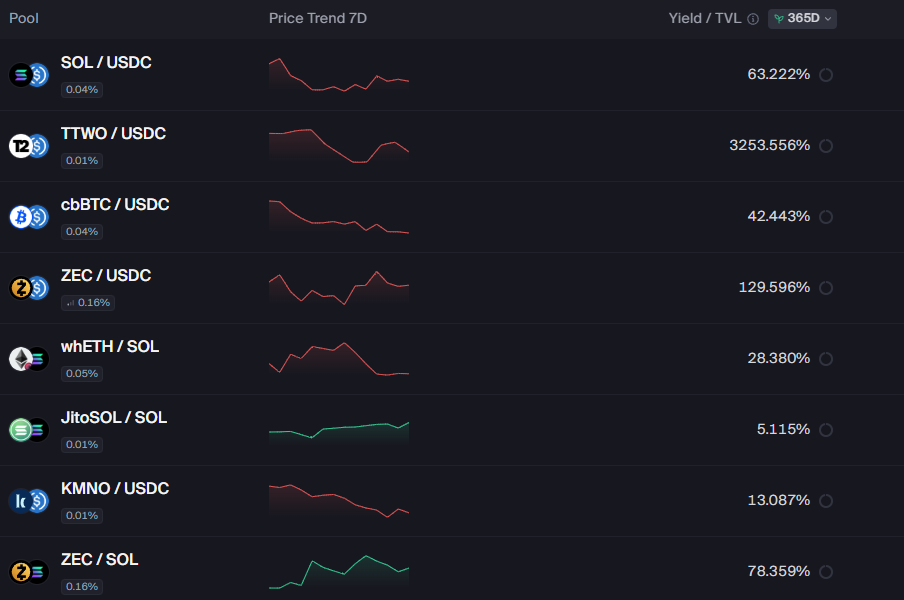
For comparison, the average American is getting a measly 0.56% on their savings accounts right now.
Of course, higher yields come with higher risks. That 3,000% APY is on a pool that features a tokenized stock — so not a typical blockchain asset.
And not all yield farming strategies work the same way.
Some involve looping — that is, lending crypto, borrowing against your loan, lending the borrowed assets and doing the whole thing again.
It’s laborious process. But the benefit is you get to stack your yields to build a stronger position.
Another approach has users lend only within a select range to target higher yields. The trade off is if the underlying price of your asset moves out of that range, you no longer earn yield.
So, the tighter your range, the higher your yield. But also the more often you have to monitor your position.
That means you need to keep an eye on prices, adjust your range and decide when to collect or reinvest your rewards.
Which can turn a great source of passive income … into a lot of work.
Another issue is that several major platforms, like Uniswap and Aave, don’t clearly show the yield you can expect to earn for the range you pick.
Those eye-catching yields of “thousands of percent” assume a very, very narrow range. The kind that almost nobody would actually use.
So, it’s hard to make a good decision on these platforms.
But today’s tool brings that more clarity and ease of use.
Say Hello to vfat
vfat is a tool that helps you manage DeFi positions in a simpler, more professional way.
Think of it as an autopilot for your liquidity positions.
You set the course, and it keeps flying the plane while you get on with your day.
Beyond automation, vfat also simplifies multi-step jobs — entering, exiting, compounding, rebalancing — into one single transaction.
That saves time, effort and fees.
And importantly, it allows you to stay in control of your money. Your funds stay in your own wallet setup; vfat never takes custody of them.
It works on Ethereum (ETH, “B+”), Base, Arbitrum (ARB, “D+”) and 34 other blockchains. And it can be used on 74 platforms, including Uniswap, Aerodrome and PancakeSwap (CAKE, “D”).
The only big network missing is Solana (SOL, “B-”), which it doesn’t support.
It’s not a complete newcomer either: 9,218 users have already opened 27,031 positions worth $29.5 million through it.
Here’s how its features work …
The Star Feature: Automatic Rebalancing
wETH/USDC on Uniswap is the biggest pool currently featured on the vfat website. So, I’ll use that as an example to show vfat’s rebalancing feature.
When you click the “plus” icon next to the 7-day volume, the setup options open on the side:
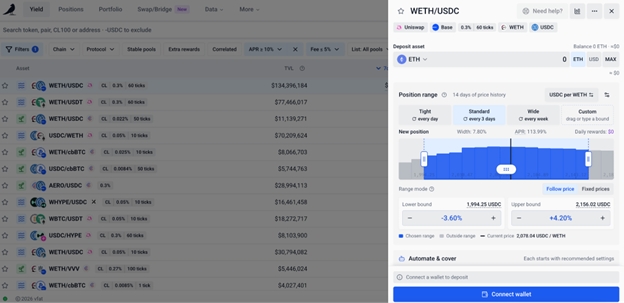
Here’s a close up so you can see it better:
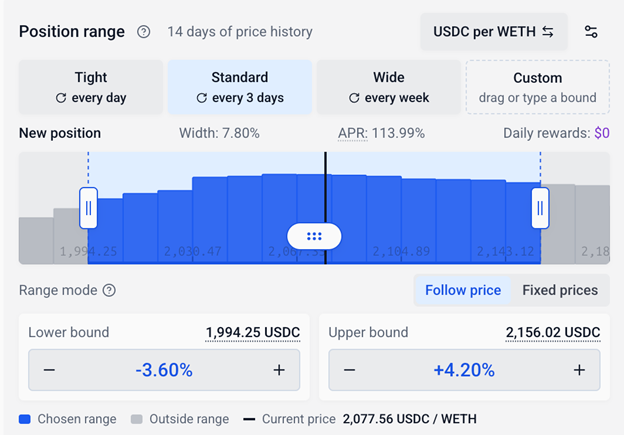
vfat gives you three ready-made choices and a custom choice. The basic rule is simple: the narrower the range, the more you earn … and the more often it needs to rebalance.
- Tight: a 5.40% price range. Estimated yield of 164% per year. Rebalances about once a day.
- Standard: a 7.80% price range (ETH between roughly $1,994 and $2,156). Estimated yield of 113.99% per year. Rebalances about every three days.
- Wide: an 11.40% price range. Estimated yield of 78% per year. Rebalances about once a week.
Keep in mind that these yields are estimates before the costs of rebalancing (more on that below). Also, the “once a day” or “every three days” are just targets. When the market moves a lot, rebalancing will happen more often.
Setting Up Your Automations
Once you’ve chosen your range, you’ll see four options: Rebalance, Rewards, Exit and Cover.
Exit is how you set up your safety net.
Clicking “Exit” lets you set up an automatic exit if the price is about to leave your range, either going up or going down:
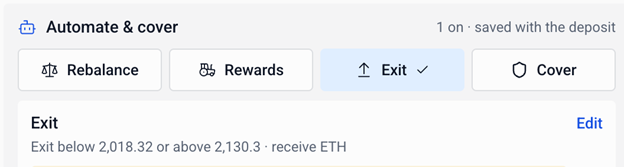
If you click “edit,” you can choose the exact prices — for a lower exit, upper exit, or both — yourself.
It’s a bit like telling a shop assistant, “If the price drops below this, or rises above that, sell for me.”
Cover is where you can buy insurance for your peace of mind.
By clicking “Cover,” you can buy insurance to protect against any smart contract bugs. (That is, errors in the code behind the platform.)
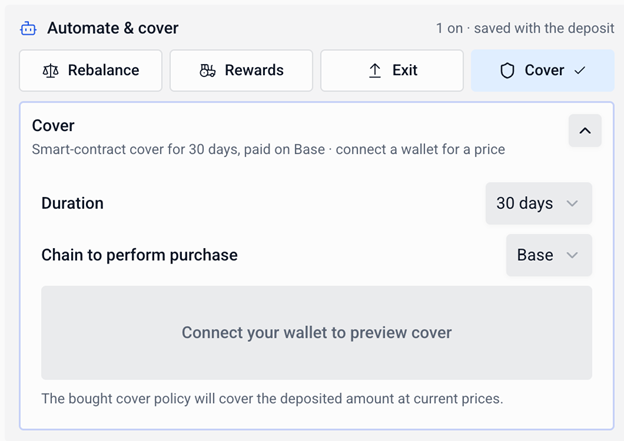
I should note however that this coverage doesn’t protect you against price drops and other things that could negatively impact your position.
The Rebalance tab is where you find your main settings.
And it means making a few key choices.
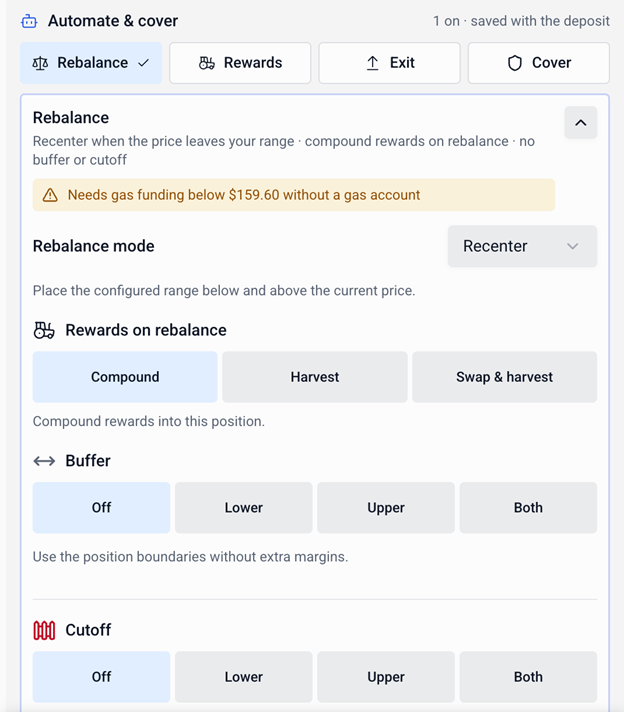
First, you’ll need to decide what should happen with your rewards:
- Compound allows you to reinvest them into your position, so your position keeps growing.
- Harvest collects them as they are, in the original reward tokens.
- Swap & Harvest collect them and swap them into a token you choose, such as a stablecoin. This is a great way to lock in profits as you go.
Then, there are two more advanced settings:
- Buffer tells vfat when to rebalance. Should it wait until the price hits the very edge of your range, or act a little earlier to give you some breathing room?
- Cutoff tells vfat to pause rebalancing if the price goes below or above a certain level. This is handy if you don’t want it to keep chasing the price during a big crash or a big rally.
The Big Caveat: Fees
Automating these processes does reduce fees.
But it doesn’t erase them.
Every rebalance costs a little money. It means extra transactions, fees and small price losses when swapping.
So rebalancing very often isn’t always the best choice.
Sometimes a wider range that rebalances less often ends up earning you more in the end.
The good news is that vfat lets you control these costs with three settings:
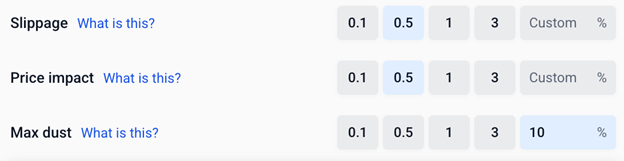
- Slippage determines the most the price is allowed to move against you while a swap is being done.
- Price impact controls how much your own trade is allowed to move the market price.
- And Max dust sets the maximum amount of small leftover tokens allowed after vfat swaps and adds liquidity during a rebalance.
These leftovers aren’t lost; they simply stay in your wallet.
For big, popular coins with plenty of trading activity, like ETH, slippage and price impact are usually tiny (unless the market is very wild).
And I wouldn’t suggest using vfat for small, risky coins anyway. In fact, I instruct my Crypto Yield Hunter members to stay away from more speculative coins in their yield strategy no matter what.
Still, it’s good to set these up, just in case.
Bottom Line
Yield farming is one way to boost your crypto income. Even in tough markets.
But the challenge of navigating DeFi and monitoring positions has kept even savvy crypto traders away.
Now, vfat evens the playing field. And brings the sky-high on-chain yield closer to your reach than before.
I hope you’ll take the time to test out this tool for yourself.
I also hope you’ll save your seat for next week’s private income briefing on Tuesday, Nov. 24 at 2 p.m. Eastern.
My colleague Nilus Mattive, who oversees all our income research, will show you his strategy to pull in up to $1,000 a week — and potentially more!
Plus, he reveals a handful of other Weiss Ratings income strategies to help your capital work harder for you.
It’s free to attend. Just be sure to save your seat here.
Best,
Marija Matić