Shadow Lobby Fights Stablecoin’s $6.6 Trillion Disruption
 |
| By Marija Matic |
The headlines have been hot lately.
But there’s one story you likely missed between the Trump-Powell standoff, the latest rate-cut theatrics and escalating tensions in Iran.
And it’s one that can have a profound impact on crypto going forward.
Like many recent developments in the crypto world, this fight is centered around stablecoins.
Shadow Lobby Strikes Out Against DeFi in CLARITY Act
Later this month, the Senate Banking Committee will markup the CLARITY Act.
This is the process that will determine what edits, if any, are applied to the current draft before it goes to the floor for a Senate vote.
As a reminder, the CLARITY Act is one of the most comprehensive regulatory frameworks considered for crypto.
If passed, it would finally give clear answers on what counts as a digital commodity, which governing agency is responsible for enforcement, and how exchanges, brokers and developers should operate.
In short, it has the potential to rewrite the rules of how crypto operates in the U.S. … and open the doors for greater adoption and utilization.
Which is why the latest development is so concerning: There is now a coordinated campaign against DeFi in the CLARITY Act.
It’s quietly accelerating in Washington. And it’s being led by an entity that calls itself Investors for Transparency.
With just days before the CLARITY Act heads to markup, the group launched an expensive Fox News advertising blitz.
The goal?
Urge viewers to call their senators and demand that all DeFi provisions be stripped from the bill.
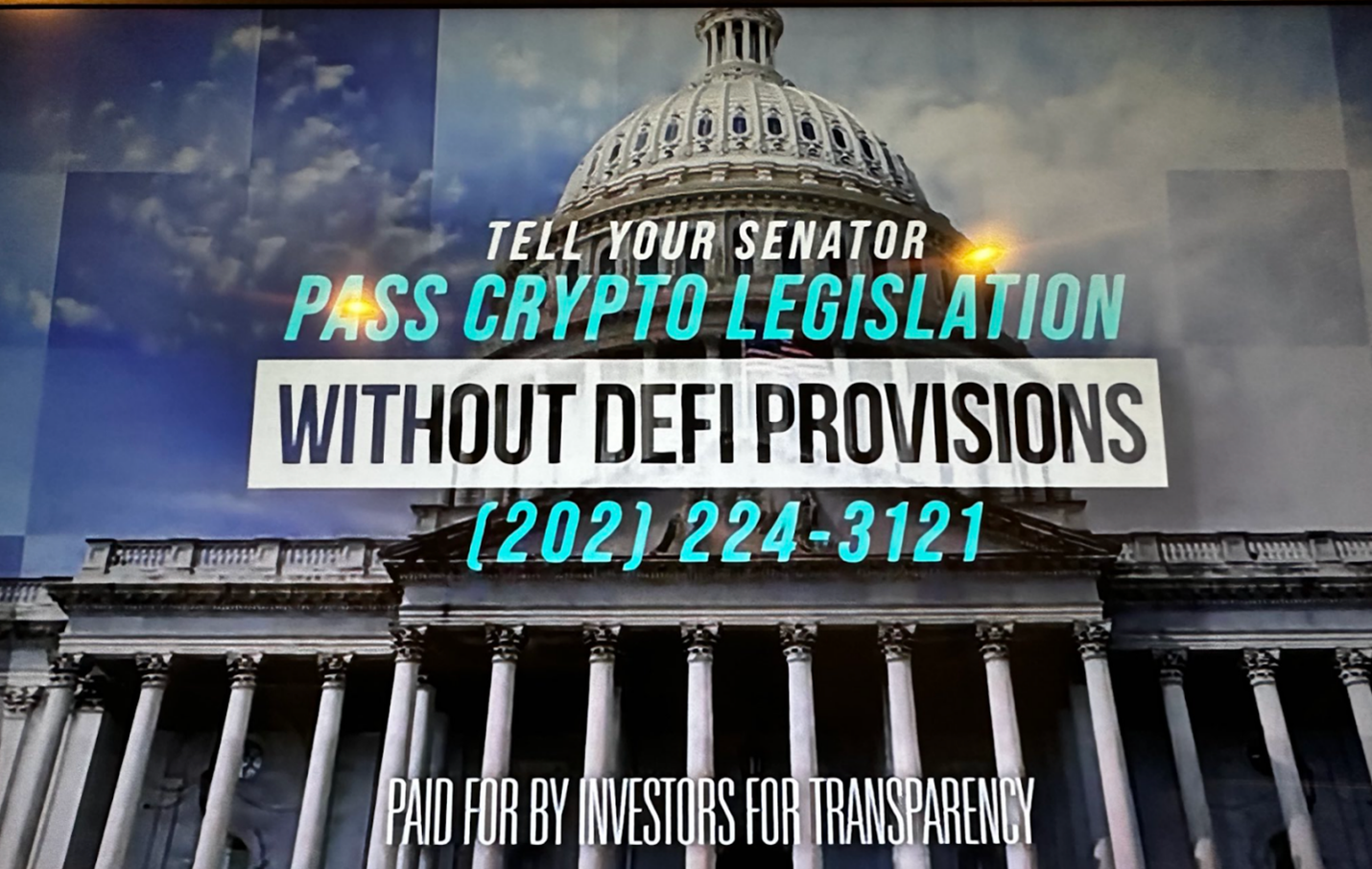
The ads also warn that DeFi “stalls innovation”:
Why?
Well, that ironically isn’t clear at first glance.
For a group that is seemingly all about transparency, it is impressively opaque.
Its donors are anonymous.
Its leadership is unlisted.
And even its goals are shrouded in mystery, as it never confirms in its ads who would benefit if DeFi is sidelined.
But digging deeper into that last mystery revealed everything we need to understand this effort.
The $6.6 Trillion Problem No One Wants to Say Out Loud
One big benefit experts foresee from the CLARITY Act is the further legitimization of stablecoins.
And according to U.S. Treasury estimates published last April, up to $6.6 trillion in bank deposits could migrate out of the traditional banking system if stablecoins achieve broad adoption.
This number explains everything.
Today, banks sit on trillions in checking accounts paying depositors 0%, while earning roughly 4% on reserves parked at the Federal Reserve.
It’s one of the most profitable spreads in modern finance.
And stablecoins disrupt that math.
Even without paying explicit interest, Treasury-backed stablecoins make it possible — through exchanges, platforms and DeFi protocols — for users to earn 3-5% equivalent yields.
And if users are motivated, they can find even higher yields through more active DeFi strategies.
From a consumer’s perspective, the choice is obvious: stablecoins + DeFi = better returns and more control over your money.
From a bank’s perspective, this isn’t an opportunity: It’s an existential threat.
Stablecoins — especially when paired with rewards — make consumer dollars portable. They weaken the assumption that banks are the default wallet for the economy.
They also threaten the existing high-fee, bank-centered payment systems.
If consumers can be incentivized to transact on-chain, the dominance of cards and legacy rails erodes.
That’s why this fight is happening inside a market structure bill. Because market structure determines who owns the rails.
And banks hate competition.
What Banks Are Really Trying to Protect
Now, banking groups are not calling for DeFi or stablecoins to be canceled. At least, not publicly.
Their official stance is cautious because they want to protect local lenders from big, bad crypto. The argument is that, with DeFi, stablecoin rewards can drain deposits from community banks and starve Small Town, USA, of loans.
But that logic doesn’t pan out.
A Charles River Associates study analyzing monthly data from 2019-2025 found no statistically significant relationship between USDC growth and community bank deposit decline once macro factors were controlled for.
Simply put, the deposit drain on small local banks doesn’t show up in the data.
Instead, this is about big banks’ control.
The Old and New “Compromises”
Last year, Congress passed the GENIUS Act, which prohibits stablecoin issuers from paying interest to holders directly.
The compromise was clear: Issuers focus on payments and stability, not savings products.
But GENIUS also left room for something else: competition.
Exchanges and third parties can still offer incentives, rewards or yield-like programs tied to stablecoin use.
That wasn’t a loophole. It was a feature of a market-based system.
Now, banks want that erased.
Rather than reopening GENIUS directly, which would be politically messy and invite a public fight, banking trade groups are attempting something more subtle: rewriting stablecoin economics through the CLARITY Act, under the banner of “market structure.”
This is legislative jiu-jitsu. Lose one bill, reshape the next.
And the newest proposed compromise is circling the Senate: Allow rewards tied to activity (transactions), but prohibit rewards tied to passive balances.
On paper, it sounds reasonable.
In practice, it’s vague, easy to game, hard to enforce and designed less around consumer protection than around suppressing competition.
The Markup Is a Fork in the Road
Stablecoins are becoming a global dollar infrastructure in real time. Over $300 billion is already on-chain.
The question is whether the U.S. wants to lead that transition … or regulate it out of reach.
Non-partisan banks are betting this debate happens quietly. That consumers won’t notice. That lawmakers won’t connect the dots.
Indeed, the lobby’s efforts have been fruitful. In the time it took me to write this issue, the markup — which was initially set for this Thursday, Jan. 15 — has been postponed to the end of the month.
The reason? Senators claim it’s a lack of bipartisan support. Likely because of this last-minute push.
Just yesterday, the American Bankers Association (ABA) sent a letter to members of the Senate demanding they close the “stablecoin loophole.”
Unfortunately for them, we’re watching closely.
And markup will reveal whether senators are, too.
Lawmakers now face a choice …
Side with lobbying groups protecting zero-yield bank deposits …
Or defend transparent, auditable protocols that give consumers real alternatives.
And if you have a dog in this fight, if you care about access to DeFi, stablecoin yield and open financial infrastructure, now is the moment to speak up.
Contact your senators before the markup and make it clear: the CLARITY Act should protect DeFi’s ability to compete … or it shouldn’t pass at all.
The banking lobby is betting no one is paying attention. It’s time to prove them wrong.
Best,
Marija Matić