The Crypto Scam That Even Smart Investors Could Miss

 |
| By Marija Matic |
Every investment strategy requires a certain amount of trust.
Even the most passive investor — someone who’s never traded a day in their life but contributes to their 401k with each paycheck — has to trust that their money is better off just tracking the market than anywhere else.
Crypto has done its best to minimize the need for trust …
Transactions are transparent. Everyone can review them on-chain.
The code that supports decentralized platforms is overwhelmingly open source. Anyone can check for vulnerabilities.
The strongest platforms even have their latest security audits available for review.
And yet, even with crypto’s “verify, don’t trust,” approach, targeting returns means accepting some things are out of your hands.
It’s a tough lesson.
One that I had to confront earlier this month.
Because — despite my own careful due diligence and verification process — one of the platforms I used to target yield betrayed that small amount of trust.
The good news is that investors aren't just sitting on their hands.
And their actions give us all an additional lesson to learn: How to move forward when your trust is broken.
First, the Verification
Altura is a Canadian-built vault. Users would deposit wrapped Tether (USDT) — one of the largest stablecoins on the blockchain. Altura would then use those stablecoins to run three different strategies. Users would receive a yield generated from them as a reward.
When I first encountered this platform in May 2026, that yield was almost 20%.
That’s incredibly high for a stablecoin strategy. For comparison, stablecoin yields on centralized exchanges is about 2%-5%.
Backing the high yield was what seemed a very strong team. Altura boasts former Fidelity and PwC employees. And earlier this year, it completed a $4 million seed fundraising round.
Not only that, but it was a rare platform that was actually insured. By Native Insurance, which had previously won recognition via the Insurance Startup Award at the 2026 Insurance Times Tech and Innovation Awards.
So, this wasn’t some roadside operation.
And yet, what happened next felt like exactly that.
The First Red Flag Wasn’t Bright
The initial incident that raised concerns didn’t even come from Altura.
It came from another platform entirely.
Just a few weeks after I began to use Altura, a different platform — MainStreet — reported unusual utilization and bad debt.
In response, the solvency-verification firm it was contracted with, Accountable, immediately terminated its contract.
But fear spreads fast on the blockchain. And not always in reasonable ways. Many users grew suspicious of any platform that relied on Accountable for credibility.
That includes Altura.
The panic triggered a wave of withdrawals. Altura processed more than $8.5M in instant redemptions in the first 24 hours. But demand moved faster than Altura’s ability to free liquidity from its on-chain vault.
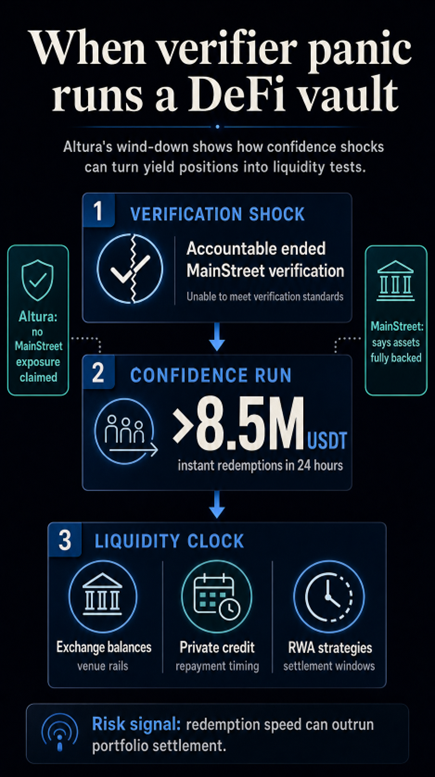
In short, the domino effect that started with MainStreet created a bank run on Altura.
So, the platform decided to halt withdrawals until it could access its reserves which were held in a bank account.
At the time, Altura assured users there was no cause for alarm. It confirmed that “every deposit is backed, the vault is over-collateralized at ~104% reserves, the price per share hasn’t dropped, no funds were lost, no strategy failed, and there was no exploit.”
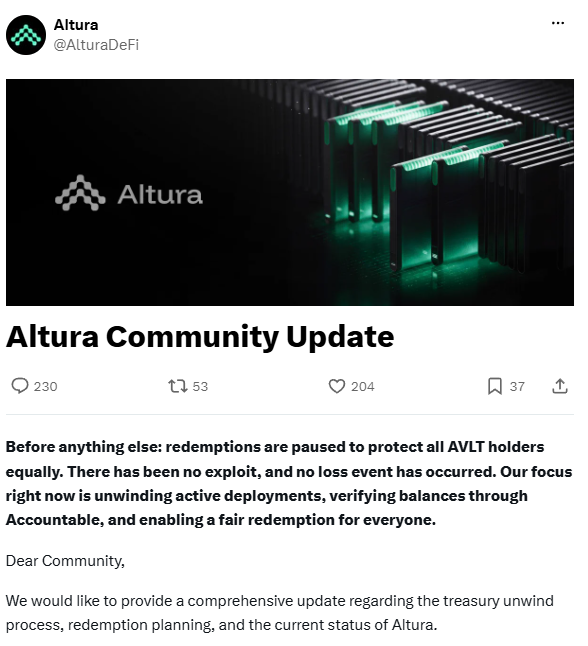
Then, on July 28, Altura gave another update: Its bank account was frozen.
It asked users for more patience as it sorted out the issue with the bank. Then, it would make whole anyone still waiting on their deposit.
What the Silence Revealed
As the weeks passed, Altura remained quiet.
Too quiet.
The silence raised suspicions. Eventually, Turtle — the company that hosted the Altura pool on its website — and the largest depositors decided to sue Altura and its Liverpool-based CEO, Ranveer Arora.
I reached to Turtle directly to get you the most accurate information and spoke with COO Waseem Shabout.
A preliminary hearing took place on Sept. 25, but Ranveer did not show up. It was a without-notice (ex parte) application, in which the claimants sought an interim Worldwide Freezing Order (WFO).
It was granted. But here’s the problem: There were no funds to freeze in the account that Altura claimed should hold them.
Based on this, Waseem told me that "the data that came back indicates that this needs to move into criminal proceedings."
Next Steps for Altura Users
Here’s what this latest development means …
Everyone affected should treat this as suspected fraud and report it to the UK authorities.
Yes, even if you live outside the UK.
If you deposited stablecoins on Altura and have an unfulfilled withdrawal request — that is, you were never able to receive your deposit back from Altura — then you’ll want to consider these next steps.
I’ve already done them for my position.
The UK's official reporting center for fraud and cybercrime is called Report Fraud.
The international number to report is +44 300 123 2040. Or you can submit a report any time through this portal.
Filing a report is free, takes about 20 minutes online, and puts you on record with UK law enforcement as a victim of Altura.
If you use the online option, you’ll want to select Report a cybercrime and then fraud and fraud by failing to disclose.
For both options, here are the important details you’ll want to include in your report …
- The date you deposited funds, the date you attempted to withdraw them, and you have not yet been paid.
- Your wallet address, as well as the transactions of both the deposit and withdrawal request.
- Altura’s details: Altura DeFi Ltd (Companies House 16838040), Level One, Basecamp, 49 Jamaica Street, Liverpool, L1 0AH. Contract Address for the pool: 0xd0Ee0CF300DFB598270cd7F4D0c6E0D8F6e13f29
- That Altura told users that remaining funds — about £16.4 million — were held in an Allica Bank account that had been temporarily restricted. On July 28, 2026, it posted screenshots of that restriction.
- Claim number BL-2026-001127. That’s the order to freeze Altura’s account, which will detail that the funds are not there.
To be clear, this doesn’t make you party to the existing civil lawsuit. What it does is help force a criminal investigation and create a paper trail.
It gives you a Crime Reference Number (CRN).
That’ll be what you can point to in the future if you ever need to prove you were impacted by this case.
The Bigger Lesson
You can do everything right … and still find yourself on the wrong side of a black swan event.
That’s a tough pill to swallow.
But don’t let it undermine your recovery.
“Verify, don’t trust” should still be your guiding principle — both when you examine a new opportunity and when you need to sort out next steps if you’ve been exposed to vulnerability or scam.
And be sure to size your positions carefully.
If you’re trying out a new platform, it’s ok to start small and build it up. And never deposit more than you can afford to lose.
Best,
Marija Matić