The Era of Agentic AI Can Only Come on the Blockchain
 |
| By Marija Matic |
I, like many others, have been fixated on volatile geopolitics and the daily noise of market forces.
But my attention immediately shifted upon seeing a tweet from Changpeng Zhao. Also known as CZ, he’s the founder of Binance.
And he shared a perspective that immediately diverted my attention:
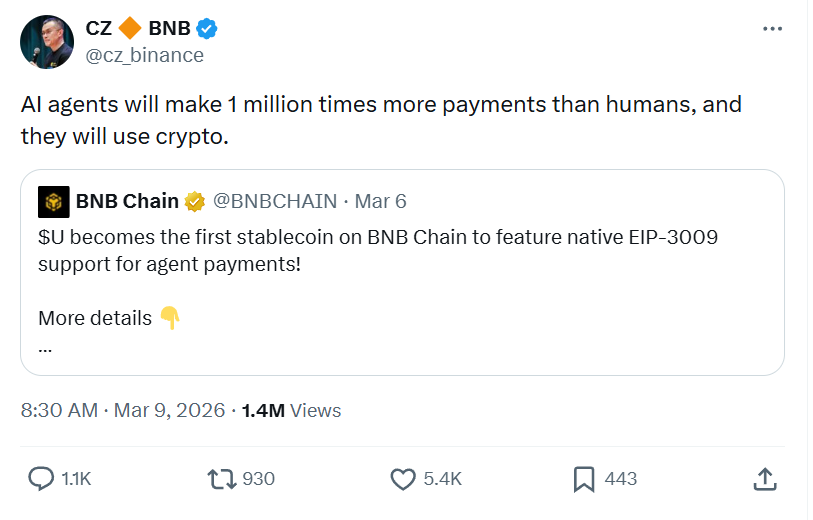
At first glance, this might sound like a sci-fi fantasy or just typical industry hype. That AI agents — autonomous robots, basically — will dominate trading.
But if you strip away the technological jargon, this assessment reveals a profound shift in how industry leaders envision we’ll interact with the digital economy.
One I find myself agreeing with. And not just because AI can do things faster.
Beyond the Chatbot: Your Digital Proxy
Most of us are used to "Passive AI" — models like ChatGPT that answer questions or draft emails.
But CZ is talking about something entirely different: Agentic AI.
They have agency, with the ability to make decisions and take actions on our behalf, 24/7. (My colleague Jurica Dujmovic goes into more detail here.)
All without human oversight or intervention.
Which means we are not far off from turning AI agents into our digital proxies.
Imagine a specialized agent tasked with finding the best travel deals. It wouldn’t just show you a list of flights, it would navigate airline systems, manage your loyalty points, secure insurance and complete the purchase using a dedicated digital wallet.
CZ predicts the time will come — and soon — when these agents make countless tiny decisions and transactions every single day …
Including micropayments and rapid-fire negotiations at a scale no human could ever keep up with.
Why Digital Agents Require Digital Money
This revolution is one that can only happen on-chain.
Our traditional financial system was built decades ago. And it was designed around humans.
It relies on manual verification, a 9-to-5 schedule on workdays, allowances for weekends and bank holidays and slow clearing times.
It simply isn't designed for an economy run by code.
Here is how blockchain fills the gaps:
1. "Intent-Driven" Finance
The financial system as we know it requires you to actively manage every step.
But AI agents enable intent-driven finance. You will give the agent a single, high-level goal: “Always keep 50% of my portfolio in safe, high-yielding deposits.”
The agent will then do the heavy lifting.
It will scan hundreds of decentralized finance (DeFi) protocols to compare opportunities. It will move assets in milliseconds — allowing it to catch yield opportunities that sometimes open and close faster than you or I can press a key.
If an agent tries to do this with ACH transfers, the opportunity is gone before the bank opens.
Blockchain allows for instantaneous settlement and true, real-time optimization.
2. Verifiable Intelligence
If you give an AI agent control over your savings, you need to know it hasn't been tampered with. The blockchain provides a "cryptographic trail."
Simply put, every decision and transaction on-chain are recorded on an immutable ledger.
Which means you can audit your assistant.
Frameworks like the Warden Protocol or security networks like Forta will help you verify that the agent followed your specific logic and wasn't altered by a third party.
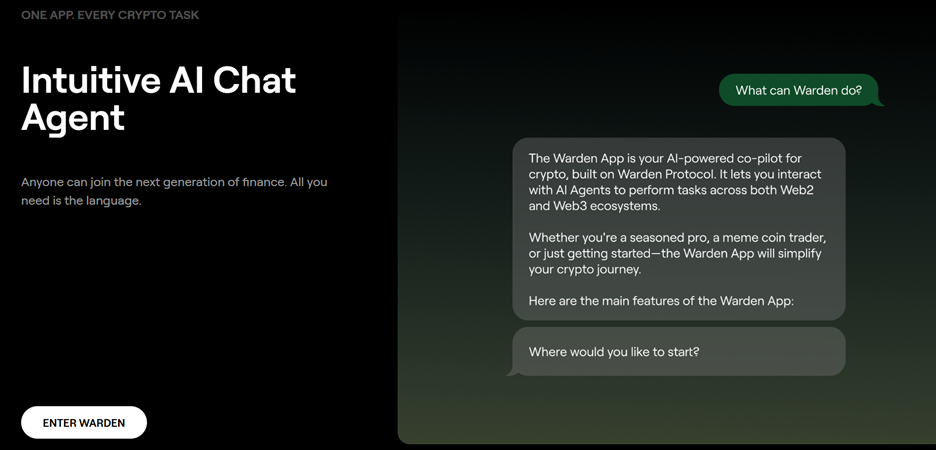
That built-in trustlessness is a feature of the blockchain. And it’s unlikely we’ll see its equivalent on the TradFi side. Even when AI agents make themselves known in that market.
3. The Micropayment Era
High transaction fees have meant that traditional payment systems have a "minimum transaction floor.”
But AI agents operating in logistics and digital commerce must be able to make sub-cent payments constantly.
Here’s an example: Your smart home agent might negotiate with a decentralized energy grid (DePIN) to buy cheaper solar power for your appliances at certain hours. But that would require it to settle the bill in sub-cent increments over the course of the day.
Using low-cost blockchains, an agent can execute thousands of these tiny transactions for less than a penny. Something that is impossible with credit cards or PayPal.
4. Governance on Autopilot
For those participating in community-governed projects, like a DAO or investment pool, you know how overwhelming governance can be.
And for many, the focus is only on high-level policy, rather than the tsunami of small decisions needed to keep things on track. Those alone can pile up. And they feel like a full-time job to read up on.
AI agents can help clear your schedule.
You set the rules (e.g., "Always vote against increasing project inflation" or "Vote for improving security audits"). Your agent then reads and analyzes the new proposals and casts its vote instantly based on your preferences.
Your voice is heard without requiring a massive commitment of time.
The Future is Algorithmic
To really enjoy the ease of digital assistants, they’ll need a way to settle their own small tasks with sovereign money to get the job done for us.
So yes, for the first time, machines will have their own “bank accounts.”
This might sound like science fiction. But we are already in a world where blockchain serves as the essential plumbing for a more autonomous future.
Which means now is the time to prepare your strategy for the day that infrastructure gets real agentic traffic.
Best,
Marija Matić