The Fine Print of the Clarity Act: Who Might Actually Win Today?

 |
| By Marija Matic |
After more than a year of deadlock, the Clarity Act suddenly has momentum.
President Trump conceded on ethics over the weekend.
Democrats got most of what they had been demanding.
And the Senate holds a procedural vote this afternoon at 2:15 p.m. Eastern that decides whether the bill lives.
That is the version getting the headlines. But it also skips past some changes in the bill that will matter over the long term.
One little-known startup is poised to become an indispensable player in the biggest tech disruption since the internet was born.
Fortune 500 firms, governments and militaries around the world could soon have no choice but to rely on it.
You won’t find it on the public markets. But you can get First-Day Access to invest in this company while it’s still private and undiscovered. Watch this video now to see how.
Buried in 635 pages of bill text is a deleted clause that can shift real criminal risk onto the people who build decentralized software.
Running alongside it, a separate track at the SEC is handing Wall Street a clean road to bring securities on-chain.
So, the same moment leaves crypto safer for BlackRock and shakier for a developer maintaining an open-source protocol from a laptop.
That shift comes down to a few lines of statutory text that drew no coverage while the ethics fight took all of it.
It is the part nobody will read … until it's used against them.
The Clause That Got Cut
The biggest losers in the current Clarity act text are developers, due to one deleted line.
Earlier drafts protected people who write crypto software, and keep their hands off users' money, from § 1960. That’s the federal crime of running an unlicensed money-transmitting business.
The latest text removes that protection.
Prosecutors have gone after crypto developers under § 1960 before, which is why the carve-out existed.
The regulatory protections survived.
A hands-off developer keeps the exemption from money-business licensing and from bank anti-money-laundering duties.
The criminal shield is the part that was cut out because Judiciary senators refused to write a criminal exemption for software into federal law.
Developers will have to rely on administrative regulations — like FinCEN guidelines and Bank Secrecy Act rules — rather than clear, permanent statutory law.
In other words, there is a higher risk of a prosecutor, and a possibility of a prison sentence.
Faced with that asymmetry, it would not be surprising to see prominent U.S. builders move development offshore rather than become the test case.
Banks Got a Circuit-breaker on Yield
The American Bankers Association leads nearly 80 other banking groups. It collectively urged the Senate to include a compromise on stablecoin yield in the bill.
This compromise aims to appease banking interests. How? By directing the Treasury secretary to restrict rewards if deposit flight from community banks occurs on a substantial scale.
Namely, if the Treasury finds within 18 months that deposits at sub-$10B banks migrated to stablecoins because of that section of the bill …
Then the Treasury must write tougher rules to ban yield.
Coinbase Is Already Playing Both Sides
Banks aren't the only ones hedging their bets ahead of today's vote.
Coinbase (COIN) struck an agreement with financial services provider Moov last week. Their deal gives community banks direct access to stablecoin capabilities.
That's not a coincidence. It's a move that positions Coinbase as an ally to the same community banks worried about deposit flight — rather than a competitor threatening to drain them.
Related story: Coinbase Could Be Among Clarity’s Biggest Winners
Wall Street Already Won, Without Congress
While developers wait to learn how exposed they are, the institutions have secured their clarity somewhere else.
On Sept. 1 the SEC proposed the first real rewrite of its transfer-agent rules in roughly four decades. The commissioners voted, over dissent, to send it out for comment.
The core of it is a structural change.
A blockchain could serve as the official master securityholder file. That is, the authoritative record of who owns a company's shares — rather than a duplicate stapled to a legacy database.
Wallet addresses would count as valid shareholder contact details alongside a mailing address or an email.
On paper, it is only a proposal sitting in a 60-day comment window.
In practice, the market is treating it as settled, because it routes tokenization around Congress.
If Wall Street can move securities on-chain through an SEC rule, it does not have to wait on a bill that might not survive the midterms.
Under the framework taking shape, a tokenized security is treated as the security it represents.
This gives managers like BlackRock, ARK and Franklin Templeton legal parity for on-chain assets.
It also hands the SEC wide latitude to adapt the compliance rules.
Transfer agents keep exclusive control of the master file. And institutional tokenized products will be built as smart-contract tokens with KYC and AML checks baked in.
Those fit the new guidelines cleanly and leave un-gated, permissionless wrappers on the outside.
It is expected that large asset managers will announce the launch of their tokenized securities products in accordance with this "innovation exemption" framework very soon.
It means that all assets are coming on-chain, and the floodgates are about to open in a major way.
Who Can Benefit from All This
Bring tokenized assets on-chain at institutional scale and they need rails, and a shared standard.
That is where the infrastructure projects can gain no matter what happens this afternoon.
Chainlink (LINK) might be one of the clearest cases.
After all, asset managers will need to operate under a certain technical standard. And Chainlink’s tech is certainly favored.
Take Wyoming, for example.
The Wyoming Stable Token Commission moved its Frontier Stable Token (FRNT) — the first stable token issued by a U.S. public entity, which can be spent anywhere Visa works — onto Chainlink's Cross-Chain Interoperability Protocol on Aug. 18.
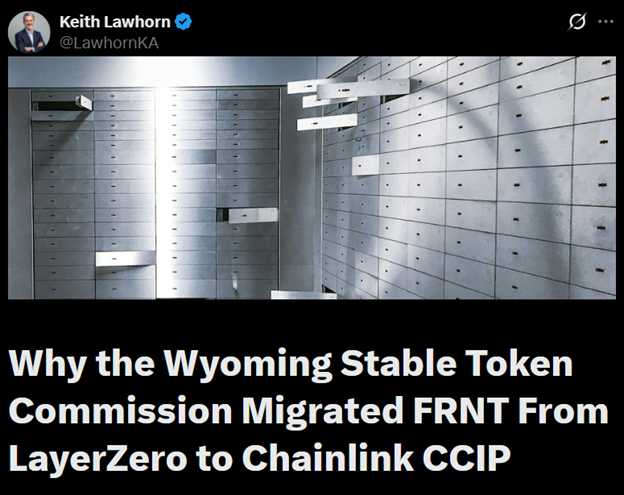
Then it added Chainlink Proof of Reserve on Sept. 2, citing protocol-level security across every chain it runs on.
Once governments and asset managers start insisting on a common technical standard, whoever supplies that standard tends to win without having to fight for it.
None of this — the SEC's parallel track, the infrastructure land grab — depends on what happens in the Senate this afternoon.
That's the interesting story overshadowed by the ethics headlines.
Congress may or may not clear its 60-vote bar at 2:15 p.m.
But Wall Street already found its own path onchain. And the rails are being built either way.
Watch the vote. But watch Chainlink, too.
Clarity by statute would help. The agencies aren’t waiting for it. Congress is the one running behind its own regulators.
Best,
Marija Matić
P.S. Today’s vote isn’t the only important deadline this week. Midnight tomorrow is another one.
That’s when we remove this video from the internet. And everyone who’s in line for First-Day Access to one of the biggest tech disruptions since the internet gets their chance to invest.
Don’t wait. Watch this video and follow the instructions at the end while you still can.