The New Blockchain Rankings: Who's Winning the Crypto Shake-Up?

 |
| By Marija Matic |
Crypto winter culls more than just once-blossoming prices.
It’s also has the networks themselves shrinking — as measured by total value locked (TVL) — as investors and users step away.
The winners in a bear market, then, are the blockchains who lost the least. Or, rather, those that won some ground because the competition lost its edge.
In other words, the latest DeFi TVL rankings measure survival, not success. Who held on, and where the surviving capital moved.
With Bitcoin (BTC, “B+”) in search of its 4-year-cycle bottom, now is the time to find the winners.
Because that should be your starting point for how to prepare for the rally that’s ahead.
How the Networks Stack Up
Before we look at the rankings, there’s a big caveat to note.
Ethereum’s (ETH, “B+”) DeFi TVL more than halved, as is typical in a bear market. But that number cannot be understood in a vacuum.
Because even in the depths of this bear market, Ethereum still owns DeFi: It holds roughly 55% of all TVL. And its grip has barely loosened in years. Ethereum's share has slipped below 50% exactly once, for a few days in 2022.
Which means the real movement you should watch is in the order behind Ethereum.
And this year, we’re very close to a four-way tie …
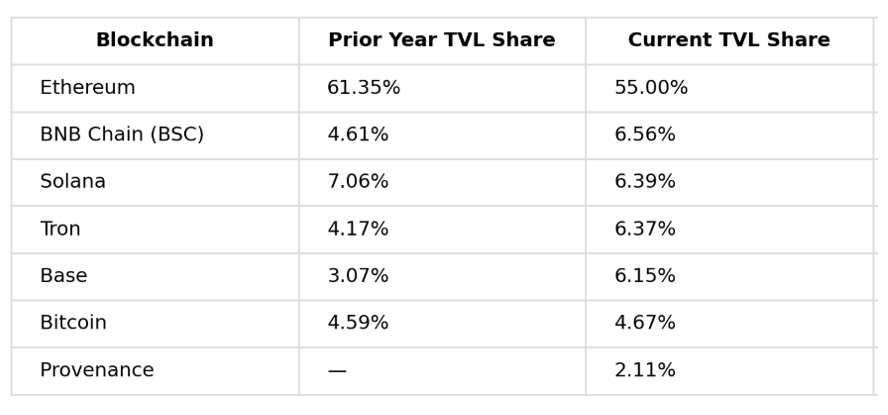
Last year, Solana (SOL, “B-”) held second place on its own. Now, it shares that spot with three others: Binance Smart Chain, Tron (TRX, “C+”) and Base.
All four now sit within 0.4 points of each other.
And they could hardly be more different:
- an exchange chain,
- a high-performance Layer-1,
- a stablecoin rail,
- and a Coinbase Layer-2.
"Who's the second-dominant DeFi chain?" went from an easy answer to a photo finish between four separate thesis.
Below Ethereum, here’s how the deck got reshuffled …
Second Place: Binance Smart Chain
This network got silver not by growing, but by falling less than the field. Despite its own TVL dropping from $6.88 billion to $4.96 billion, Binance Smart Chain was able to push last year’s runner up down a slot.
But unlike Solana, which has seen record high TVLs in every cycle, BSC is still a shadow of its 2021 peak near $21 billion.
Third Place: Solana
Solana ripped to a record high TVL in September 2025 as it rode a memecoin and AI-agent mania. More than half of that was given back by August.
If you live by the hype cycle, you’ll likely also die by it. That’s exactly what cost Solana the runner-up spot.
Still, Solana flipped Ethereum and jumped to the No. 1 when it comes to volume on decentralized exchanges, showing it’s the hot spot of activity.
Which is why I believe we’ll see TVL return during the next hype cycle.
Fourth Place: Tron
Tron’s value locked — as measured on JustLend, TronSave and the like — topped out in 2024. And since spring last year, it has held remarkably steady.
Which means, like BSC, it didn't grow into its spot. Tron simply stood, while others lost.
Note: This is on-chain DeFi TVL, which is separate from Tron's much larger role moving stablecoins.
Fifth Place: Base
Coinbase’s Layer-2 jumped up a rung this year. Not only that, but it's one of the rare chains that saw its absolute TVL rise — from $4.58 billion to $4.65 billion.
In a year when most chains got thinner, standing still was enough to climb the ranks, on the back of Coinbase's built-in user base.
Sixth Place: Bitcoin
Bitcoin's network isn't really DeFi-friendly by design, so there's little native activity to measure. DeFiLlama's number mostly captures the rare protocols that bring BTC into DeFi through cross-chain trading, with ThorChain (RUNE, “E+”) doing the bulk of it.
Seventh Place: Provenance (HASH, “E-”)
This new chain crashed the party. It went from $124 million last August to $1.62 billion now, with most of that landing by this February.
More notably, by claiming seventh, it bumped Arbitrum (ARB, “D+”) out of this line up entirely.
The Rise of Finance-Branded Chains
That seventh-place upset shouldn’t be ignored.
It’s the clearest example of a new trend you can see all over this lineup: The builders behind the top chains are changing …
- Base belongs to Coinbase.
- Provenance was built by Figure, a centralized U.S. lending company.
- Robinhood Chain — a new entrant at No. 13 — launched this summer using Arbitrum tech. It reached the top 15 within weeks by funneling Robinhood’s existing users.
Add the exchange-run chains further down the list — Kraken's Ink, OKX's X Layer, etc. — and the pattern is clear …
The companies that already own the users are building their own chains. And access beats technology.
The implications go even deeper for DeFi users. The one flip worth a closer look
Provenance does one thing: tokenize real-world assets. Private credit in particular.
That means the newcomer that pushed an established, general-purpose Layer-2 out of the No. 7 spot … isn’t a pure DeFi play.
This tells me that institutional plumbing is elbowing its way into a chart that used to be nothing but DeFi playgrounds.
That's the shift in miniature.
But the tokens tells a different story than the network itself.
Provenance's native token, HASH, is the least liquid asset in the top 100 cryptos. It’s not just thinly traded. It’s barely traded at all.
Its price has been dismal: A young token with a large supply overhang that keeps diluting holders. It was built for a regulated institutional niche and has none of the retail appetite that pumps crypto-native names.
While the network is worth watching, the token doesn’t seem to be worth chasing.
That deeper understanding is critical for investors following the DeFi sector.
What the Shifting Tides Tell Us
Line up what entered the top 30 DeFi TVL rank against what left, and the rotation is clear …
Out go many “Ethereum killer” plays.
The newcomers replacing them are real-world-finance chains — tokenized assets and stablecoin payments.
Much of the drop is standard DeFi-winter mechanics: yields compress and token prices fall. And because so much TVL is priced in those same tokens, locked value shrinks even without outflows.
While many speculative chains emptied out, the ones filling up are tied to real financial use. That doesn’t mean their tokens are worth your capital. But it does give you a direction to start your research.
The good thing about bear cycles is that the capital is still moving. But now, it’s chasing utility over hype.
Which creates a healthier base to build the next bull cycle on.
Best,
Marija Matić